


Key Highlights
- Second-quarter revenue reached $14.41 billion, climbing 3% year-over-year in US dollar terms, powered by volume expansion
- Core operating income reached $5.94 billion, surpassing Wall Street’s consensus estimate of $5.31 billion
- Breast cancer treatment Kisqali delivered $1.7 billion in sales, representing 44% growth; Scemblix revenue nearly doubled to $562 million
- Heart failure medication Entresto saw sales plunge 50% to $1.18 billion amid intensifying US generic pressure
- Company maintained its 2026 financial outlook while shares appreciated approximately 2% during morning trading
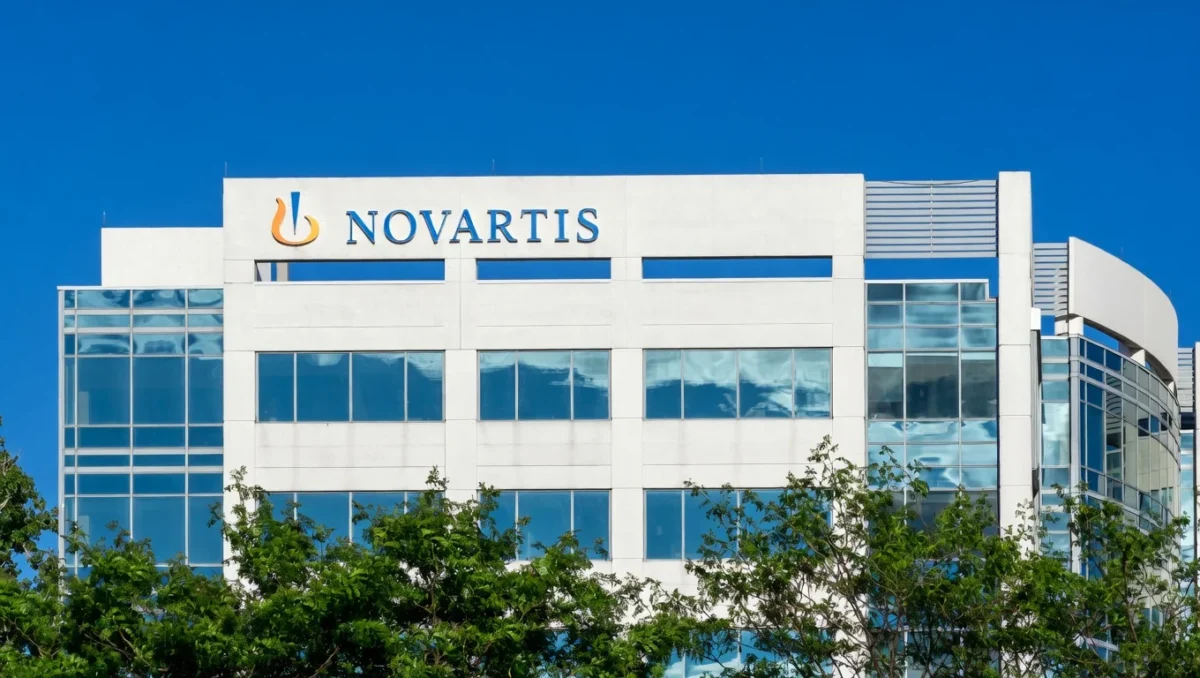
The Swiss pharmaceutical giant Novartis reported second-quarter revenue of $14.41 billion on Tuesday, reflecting a 3% increase measured in US currency, as strength across its emerging product lineup compensated for a dramatic fall in its cardiovascular franchise Entresto.
Shares appreciated roughly 2% during morning session activity after the earnings release, pushing the pharmaceutical company’s market capitalization to approximately $310 billion following a 14% year-to-date advance.
The company’s core operating income, a critical non-IFRS metric closely monitored by the investment community, registered $5.94 billion. This figure significantly exceeded the consensus analyst projection of $5.31 billion compiled by Visible Alpha.
Barclays equity research highlighted that the profitability outperformance stemmed primarily from disciplined expense management. Core selling, general and administrative costs declined 6% to $3.24 billion during the three-month period.

Reported net income decreased 19% to $3.26 billion, impacted by elevated tax obligations and interest costs. Diluted earnings per share contracted 17% to $1.71.
The oncology treatment Kisqali expanded 44% to $1.7 billion in quarterly sales. Scemblix experienced dramatic growth, advancing 89% to $562 million. Meanwhile, Kesimpta increased 32% to $1.42 billion, Pluvicto rose 43% to $651 million, and Leqvio progressed 59% to $480 million.
These positive developments across newer therapeutic agents were partially offset by Entresto’s 50% contraction to $1.18 billion as generic substitution accelerated throughout the United States market. Analyst consensus had projected $1.23 billion. Legacy product Tasigna similarly declined 58% to $142 million.
Financial Outlook Maintained
Novartis preserved its complete fiscal year 2026 projections without modification. Management anticipates revenue expansion in the low single-digit percentage range while core operating income is expected to experience a low single-digit percentage decline when measured at constant exchange rates.
Chief Executive Officer Vas Narasimhan characterized the quarterly performance as demonstrating a “solid” resumption of top-line growth momentum and confirmed the organization remains “on track to deliver our full-year guidance and mid-term outlook.”
Operating free cash flow contracted 12% to $5.56 billion. Net debt elevated to $39.4 billion as of June 30th, compared with $21.9 billion at December 31st, 2025. The expansion resulted from $15.3 billion deployed toward acquisitions and intangible asset purchases, a $9.1 billion dividend distribution, and $3.1 billion allocated to share repurchase programs.
Development Pipeline Under Scrutiny
Market participants are carefully monitoring three investigational compounds — pelacarsen, remibrutinib, and del-desiran. Wall Street analysts project these therapeutic candidates could collectively deliver up to $10 billion in maximum annual revenue potential.
This developmental portfolio carries strategic significance because Cosentyx and Kisqali, two pillars of Novartis’ current expansion strategy, face patent cliff challenges after 2030.
Cosentyx delivered 12% growth reaching $1.82 billion during the second quarter, partially enhanced by an approximate $100 million non-recurring favorable adjustment within the United States market.
During July, Novartis announced a definitive agreement to acquire Myricx Bio, a biotechnology enterprise specializing in antibody-drug conjugate platforms, with transaction closure anticipated during the latter half of 2026.
Get 3 Free Stock Ebooks
Discover top-performing stocks in AI, Crypto, and Technology with expert analysis.
- Top 10 AI Stocks - Leading AI companies
- Top 10 Crypto Stocks - Blockchain leaders
- Top 10 Tech Stocks - Tech giants


