


Key Takeaways
- Technology equities powered the Nasdaq to an 8%+ May surge, marking the strongest consecutive two-month advance since 2002.
- All three primary U.S. indices concluded last week at unprecedented closing levels, with Monday futures indicating continued momentum.
- Weekend military action saw American aircraft targeting Iranian surveillance and unmanned aerial vehicle installations, with Tehran claiming countermeasures.
- Crude markets rallied sharply Monday, pushing Brent above $93 per barrel and WTI past $90 amid escalating tensions.
- Market participants are closely monitoring Friday’s employment figures for insights into labor conditions and potential Federal Reserve policy adjustments.
Equity markets are entering June with remarkable momentum, having concluded May with all three benchmark indices achieving record territory. Technology sector leadership propelled most advances, with Monday morning futures signaling additional upside.
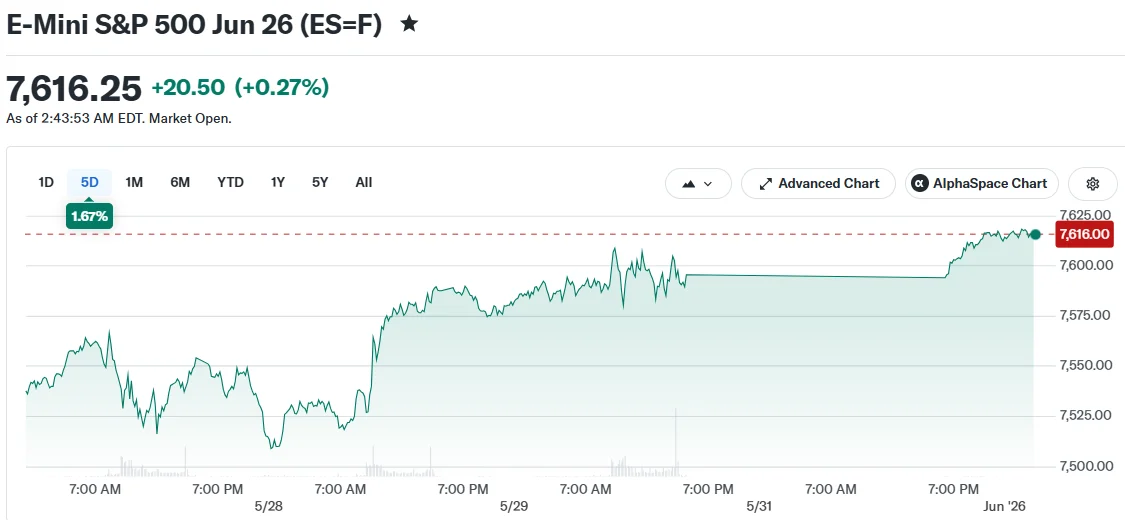
Early trading showed Dow futures advancing 0.1%, S&P 500 futures climbing 0.3%, and Nasdaq 100 futures jumping 0.6%. May’s performance delivered an 8%+ rally for the Nasdaq Composite, approximately 5% appreciation for the S&P 500, and nearly 3% gains for the Dow.
The Nasdaq’s combined April-May performance marks its strongest consecutive two-month period since the final months of 2002. Robust quarterly results from technology sector leaders, especially AI chipmakers, have provided the primary catalyst for the advance.
Yet even as equities flourish, international geopolitical risks persist at heightened levels. Weekend developments included U.S. military aircraft targeting Iranian detection systems and unmanned aircraft bases. Iran’s Islamic Revolutionary Guard Corps announced retaliatory actions, perpetuating weeks of tit-for-tat military confrontations.
Energy Markets Surge on Military Escalation
Oil markets reacted forcefully to the weekend’s military developments. Brent crude contracts surged 3.1% to approach $94 per barrel, while West Texas Intermediate advanced 3% to approximately $90. These gains reversed some of WTI’s steepest monthly decline since April 2025, when it plummeted nearly 17% during May.

President Trump indicated plans to consult with senior advisers for a “final determination” regarding Iranian policy. He additionally advocated for unrestricted navigation through the Strait of Hormuz, a critical passage for international petroleum transport.
Market observers are maintaining vigilant watch over developments. Deutsche Bank’s Jim Reid observed the confrontation has now persisted for 54 days following an attempted ceasefire. He noted markets appear simultaneously closer to diplomatic resolution and catastrophic breakdown than ever before.
“It’s hard to imagine remaining in limbo for much longer,” Reid said.
The dollar index edged upward 0.1% versus major currencies as capital flowed toward traditional safe havens. The benchmark 10-year Treasury yield registered modest gains, reaching 4.47%.
Employment Data Takes Center Stage
Middle East tensions aren’t the sole focus for market participants this week.
Friday’s employment situation report represents the week’s most critical economic release. The payroll figures will provide essential perspective on labor market resilience and could reshape projections for Federal Reserve monetary policy trajectories through year-end.
Bitcoin declined Monday, with market commentators attributing weakness to diminished risk appetite connected to escalating U.S.-Iran hostilities.
Japan’s Nikkei index achieved record territory Monday, propelled by technology shares in a pattern reflecting Wall Street’s recent strength.
With corporate earnings season substantially concluded, market direction may increasingly depend on whether diplomatic channels can produce meaningful progress on U.S.-Iran negotiations or whether continued military confrontations will undermine investor sentiment.
Get 3 Free Stock Ebooks
Discover top-performing stocks in AI, Crypto, and Technology with expert analysis.
- Top 10 AI Stocks - Leading AI companies
- Top 10 Crypto Stocks - Blockchain leaders
- Top 10 Tech Stocks - Tech giants


