


TLDR
- Shares of Samsung Electronics plunged approximately 9% on Friday following the largest labor union’s refusal to cancel an upcoming 18-day walkout scheduled to commence May 21.
- Negotiations facilitated by government mediators broke down this week as management and workers remained deadlocked over compensation structures and bonus limitations.
- Union members are seeking elimination of performance bonus restrictions and implementation of an earnings-based profit distribution system, pointing to superior terms recently secured by SK Hynix employees.
- Company leadership made the trip to Samsung’s Pyeongtaek facility for direct discussions with union representatives, while issuing a formal apology for the ongoing conflict.
- Financial analysts at JPMorgan project the labor action could slash operating profits by 21T to 31T won ($14B–$20.8B), alongside approximately 4.5T won in lost revenue.
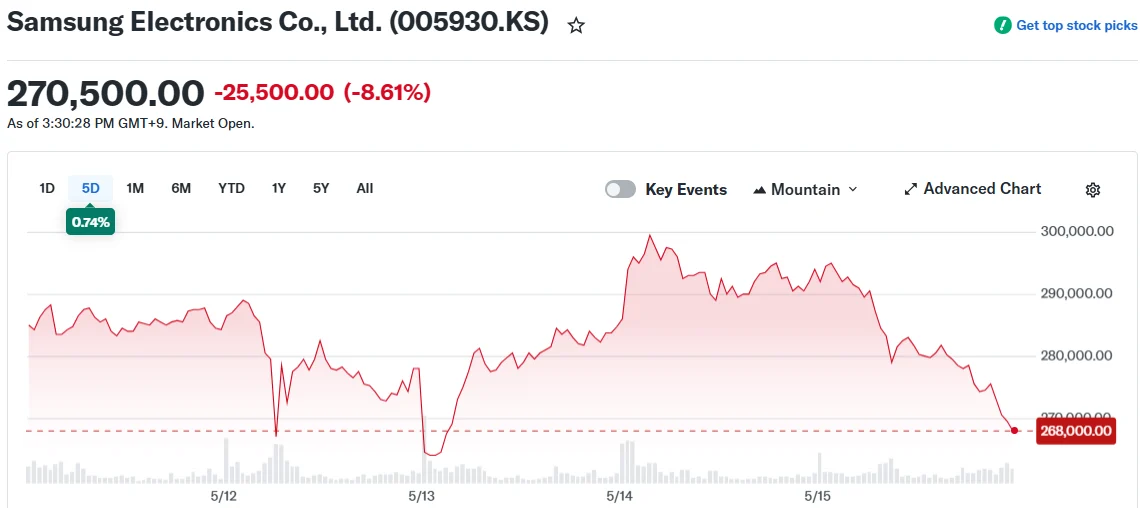
Shares of Samsung Electronics experienced a dramatic selloff Friday, plummeting roughly 9% to 273,500 won during early trading on the Korea Stock Exchange. The sharp decline followed confirmation from the National Samsung Electronics Union that its planned 18-day labor action would proceed as scheduled beginning May 21, rejecting management’s proposal to return to bargaining without preconditions.
While union representatives indicated willingness to resume discussions, they established a firm condition: no talks until after June 7. This timeline ensures the strike will move forward as planned.
The technology giant’s market capitalization took a massive hit Wednesday, shedding as much as 99.07 trillion won ($66.18 billion) in a single session when compensation negotiations collapsed. Friday’s trading session compounded those devastating losses.
Tensions have been escalating for several months now. Throughout April, employees staged demonstrations at manufacturing facilities located south of Seoul, demanding improved pay packages. Their primary objectives include removing caps on performance bonuses and establishing a profit distribution mechanism linked directly to Samsung’s operational earnings.
A significant driver of worker discontent stems from compensation disparities with competing chipmaker SK Hynix. After SK Hynix recently finalized more favorable bonus arrangements with its employees, Samsung workers have expressed growing frustration over the widening gap.

Government-sponsored mediation efforts between company management and union leadership collapsed earlier in the week. The parties remained unable to reach consensus on bonus calculation methodologies or cap structures.
South Korean government officials have been monitoring developments with increasing concern. Both the prime minister and the minister responsible for industrial policy have publicly called on all parties to continue dialogue, cautioning that a work stoppage could severely impact export performance, destabilize financial markets, and hinder overall economic expansion.
The presidential administration also issued a statement Friday expressing hope that the labor dispute could still be resolved without a strike. Government representatives noted that the legal threshold for emergency intervention measures had not yet been met.
Samsung responded swiftly to the union’s strike confirmation. Senior company officials traveled to the Pyeongtaek manufacturing complex for face-to-face meetings with union leadership. The corporation also released a public statement expressing regret for the disruption caused by the labor conflict and committing to approach future negotiations with flexibility and openness.
What a Strike Could Cost
JPMorgan analysts have quantified the potential financial damage. The investment bank revised its estimates upward, citing expectations of broader employee participation than initially forecast.
According to JPMorgan’s analysis, Samsung’s operating profit could be reduced by 21 trillion to 31 trillion won ($14.08 billion to $20.79 billion). Revenue losses are projected to approach 4.5 trillion won.
These projections represent substantial exposure for a corporation already navigating challenging conditions in the semiconductor industry.
What Happens Next
Union leadership has not completely closed the door on negotiations — discussions remain possible after the June 7 deadline. However, with the walkout scheduled to launch May 21, the opportunity to prevent manufacturing disruptions before that date is rapidly diminishing.
Samsung executives were en route to Pyeongtaek facilities as of Friday morning, though the company has not yet publicly confirmed whether a new negotiating session has been scheduled.
Get 3 Free Stock Ebooks
Discover top-performing stocks in AI, Crypto, and Technology with expert analysis.
- Top 10 AI Stocks - Leading AI companies
- Top 10 Crypto Stocks - Blockchain leaders
- Top 10 Tech Stocks - Tech giants


