


Key Takeaways
- Shares of SanDisk declined 9.44% on Tuesday even as Bank of America upgraded its price target significantly
- Bank of America lifted its SNDK price objective from $2,100 to $2,500 while reaffirming its Buy recommendation
- Analyst Wamsi Mohan projects average selling prices could surge as much as 35%, alongside 13% sequential bit growth
- The memory maker has surged 800% this year and an astounding 4,755% over the trailing twelve months, reaching a $323 billion valuation
- Concerns include an elevated forward P/E ratio of 33 — surpassing both Nvidia and Micron — plus negative technical indicators
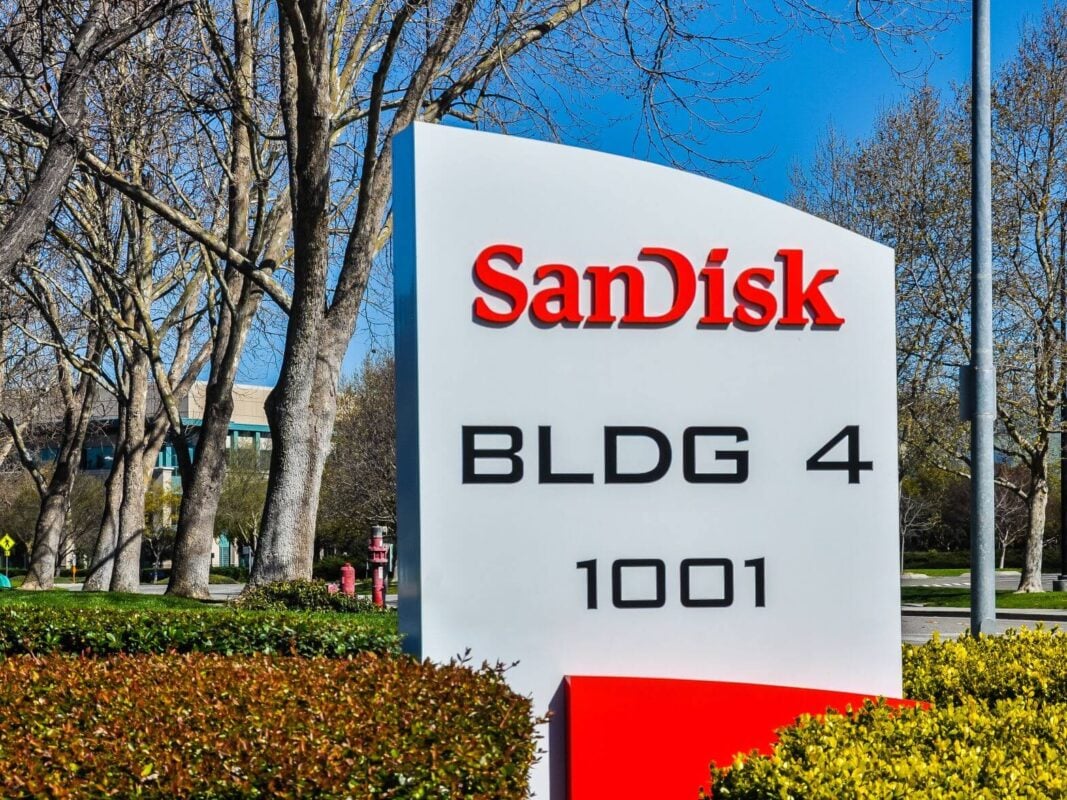
Shares of SanDisk experienced a steep decline on Tuesday, shedding 9.44% during the trading session. The sell-off occurred despite Bank of America Securities upgrading its price objective on the memory storage company from $2,100 to $2,500.
Bank of America analyst Wamsi Mohan maintained his Buy recommendation on the stock. The rationale behind his upgraded target centers on the ongoing supply-demand mismatch in the NAND market, which Mohan anticipates will persist through 2027.
Mohan forecasts that SanDisk’s average selling prices could increase by up to 35%. Additionally, he projects bit growth — measuring the total volume of memory shipped — will expand 13% on a sequential basis.
Based on these projections, Bank of America now estimates SanDisk will report June-quarter revenue of $9.1 billion alongside earnings per share of $37.01. This stands above the Street’s current consensus estimates of $8.35 billion in revenue and $34.26 in EPS.

For the subsequent quarter, BofA anticipates revenue reaching $11.5 billion with EPS climbing to $48.55.
Multi-Year NAND Contracts Strengthen Revenue Predictability
A cornerstone of Mohan’s optimistic outlook involves SanDisk’s expansion into long-term NAND supply agreements, referred to as NBMs. These arrangements secure multi-year revenue streams and enhance earnings predictability for market participants.
Bank of America anticipates widespread adoption of these contracts among cloud service providers and enterprise clients. The firm highlighted that these agreements are designed to maintain gross margins within SanDisk’s established target corridor.
This strategic pivot has contributed to SanDisk’s extraordinary market performance. The company has posted an 800% gain year-to-date and a staggering 4,755% advance over the past year. This remarkable rally has transformed the former Western Digital division into a $323 billion enterprise.
Several other Wall Street firms have also expressed bullish views. Mizuho Securities increased its target from $1,825 to $2,200. Cantor Fitzgerald established a $2,900 objective. Susquehanna leads with the highest target at $3,250.
The Street consensus rating stands at Strong Buy — consisting of 14 Buy ratings, two Hold ratings, and zero Sell ratings over the past three months. The average analyst price target of $1,979.38 suggests approximately 3% downside from current trading levels.
Valuation and Technical Concerns Emerge
Despite widespread analyst endorsement, the stock faces multiple headwinds — Tuesday’s sharp decline underscores these challenges.
SanDisk’s forward price-to-earnings multiple has expanded to 33, exceeding Nvidia at 22 and Micron Technology at 18. This valuation premium is attracting increased scrutiny from investors.
Supply dynamics present another consideration. Elevated memory pricing could incentivize competitors including Micron, Kingston, and Kioxia to accelerate production capacity, ultimately applying downward pressure on pricing.
From a technical perspective, the weekly chart displays a bearish RSI divergence pattern. The Relative Strength Index has trended lower even as the stock price has advanced — a configuration frequently associated with impending corrections.
The stock currently trades at $2,238, substantially above its 50-day moving average of $1,458.
Get 3 Free Stock Ebooks
Discover top-performing stocks in AI, Crypto, and Technology with expert analysis.
- Top 10 AI Stocks - Leading AI companies
- Top 10 Crypto Stocks - Blockchain leaders
- Top 10 Tech Stocks - Tech giants


