



TLDR
- Monday’s session saw the Dow decline 0.3% and S&P 500 drop 0.1%, while Nasdaq posted modest gains
- Market breadth deteriorated with more than 350 S&P 500 components declining despite flat headline index performance
- Semiconductor stocks outperformed significantly, with the iShares Semiconductor ETF climbing 2.7%
- Quarterly results from Walmart, Target, Home Depot, and Lowe’s will dominate investor attention this week
- Market expectations for a September Federal Reserve rate cut fell below 33% amid conflicting economic signals
Wall Street kicked off the week with divergent performance across major benchmarks, as investors positioned themselves ahead of a critical stretch of retail sector earnings reports.
The Dow Jones Industrial Average declined approximately 165 points, representing a 0.3% decrease at the opening bell. The S&P 500 retreated 0.1% following its third consecutive week of positive returns. Meanwhile, the Nasdaq Composite managed to advance 0.2%, propelled primarily by semiconductor sector strength.
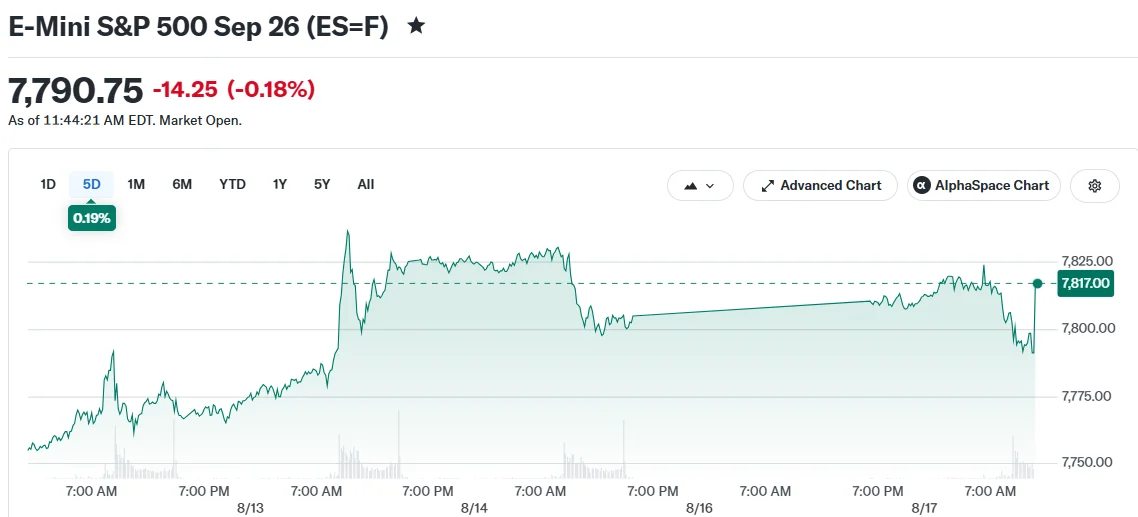
Underneath the Surface: Market Breadth Tells a Different Story
Monday’s headline figures masked significant underlying weakness across the broader equity market. Despite the S&P 500’s relatively stable performance, more than 350 constituent stocks registered losses during the session.
The Invesco S&P 500 Equal Weight ETF, which provides balanced exposure across all index components, declined 0.6%. This divergence between market-cap weighted and equal-weighted indexes highlights the concentration of gains in a handful of large-cap names.
Technology emerged as the sole advancing sector within the S&P 500. The iShares Semiconductor ETF surged 2.7%, contrasting with declines in both software-focused ETFs and Magnificent Seven stock groupings.

The pattern suggests investors are gravitating back toward artificial intelligence-adjacent plays during this quiet period. Meanwhile, the broader market is struggling to maintain upward momentum.
Retail Sector Reports and Monetary Policy Take Center Stage
Market participants are turning their focus toward upcoming retail earnings releases. Major retailers including Walmart, Target, Home Depot, and Lowe’s will unveil quarterly performance this week. These reports will provide crucial insights into consumer spending patterns throughout the recent back-to-school shopping period.
Simultaneously, market pricing for a potential September interest rate adjustment at the Federal Reserve’s Jackson Hole symposium has declined. Probability estimates now sit below 33%, reflecting uncertainty stemming from conflicting inflation and employment indicators.
Wednesday brings the release of Federal Open Market Committee meeting minutes. This documentation should provide additional clarity regarding policymakers’ perspectives on the trajectory of monetary policy.
Oil prices also drew attention Monday. Brent crude futures climbed toward $88 per barrel as geopolitical considerations related to Middle East tensions continue influencing energy markets.
Treasury yields maintained their upward trajectory. Both 10-year and 30-year maturities extended recent advances, reflecting ongoing investor concerns about expanding federal debt levels.
The S&P 500 entered Monday’s session riding three straight weeks of gains. However, the day’s trading action indicates that upward momentum may be waning beyond a concentrated subset of technology and semiconductor equities.
With the economic calendar relatively light until Wednesday’s Fed minutes release, quarterly reports from major retail chains are positioned to be the primary market catalyst throughout the week.
Get 3 Free Stock Ebooks
Discover top-performing stocks in AI, Crypto, and Technology with expert analysis.
- Top 10 AI Stocks - Leading AI companies
- Top 10 Crypto Stocks - Blockchain leaders
- Top 10 Tech Stocks - Tech giants


