


Key Highlights
- The Philadelphia Semiconductor Index achieved bull market status with a 21% rally from its late July bottom, exiting bear territory in merely 21 days
- Credo Technology emerged as the sector’s champion, skyrocketing 59% since July 29, marginally outpacing Coherent’s 58% climb
- Tuesday trading saw semiconductor equities retreat as elevated oil costs and increasing bond yields pressured the industry
- Apple continues evaluating memory chips from Chinese suppliers against U.S. government recommendations, driven by supply chain challenges and rising costs
- Anthropic, an AI technology firm, delivered revenue expansion exceeding 1,400% year-over-year, reinforcing projections for sustained semiconductor demand
The Philadelphia Semiconductor Index crossed into bull market territory this week following a 21% advance from its bottom on July 29. This recovery represents the industry’s swiftest emergence from bearish conditions since the March 2020 market disruption, significantly faster than the typical 54-day average.
The unexpected champion of this semiconductor resurgence wasn’t industry giants like Nvidia or Intel. Instead, Credo Technology, which manufactures copper connectivity cables for AI server infrastructure, took the lead position. The company’s shares exploded 59% from the July 29 baseline, barely surpassing Coherent’s impressive 58% appreciation.
Major industry players also delivered robust performance during the recovery phase. Nvidia recorded an 18% increase, Intel posted a 26% advance, and Micron demonstrated a 37% rise throughout the identical timeframe.
Sector Faces Headwinds in Tuesday Session
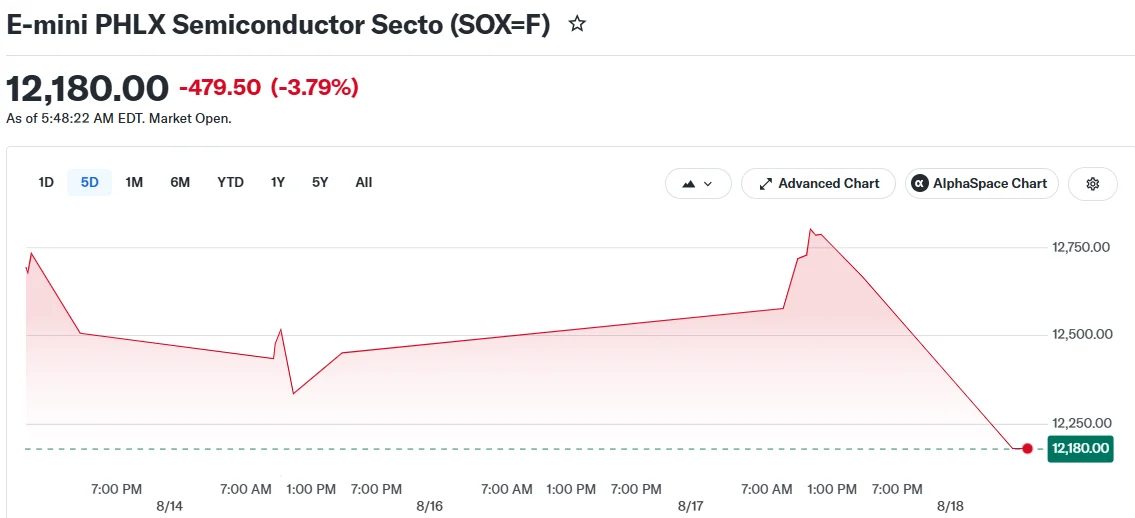
Even with the bull market achievement, semiconductor equities experienced significant declines during Tuesday’s premarket hours. Escalating oil prices coupled with advancing bond yields dragged down numerous recent outperformers in the sector.
Intel, Micron, Coherent, and Marvell each posted premarket losses exceeding 5% before Tuesday’s opening bell. Credo Technology similarly experienced approximately 5% erosion in early trading.

The Philadelphia Semiconductor Index had advanced 1.6% during Monday’s session alone, the trading day that validated the bull market designation. Tuesday’s activity erased a portion of that positive momentum.
Apple Navigates Complex Chip Supply Dynamics
Apple finds itself managing a supply chain dilemma that positions the company squarely within U.S.-China geopolitical friction. The Trump administration has recommended Apple avoid procuring memory chips from Chinese suppliers. Nevertheless, Apple proceeds with evaluation of components from these manufacturers as inventory scarcity drives pricing upward.
U.S. Commerce Secretary Howard Lutnick has publicly criticized Apple’s procurement strategy. Apple’s shares currently trade at $305.59, which GuruFocus analysis indicates represents approximately 7.8% premium to its calculated fair value of $283.43.
Apple maintains a GF Score of 96 from a possible 100, demonstrating robust profitability indicators and growth characteristics. Nevertheless, insider transactions totaling over $16 million in sales during the previous three months have generated some analyst reservations.
Apple’s price-to-earnings multiple currently registers at 35x, elevated compared to its five-year median of approximately 30x.
Artificial Intelligence Applications Sustain Bullish Chip Projections
Anthropic, an artificial intelligence development company, disclosed revenue multiplication exceeding 14 times on a year-over-year basis. This performance has strengthened market confidence that demand for semiconductors supporting AI infrastructure will maintain its trajectory.
Semiconductor manufacturers including Micron and SanDisk similarly registered Monday gains, demonstrating widespread optimistic sentiment throughout the chip manufacturing landscape.
The convergence of AI-powered demand alongside a historically swift bull market transition has repositioned the semiconductor industry as a central focus for investment capital, notwithstanding near-term challenges stemming from commodity and fixed-income market volatility.
Get 3 Free Stock Ebooks
Discover top-performing stocks in AI, Crypto, and Technology with expert analysis.
- Top 10 AI Stocks - Leading AI companies
- Top 10 Crypto Stocks - Blockchain leaders
- Top 10 Tech Stocks - Tech giants


