


Key Takeaways
- A group of seven Democratic senators has expressed serious reservations about the CLARITY Act, citing weaknesses in ethics standards, consumer safeguards, and anti-money laundering provisions
- The 616-page legislative text was unveiled by Senate Republicans on Wednesday and includes restrictions preventing federal officials from launching or endorsing digital currencies
- These restrictions on government officials would sunset on January 20, 2029 — coinciding with the conclusion of President Trump’s current administration
- Financial disclosures revealed Trump generated more than $1.4 billion through cryptocurrency-related businesses in 2025, intensifying Democratic scrutiny
- Senate passage requires 60 affirmative votes, necessitating approximately 10 Democrats to cross party lines
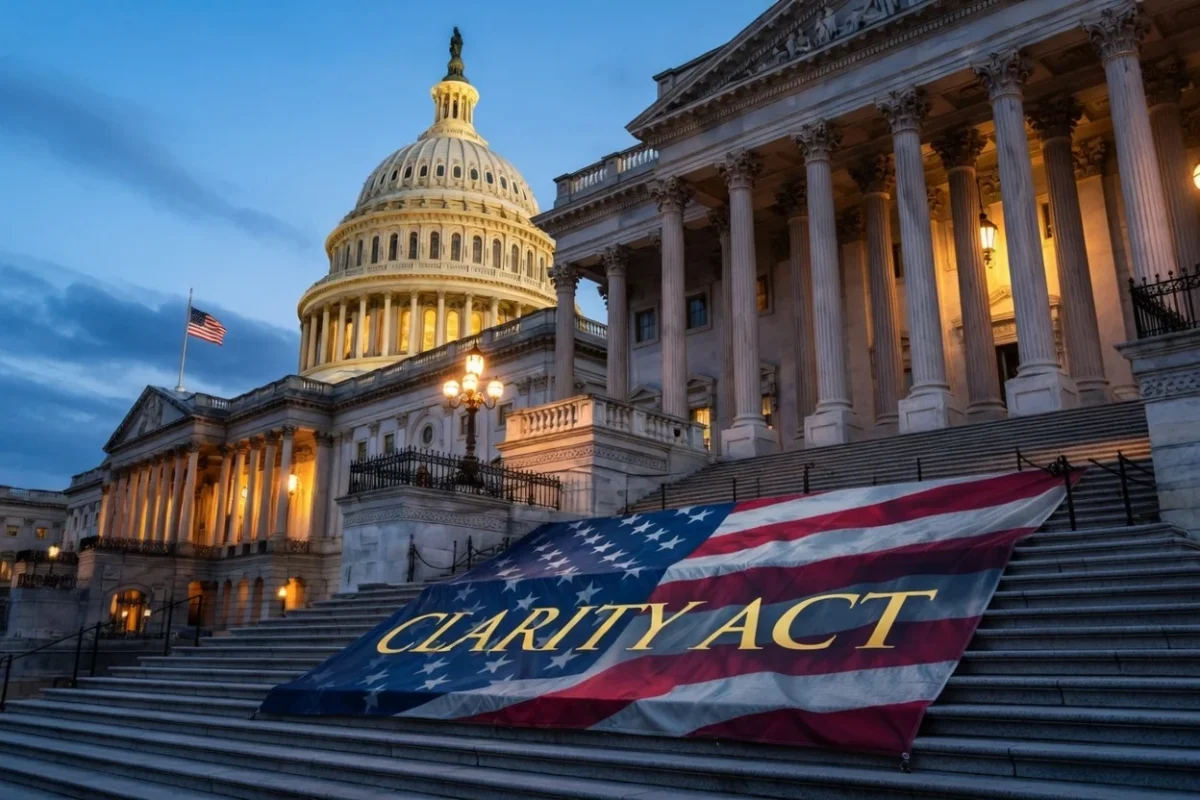
The complete legislative text of the Digital Asset Market Clarity Act became public on Wednesday when Senate Republicans unveiled the proposal, though prominent Democratic lawmakers immediately signaled the legislation requires substantial revisions before earning their backing.
A coalition of seven senators — Angela Alsobrooks, Cory Booker, Catherine Cortez Masto, Ruben Gallego, John Hickenlooper, Mark Warner, and Raphael Warnock — issued a collective statement characterizing the bill as insufficient on multiple fronts.
Their statement highlighted deficiencies in ethical standards for elected representatives, protections for cryptocurrency users, measures against illegal financial activity, conflict of interest protocols, and market oversight mechanisms.
Breaking Down the Ethics Language
The extensive 616-page legislative package contains provisions prohibiting all federal government officials, their spouses, and staff members from creating or promoting digital currencies. Crypto platforms would simultaneously be forbidden from offering tokens connected to federal officeholders.
Senator Cynthia Lummis, one of the bill’s principal supporters, verified that these ethical constraints would extend to President Trump.
White House officials characterized these measures as representing the “most comprehensive and wide-ranging ethics provision in history.” Senator Bernie Moreno echoed this sentiment, declaring it “the most powerful ethics language in U.S. history.”

Nevertheless, these prohibitions are time-limited. They terminate on January 20, 2029 — the final day of Trump’s present presidential term.
Democratic lawmakers have additionally expressed alarm that the language seemingly excludes offspring of public servants. Trump’s three sons are co-founders of World Liberty Financial, while two launched American Bitcoin, a Bitcoin mining enterprise.
Questions About Implementation and Timing
The responsibility for enforcing these ethics provisions would rest with the U.S. Attorney General rather than state-level prosecutors. Certain Democrats, including Alsobrooks, have indicated this framework is unacceptable to them.
Trump’s financial disclosure documents indicated he earned in excess of $1.4 billion from cryptocurrency-related enterprises in 2025, ensuring ethics remains a focal point of ongoing discussions.
The legislation requires 60 Senate votes for passage, meaning up to 10 Democratic senators would need to provide their endorsement.
Senate Majority Leader John Thune is reportedly preparing to schedule a floor vote for next week, irrespective of whether sufficient Democratic backing has materialized.
The Senate begins its summer recess following August 7, creating a compressed timeframe for legislative activity.
The Democratic senators emphasized their ongoing engagement in negotiations. “We have been working in good faith with our Republican colleagues for the past year and will continue doing so,” their collective statement affirmed.
Kristin Smith from the Solana Policy Institute observed that the legislation has incorporated comprehensive disclosure requirements, provisions addressing illicit finance, and enhanced spot market oversight, characterizing it as a legitimate opportunity for bipartisan cooperation.
Should the Senate approve the measure, it would proceed to the House of Representatives before potentially arriving at President Trump’s desk for signature.
Get 3 Free Stock Ebooks
Discover top-performing stocks in AI, Crypto, and Technology with expert analysis.
- Top 10 AI Stocks - Leading AI companies
- Top 10 Crypto Stocks - Blockchain leaders
- Top 10 Tech Stocks - Tech giants


