



TLDR
- Major equity indexes climbed Friday following disappointing September employment figures that reduced expectations for additional Fed tightening this month.
- September payroll growth totaled a mere 29,000 positions, marking the weakest monthly gain of the year, as joblessness increased to 4.2%.
- Long-dated government bond yields continued their ascent, with benchmark rates touching levels last observed over two decades ago.
- Nike tumbled 3.6% following disappointing quarterly results and cautious forward guidance, while Tesla surged 4.7% on robust delivery figures.
- Crude oil prices retreated throughout the week after major economies committed to tapping strategic reserves to ease energy market pressures.
Wall Street finished Friday’s session in positive territory, capping a turbulent week for equity markets. The S&P 500 advanced 0.8% while the Nasdaq Composite surged 1.2%, briefly setting a fresh intraday high.
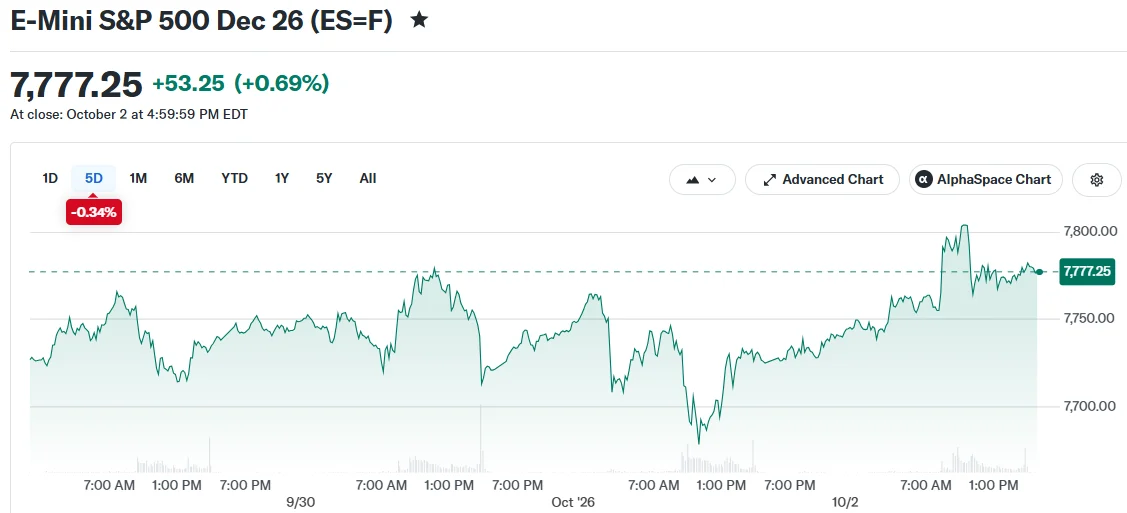
The Dow Jones Industrial Average added 0.5% during Friday’s trading. However, when examining the entire week’s performance, only the Nasdaq managed to close with gains.
Employment Data Reveals Significant Slowdown
Friday’s rally materialized following a surprisingly soft September employment report. According to the U.S. Bureau of Labor Statistics, employers added merely 29,000 nonfarm positions during the month.
This figure landed substantially below the 89,000 new jobs analysts had projected. The reading represented the weakest monthly hiring pace recorded throughout the entire year.
Earlier employment figures for July and August also underwent downward revisions, collectively shedding 60,000 positions. Meanwhile, the jobless rate edged higher to 4.2% from the prior month’s 4.1%.

Compensation growth also demonstrated deceleration. Average hourly earnings climbed a modest 0.1% on a monthly basis and 3% year-over-year, representing the slowest annual advance observed since May 2021.
Market participants interpreted these figures as evidence the Federal Reserve possesses flexibility to maintain its current policy stance when officials convene later this month. Data from the CME FedWatch tool indicated the probability of an October rate increase dropped to approximately 23%.
Nevertheless, certain Federal Reserve policymakers have indicated additional monetary tightening could prove necessary to contain price pressures. Dallas Fed President Lorie Logan suggested rates might require an increase of at least 50 basis points.
Long-Term Rates Extend Historic Rally
Despite diminishing rate hike expectations, fixed-income markets painted a contrasting picture. Longer-maturity Treasury yields maintained their upward trajectory throughout the week.
The benchmark 10-year yield reached its loftiest level since 2002. The 30-year yield climbed to a threshold last witnessed in May 2002.
Market observers attributed this movement to multiple converging forces. These encompassed expanding federal debt obligations, substantial corporate borrowing to finance artificial intelligence infrastructure investments, and persistent inflation anxieties.
Oil prices traveled in the reverse direction. Brent crude retreated 4.4% across the week while U.S. crude slipped 3.2%.
The selloff materialized after G7 countries committed to releasing as much as 100 million barrels from strategic petroleum reserves. This coordinated action aims to bring stability to worldwide energy markets.
Individual Stock Spotlight: Nike And Tesla
Nike shares declined 3.6% following the athletic apparel giant’s quarterly revenue shortfall. Management also provided disappointing projections for the upcoming fiscal year.
Company executives announced plans for additional workforce reductions and a comprehensive restructuring of international operations. Nike continues grappling with intensifying competitive pressures and sluggish demand throughout China.
Tesla charted an opposite course, climbing 4.7%. The electric vehicle manufacturer reported 486,532 vehicle deliveries during the third quarter, surpassing Wall Street consensus estimates of approximately 462,000 units.
Moving forward, market participants are preparing for upcoming inflation metrics. The consumer price index and producer price index releases are scheduled for October 14 and 15.
The Federal Reserve’s subsequent monetary policy announcement is set for October 28.
Get 3 Free Stock Ebooks
Discover top-performing stocks in AI, Crypto, and Technology with expert analysis.
- Top 10 AI Stocks - Leading AI companies
- Top 10 Crypto Stocks - Blockchain leaders
- Top 10 Tech Stocks - Tech giants


