


Key Takeaways
- SK Hynix has dethroned Samsung Electronics as South Korea’s highest-valued publicly traded company, achieving a market capitalization of $1.35 trillion
- Shares have skyrocketed over 340% year-to-date, propelled by explosive growth in high-bandwidth memory (HBM) chip sales for artificial intelligence applications
- The company commands 61% of the worldwide HBM market, significantly outpacing Samsung’s 17% and Micron’s 21% shares
- Samsung has maintained the leading position for more than two decades since 2000, and contends its valuation should incorporate preferred shares, totaling approximately 2,252 trillion won
- Reports indicate SK Hynix is considering a Nasdaq listing in the United States to expand its global investor reach
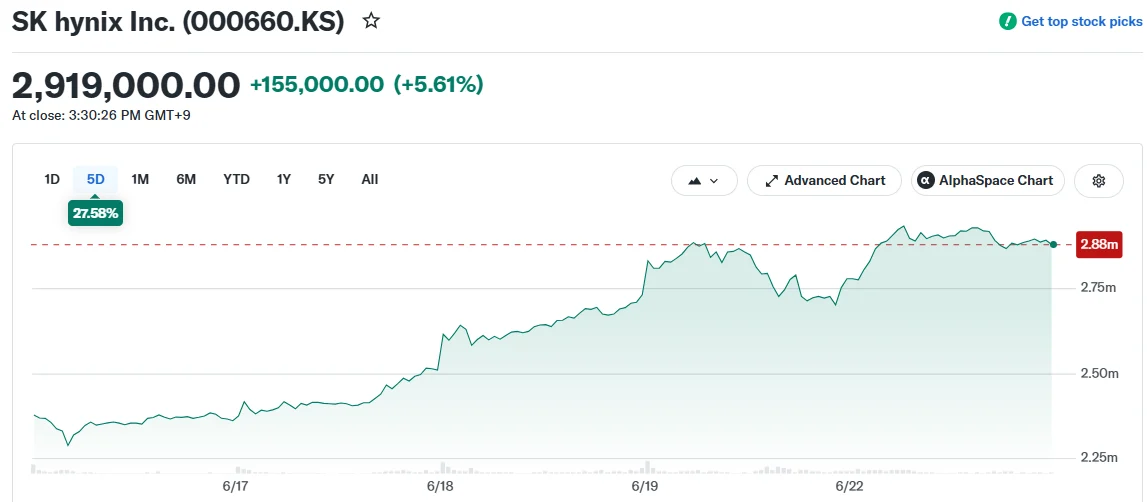
SK Hynix shares climbed 5.7% during Monday’s trading session, elevating its total market value to 2,082.5 trillion won ($1.35 trillion) and narrowly surpassing Samsung Electronics — which advanced a modest 0.4% — marking a historic first.
Samsung has occupied the number one position for nearly a quarter-century. The margin separating these tech giants remains extremely narrow, and Samsung maintains that incorporating its preferred stock would elevate its total market capitalization to approximately 2,252 trillion won.
This achievement represents the culmination of an extraordinary performance by SK Hynix, whose shares have experienced a phenomenal rally exceeding 340% throughout the current year.
The driving force behind this remarkable surge is HBM — high-bandwidth memory technology that utilizes vertical chip stacking to achieve superior processing speeds and reduced energy consumption. These specialized chips serve as critical components within AI processors manufactured by Nvidia and deployed by major clients including Alphabet’s Google.
Different from conventional DRAM chips, HBM technology is deeply integrated with AI computing infrastructure. This integration establishes significant competitive barriers and grants manufacturers pricing leverage that traditional memory products never achieved. SK Hynix controls 61% of the worldwide HBM marketplace. Samsung captures 17%, while Micron holds 21%.

Remarkable Transformation from Near-Bankruptcy to $1.35 Trillion Giant
The company’s resurrection narrative is genuinely remarkable. Back in 2002, the business then operating as Hynix Semiconductor teetered on the brink of collapse under crushing debt obligations and nearly sold itself to Micron. When that transaction collapsed, the company remained under creditor supervision for almost ten years. By 2003, shares had plummeted to just 135 won — penny stock territory.
In 2023, a severe memory market contraction delivered another crushing blow. SK Hynix recorded an annual operating loss totaling 7.73 trillion won during that challenging period.
Despite the downturn, the company maintained aggressive investment in HBM technology — a strategic gamble that ultimately succeeded. Throughout 2024, it achieved a record-breaking operating profit of 23.5 trillion won as artificial intelligence infrastructure spending from Microsoft, Google and Meta intensified dramatically.
SK Group Chairman Chey Tae-won, who championed the original Hynix acquisition despite facing substantial internal resistance, articulated his strategic vision in a book released this January.
“What I really wanted to accomplish when we acquired Hynix was to transform it from a commodity memory producer into a mainstream semiconductor company whose products are indispensable,” he said.
He added: “In the past, it did not matter whether memory came from Hynix, Samsung or Micron. HBM is different. If SK Hynix’s HBM is replaced with another product, the AI system may not function properly.”
Samsung’s Manufacturing Advantage Continues to Erode
The competitive dynamic between these semiconductor powerhouses extends beyond market capitalization alone. Samsung’s historical manufacturing supremacy in DRAM production faces mounting challenges.
Bank of America projects SK Hynix’s monthly DRAM production capacity will hit approximately 589,000 wafers during the current year, compared to roughly 691,000 for Samsung. However, SK Hynix is forecast to boost output by 38% from 2025 through 2028, while Samsung’s growth trajectory stands at approximately 17.5%.
By 2028, these expansion plans would reduce the manufacturing capacity differential to less than 10%, down substantially from 23% in 2025.
“Previously, the difference in manufacturing scale meant there was simply no way for rivals to close the profitability gap with Samsung,” said Kim Sunwoo, senior analyst at Meritz Securities.
SK Hynix is also reportedly pursuing a United States listing on the Nasdaq exchange, a strategic move that would significantly enhance its visibility and accessibility among international institutional investors.
Get 3 Free Stock Ebooks
Discover top-performing stocks in AI, Crypto, and Technology with expert analysis.
- Top 10 AI Stocks - Leading AI companies
- Top 10 Crypto Stocks - Blockchain leaders
- Top 10 Tech Stocks - Tech giants


