


Key Takeaways
- SK Hynix reached a $1 trillion market capitalization this week, marking only the second time a South Korean firm has achieved this benchmark.
- Shares have climbed 240% since the start of the year, with gains exceeding 80% in May alone.
- First-quarter revenue jumped nearly threefold to 52.6 trillion won ($34.8bn) year-over-year, while operating profit increased by five times.
- The chipmaker commands a 57% market share in high-bandwidth memory (HBM) and has captured roughly 70% of Nvidia’s Vera Rubin HBM supply contracts.
- American investors currently lack direct access to the stock, but the Roundhill Memory ETF (DRAM) — trading near $60 — allocates 27% to SK Hynix as its second-largest holding.
SK Hynix has entered one of the world’s most elite corporate circles this week, surpassing the $1 trillion market capitalization mark driven by unprecedented AI-fueled appetite for advanced memory chips.
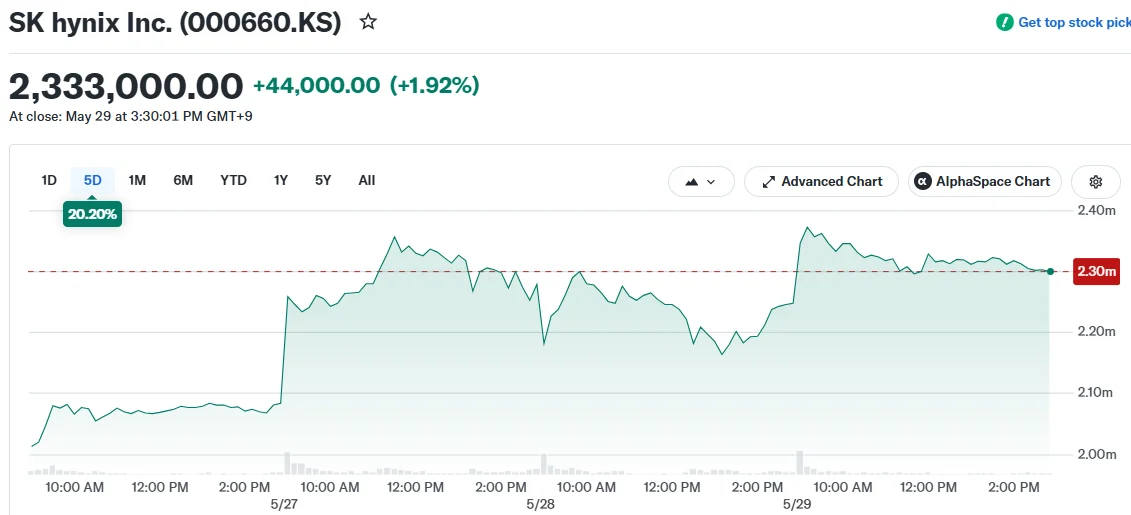
The South Korean semiconductor manufacturer’s shares have rocketed 240% year-to-date, including an astonishing 80%-plus jump in May — representing one of the most powerful monthly rallies ever recorded for a company of this magnitude. As of Friday’s close, the company’s market capitalization reached 1.66 quadrillion won, equivalent to approximately $1.10 trillion.
SK Hynix becomes the third semiconductor company to achieve this milestone within the current month, joining American giant Micron and South Korean peer Samsung Electronics. These three corporations collectively dominate nearly the entire global memory chip manufacturing landscape.
The catalyst is straightforward: AI infrastructure demands massive memory resources. With soaring requirements for GPUs and AI processors, the appetite for high-bandwidth memory (HBM) that enables these systems has skyrocketed — positioning SK Hynix as the primary winner.
Financial Performance Reaches Unprecedented Heights
First-quarter revenue totaled 52.6 trillion won ($34.8bn), representing a threefold increase compared to the same period last year. Operating profit soared fivefold to 37.6 trillion won ($24.9bn). Operating margins reached an unprecedented 72%.

These figures transcend typical strong performance — they’re genuinely extraordinary. HBM technology, which the company developed and continues to lead, has fundamentally transformed SK Hynix’s financial profile.
SK Hynix controlled 57% of the worldwide HBM market during Q4 2025, and anticipates maintaining above 50% market share for next-generation HBM4 throughout 2026. The company has also locked in approximately 70% of HBM supply agreements for Nvidia’s Vera Rubin architecture, creating deep interdependence with the world’s leading chip manufacturer.
Additionally, SK Hynix is establishing three-to-five year long-term contracts with clients — a fundamental transformation designed to minimize the dramatic cyclical volatility that has historically characterized the memory sector.
Access Options for American Investors
SK Hynix shares are not currently available on US exchanges. While the company has submitted applications for American depositary receipts (ADRs) that may commence trading later this year, no definitive timeline has been established.
For now, the Roundhill Memory ETF (DRAM), currently priced between $60–$63 per share, provides the most straightforward exposure route. SK Hynix represents 27% of the fund’s holdings. Micron leads at slightly above 29%, with Samsung accounting for 19%.
The ETF additionally provides NAND exposure via Kioxia and Sandisk, alongside hard-disk-drive manufacturers including Seagate and Western Digital.
From a valuation perspective, SK Hynix trades at a forward P/E below 7 — remarkably modest for a company delivering these results, though this partially reflects currency complications and limited accessibility for international investors.
SK Hynix anticipates DRAM will face supply constraints extending through 2030, prompting a 19 trillion won ($13bn) investment in a new fabrication facility focused on advanced packaging technologies to meet surging demand.
Throughout history, only 17 companies have ever achieved a $1 trillion valuation. SK Hynix now joins an exclusive group of just four non-American firms on that roster, alongside Samsung, TSMC, and Saudi Aramco.
Get 3 Free Stock Ebooks
Discover top-performing stocks in AI, Crypto, and Technology with expert analysis.
- Top 10 AI Stocks - Leading AI companies
- Top 10 Crypto Stocks - Blockchain leaders
- Top 10 Tech Stocks - Tech giants


