



Key Takeaways
- The S&P 500 declined 0.2% on Friday yet managed to secure a 0.4% weekly advance, marking its third consecutive week of gains
- Thursday saw the benchmark index reach an unprecedented intraday peak of 7,816.70 before experiencing a modest retreat
- Market volatility, measured by the VIX, plunged to 14.28, approaching levels rarely seen since the early 1990s
- July’s retail sales data disappointed while August consumer sentiment deteriorated
- Futures markets now indicate approximately 67% probability that the Federal Reserve maintains current interest rates in September
The S&P 500 concluded Friday’s session at 7,785.76, marking a 0.2% decline just 24 hours after establishing a fresh all-time intraday peak of 7,816.70. The Dow Jones Industrial Average retreated 107 points, representing a 0.2% loss, settling at 53,732.41. Meanwhile, the Nasdaq Composite recorded a 0.3% decrease, finishing at 26,729.16.
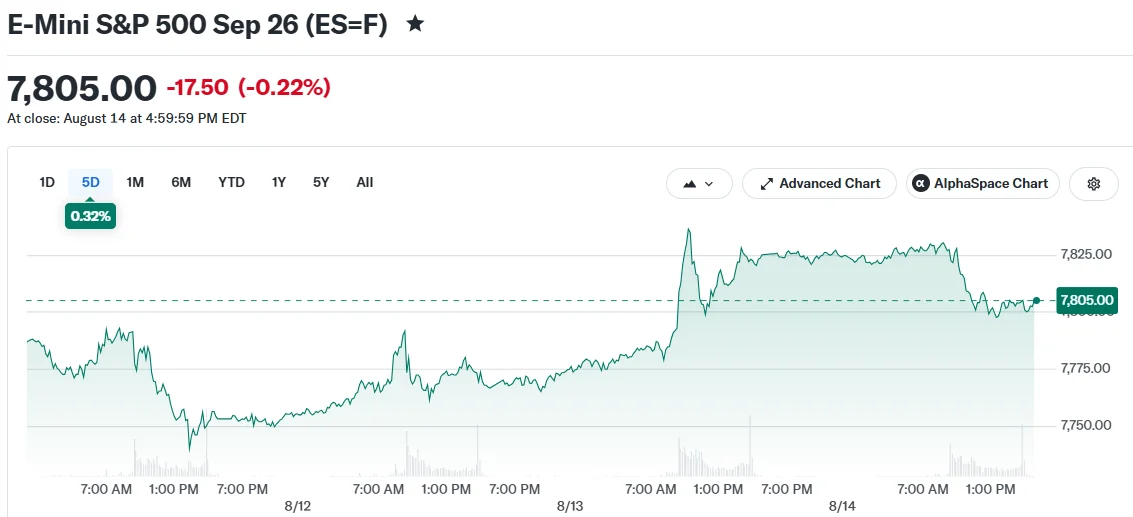
Notwithstanding Friday’s modest pullback, the S&P 500 registered a 0.4% weekly gain, extending its positive momentum to three consecutive weeks. The Nasdaq similarly concluded the week in positive territory with a 0.1% increase, though the Dow experienced a 0.6% weekly decline.
The CBOE Volatility Index, Wall Street’s primary fear gauge, tumbled to an intraday low of 14.28 on Friday. This reading represents exceptionally subdued market anxiety. Historical analysis dating back to 1990 reveals that the VIX has traded below the 15 threshold only approximately 32% of the time, with a long-term average hovering around 19.45.
This remarkable tranquility in volatility persisted even as Brent crude oil advanced 1.7% following geopolitical developments in Iran. The broader market reaction to this news remained notably muted.
Mizuho analyst Daniel O’Regan observed that market participants appear increasingly desensitized to geopolitical tensions. He drew parallels between the current measured response to Iranian developments and the way investors eventually normalized reactions to ongoing Russia-Ukraine conflict updates.

Consumer Indicators Show Signs of Weakness
Friday’s economic releases painted a concerning picture of consumer health. July retail sales figures fell short of economist predictions, registering a month-over-month contraction. Additionally, the August consumer confidence index retreated, erasing advances observed during the June and July period.
eToro’s Bret Kenwell cautioned against reading too much into a single month of disappointing spending data. However, he acknowledged that these figures become more difficult to overlook when considered alongside previously released weak GDP growth and employment statistics.
Kenwell suggested that the softer economic readings could reduce the Federal Reserve’s urgency to implement additional rate increases, though he emphasized that persistent economic deterioration presents its own set of challenges.
Interest rate futures markets currently assign approximately a two-thirds probability to the Fed maintaining its current policy stance at the upcoming September meeting. The 2-year Treasury yield advanced to 4.17%, while the 10-year benchmark climbed near 4.7%.
Corporate Results and Market Outlook
Over 90% of S&P 500 constituents have completed their second-quarter earnings announcements. Aggregate earnings expansion is running at approximately 50% year-over-year, based on FactSet’s latest compilation.
Infrastructure Capital Advisors’ Jay Hatfield shared his optimistic forecast with CNBC, projecting the S&P 500 could reach 8,100 by December 31st. His scenario assumes oil prices maintain levels above $80 per barrel, continued closure of the Strait of Hormuz, and steady Fed policy.
With the coming week’s economic calendar relatively sparse, investor focus will pivot toward retail sector earnings releases. Major retailers including Home Depot and Walmart are scheduled to announce quarterly results.
Market strategists emphasize that these retail earnings will provide crucial insights into the true state of American consumer spending power.
Get 3 Free Stock Ebooks
Discover top-performing stocks in AI, Crypto, and Technology with expert analysis.
- Top 10 AI Stocks - Leading AI companies
- Top 10 Crypto Stocks - Blockchain leaders
- Top 10 Tech Stocks - Tech giants


