


Quick Overview
- American military forces targeted Iranian rocket launch sites in the Strait of Hormuz, driving crude prices higher by more than 2%
- Federal Reserve Chair Kevin Warsh’s Jackson Hole remarks triggered heightened expectations for imminent interest rate increases
- Market-implied odds of a Fed rate hike in September surged to approximately 57-60%
- Dow Jones futures declined 85 points, while S&P 500 and Nasdaq futures each retreated 0.2% before the opening bell
- Government bond yields climbed to multi-year peaks across Japan and Germany amid broadening inflation anxieties
Equity index futures in the United States declined during Monday’s early trading hours as a dual threat from Middle Eastern military conflict and increasingly hawkish Federal Reserve rhetoric undermined investor sentiment on the month’s final trading day.
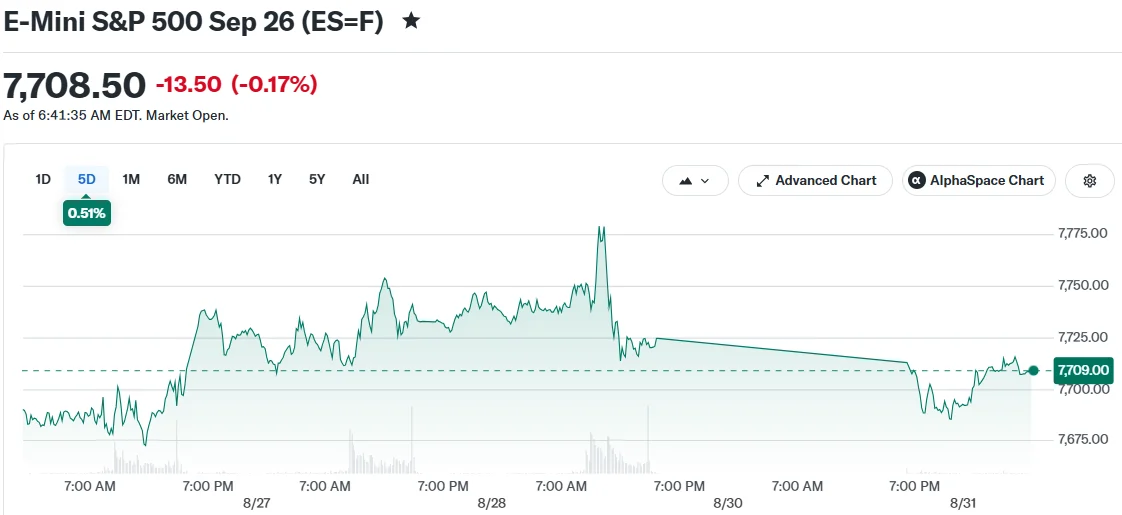
Futures tied to the Dow Jones Industrial Average retreated 85 points, representing a 0.2% decline. Both S&P 500 and Nasdaq 100 futures registered similar 0.2% losses during pre-opening trading activity.
Crude Prices Jump Following Middle East Military Operations
American military assets conducted strikes against two Iranian rocket launching positions located on Larak Island within the Strait of Hormuz during Sunday operations. Tehran retaliated with attacks targeting U.S. personnel stationed in Jordan and declared successful strikes against a commercial tanker navigating the critical waterway.
President Trump declared via social media that Iran’s primary crude export facility at Kharg Island was being destroyed, although no official military sources have verified this assertion.
Brent crude advanced 2.3% to reach $90.17 per barrel. West Texas Intermediate likewise gained 2.3% to settle at $85.32. The Strait of Hormuz represents a critical chokepoint for international petroleum shipments, and any potential disruption typically generates immediate market volatility.

Central Bank Rate Increase Expectations Surge Following Policy Speech
Federal Reserve Chairman Kevin Warsh delivered remarks at the Jackson Hole economic symposium last Friday, emphasizing that inflation threats continue to be inadequately priced into current market expectations. His commentary diminished anticipations for monetary easing and elevated the likelihood of additional rate tightening.
Financial markets reacted swiftly. The implied probability of a September interest rate increase jumped from approximately 40% one week earlier to 57-60% by Monday’s opening, based on CME FedWatch tool calculations.
Barclays analysts now forecast the Federal Reserve will implement 25 basis point rate increases at both the September and December policy meetings. JPMorgan’s lead U.S. economist acknowledged the September meeting presents a “live” decision but maintains expectations for the initial hike to occur in December.
Two-year Treasury note yields maintained their position at 4.34% following Friday’s sharp 12 basis point surge. Japan’s equivalent 2-year government bond yield touched a three-decade high. Germany’s 2-year yield climbed to its loftiest level since July 2024.
Elevated interest rate projections typically pressure asset valuations downward, particularly affecting growth-oriented and technology shares, which accounts for Monday’s early weakness.
Notwithstanding Monday’s pullback, August has delivered positive returns overall. The Dow Jones Industrial Average has appreciated 2% during the month and appears positioned for a fifth consecutive monthly advance. The S&P 500 has climbed nearly 3% while the Nasdaq Composite has registered approximately 4% gains.
Critical employment statistics are scheduled for release this week, including Tuesday’s JOLTS Job Openings report and Friday’s comprehensive U.S. Employment Report. Quarterly earnings announcements from Broadcom and Dell Technologies will also attract attention as additional indicators of artificial intelligence infrastructure investment patterns.
Gold prices edged lower by 0.3% to $4,437 per ounce but maintain approximately 10% gains for August overall.
Get 3 Free Stock Ebooks
Discover top-performing stocks in AI, Crypto, and Technology with expert analysis.
- Top 10 AI Stocks - Leading AI companies
- Top 10 Crypto Stocks - Blockchain leaders
- Top 10 Tech Stocks - Tech giants


