


Key Highlights
- Major US equity index futures declined during Wednesday’s pre-market session with Alphabet and Tesla earnings on deck
- Crude oil surged following continued US military operations against Iran for the eleventh consecutive evening
- Brent crude surpassed the $90 per barrel threshold for the first time in over 30 days, reigniting inflation concerns
- Market participants now assign an 85% probability to at least one Federal Reserve rate increase by late 2026
- The Trump administration mulls replacing temporary 10% worldwide tariffs with elevated permanent levies, potentially including 100% duties on generic pharmaceutical imports
American equity futures traded lower during Wednesday’s early hours as market participants prepared for quarterly results from two technology giants, while escalating energy costs refocused attention on inflationary pressures.
The Dow Jones Industrial Average futures declined 0.1%. Futures tied to the S&P 500 retreated approximately 0.4%. Nasdaq 100 contracts tumbled as much as 0.9%, signaling potential weakness for technology-focused equities at the opening bell.
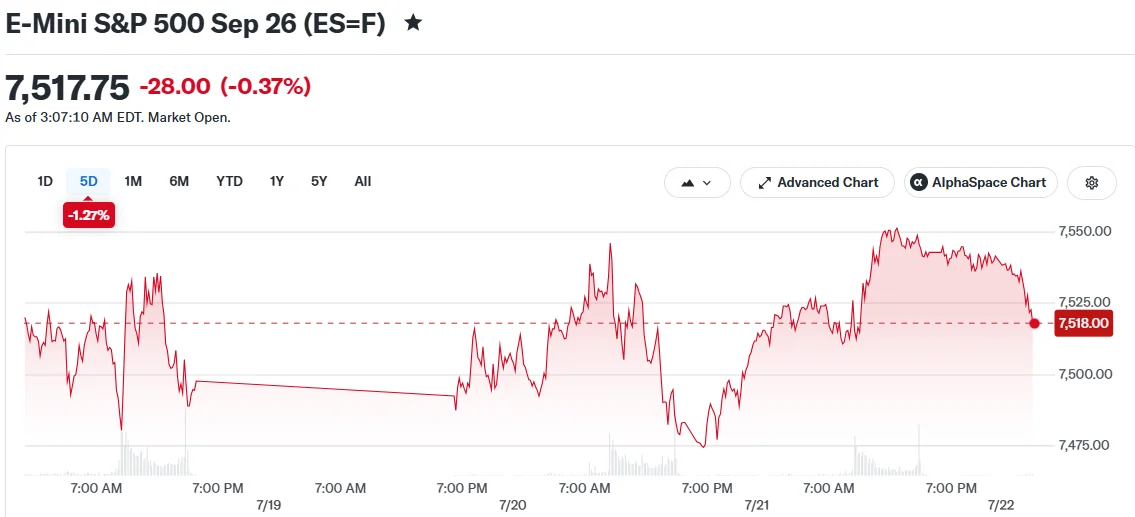
The morning decline followed a Tuesday session where all three benchmark indices ended three consecutive days of losses, buoyed by semiconductor sector strength.
Alphabet and Tesla are scheduled to unveil their second quarter financial performance following Wednesday’s market close. These technology behemoths represent the initial pair from the elite “Magnificent Seven” megacap group reporting this earnings cycle.
Market observers will scrutinize Alphabet’s figures to determine if substantial artificial intelligence investments are generating returns. Tesla’s capital expenditure guidance remains paramount as the electric vehicle manufacturer accelerates its automation initiatives.

Crude Oil Rallies Following Middle East Military Action
Oil prices advanced substantially during morning hours after American forces executed military strikes targeting Iran for an eleventh straight night. Brent crude jumped 3.2% to reach $93.95 per barrel. West Texas Intermediate advanced 3.6%, touching $87.36 per barrel.
Brent’s breach of the $90 threshold—a first in more than four weeks—captured significant market attention. Deutsche Bank’s Jim Reid highlighted concerns that the advance rekindled worries regarding potential stagflationary conditions.
Reid observed that climbing energy prices prompted traders to increase expectations for Federal Reserve monetary tightening, with some market participants even contemplating the possibility of an immediate rate adjustment.
Federal Reserve Tightening Expectations Increase
The probability of no fewer than one Fed rate increase before 2026 concludes has surged to 85%, climbing from 70% merely seven days earlier, based on CME FedWatch analytics.
Elevated energy costs translate directly into inflation projections. This dynamic creates challenges for the Federal Reserve, since any decision to increase borrowing costs could pressure equity valuations.
Defense Secretary Pete Hegseth informed congressional leaders Tuesday that American expenditures related to the Iranian conflict have reached $37.5 billion to date.
Trade Policy Developments and Corporate Results
Regarding commercial policy, President Trump reportedly plans to substitute expiring 10% global tariffs with elevated permanent import duties. Proposals include a potential 100% levy on generic pharmaceutical imports. Additionally, a fresh 25% tariff targeting Brazilian merchandise became effective Wednesday.
In corporate earnings news, Supermicro equity advanced during pre-market hours after the artificial intelligence server manufacturer disclosed unprecedented order backlog figures. IBM is similarly scheduled to announce Q2 performance Wednesday following last week’s sharp stock decline prompted by a profit warning.
Get 3 Free Stock Ebooks
Discover top-performing stocks in AI, Crypto, and Technology with expert analysis.
- Top 10 AI Stocks - Leading AI companies
- Top 10 Crypto Stocks - Blockchain leaders
- Top 10 Tech Stocks - Tech giants


