



Quick Summary
- Equity futures advanced Monday morning, with Dow futures gaining 0.4% and S&P 500 futures climbing 0.2% ahead of the opening bell
- Last month saw the Nasdaq jump more than 8%, marking its strongest two-month performance since 2002 when paired with April’s 25% surge
- Technology and artificial intelligence sector earnings fueled the extraordinary market advance throughout May
- Ongoing tensions between the United States and Iran following weekend military actions continue to support elevated crude prices
- This week’s most anticipated economic indicator is Friday’s employment situation report
Equity futures posted gains Monday morning as market participants aimed to build on May’s impressive performance heading into a new trading month.
Futures tied to the Dow Jones Industrial Average advanced 0.4%, with S&P 500 futures rising 0.2%. Nasdaq 100 futures similarly climbed 0.2% during early morning sessions.
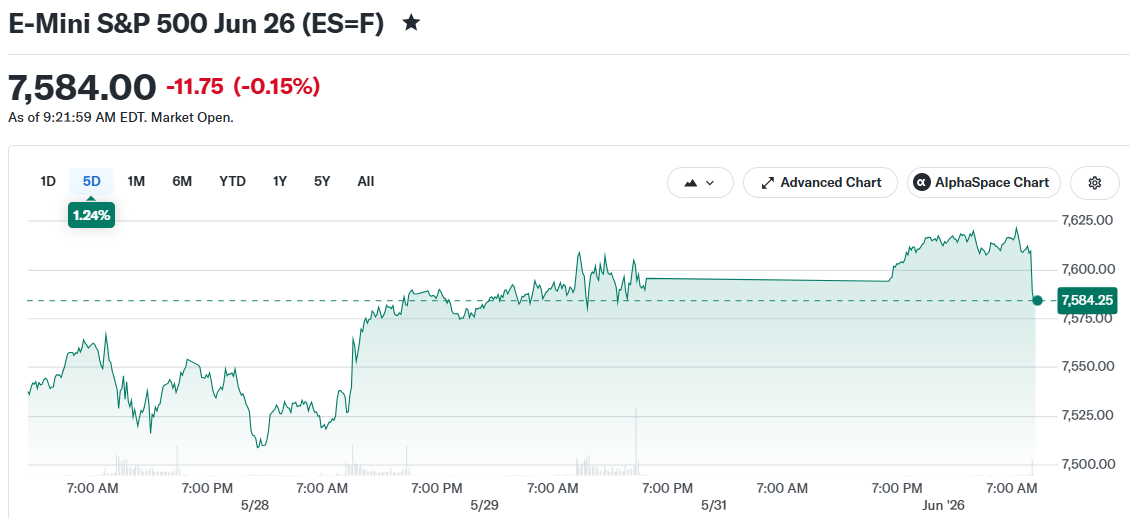
The upward movement comes after an exceptionally strong finish to May. The Nasdaq Composite posted gains exceeding 8% during the month, and together with April’s 25% advance, represents the index’s most powerful two-month rally since the final months of 2002.
The S&P 500 climbed approximately 5% throughout May. The Dow Jones Industrial Average added close to 3% during the same timeframe.
Each of the three principal benchmarks finished last week at all-time peaks. Technology equities have predominantly fueled the advance, with AI chipmakers attracting substantial capital from market participants.

Robust quarterly results from technology corporations have served as a primary catalyst. Market participants have richly rewarded numerous prominent companies operating in the artificial intelligence and semiconductor sectors.
Middle East Tensions Create Market Headwinds
While market sentiment remains positive, geopolitical developments continue generating concern. American military aircraft targeted Iranian radar installations and unmanned aerial vehicle facilities during the weekend, with Iran’s Islamic Revolutionary Guard Corps announcing retaliatory measures.
President Trump indicated he would convene with senior advisers to reach a “final determination” regarding future actions. He additionally demanded the immediate restoration of access through the Strait of Hormuz, a critical passageway for international energy transportation.
Oil prices pushed higher in response to the weekend military operations. Brent crude advanced 3.1% to reach $93.98 per barrel, while West Texas Intermediate gained 3% to settle at $90.40 per barrel.
Despite Monday’s recovery, WTI registered its most significant monthly decline since April 2025, dropping nearly 17% throughout May.
The greenback inched up 0.1% relative to a collection of major global currencies. The 10-year Treasury note yield increased 2 basis points to reach 4.47%, reflecting investor movement toward defensive positions.
Deutsche Bank analyst Jim Reid said the outlook for June will depend heavily on whether a US-Iran deal materializes. “We’ve never felt closer to a deal but potentially never felt closer to it all falling apart,” he said.
Employment Data Takes Center Stage
Market participants will closely monitor Friday’s nonfarm payrolls release. The figures will provide updated insights into employment conditions and may shape expectations regarding Federal Reserve monetary policy adjustments in upcoming months.
Optimism surrounding potential diplomatic progress between Washington and Tehran had supported markets in recent trading sessions. Nevertheless, the weekend military actions have reintroduced uncertainty about the timeline for potential conflict resolution.
Markets continue operating in a wait-and-see mode regarding geopolitical developments, as traders weigh robust technology sector performance against persistent Middle Eastern instability.
Get 3 Free Stock Ebooks
Discover top-performing stocks in AI, Crypto, and Technology with expert analysis.
- Top 10 AI Stocks - Leading AI companies
- Top 10 Crypto Stocks - Blockchain leaders
- Top 10 Tech Stocks - Tech giants


