



Key Takeaways
- Futures for the Dow Jones Industrial Average advanced approximately 0.7% to 0.8% in pre-market trading.
- S&P 500 futures posted gains of roughly 0.7%, reflecting positive sentiment across the market.
- Nasdaq-100 futures jumped between 1% and 1.1%, outperforming other major indices ahead of the opening.
- Crude oil prices declined, with WTI dropping under $100 and Brent approaching $102, alleviating inflation pressures.
- Market participants are focused on the upcoming Trump-Xi summit, where trade policy and artificial intelligence are likely topics.
- Treasury yields retreated alongside falling energy costs as investors reevaluated the Federal Reserve’s latest rate decision.
Equity futures in the United States posted gains Monday morning as declining crude oil prices and enhanced diplomatic sentiment between Washington and Beijing lifted investor confidence ahead of the market open.
Futures tied to the Dow Jones Industrial Average increased by roughly 0.7% to 0.8%.
Contracts linked to the S&P 500 advanced approximately 0.7%, while Nasdaq-100 futures rose between 1% and 1.1%.
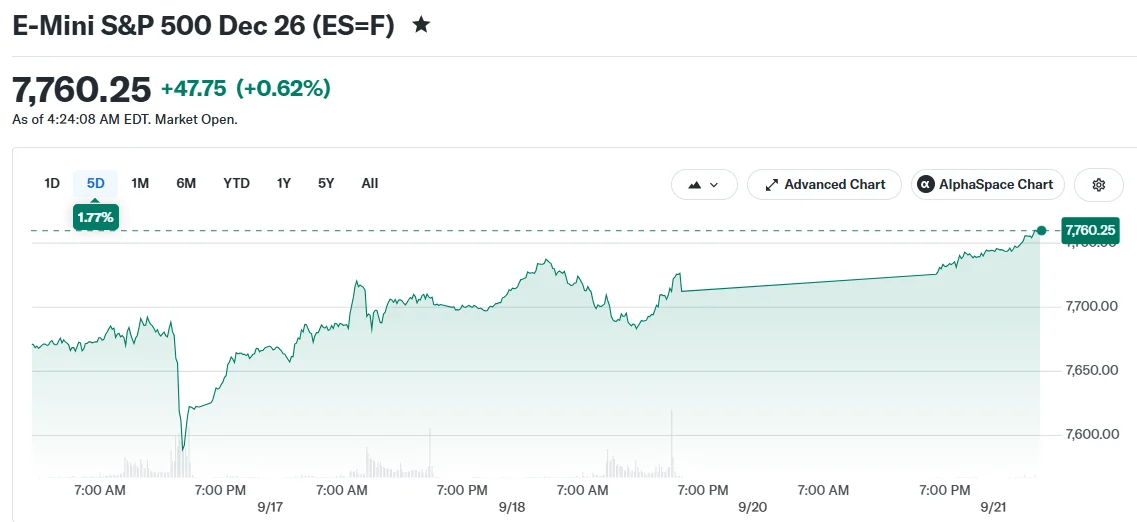
The positive momentum arrived following a choppy week for American equities, during which the Dow recorded its third consecutive weekly loss.
Tech Stocks Drive Nasdaq Higher as Energy Costs Ease
Technology shares were positioned to propel the broader market upward following strength in Asian chip stocks during overnight trading.

Among the three primary U.S. indices, the Nasdaq-100 displayed the most robust futures performance.
Market participants also found relief in declining energy prices.
West Texas Intermediate crude dropped beneath the $100 per barrel threshold, while Brent crude approached $102.
The pullback in oil followed increasing optimism that Washington and Tehran might restart diplomatic engagement.
President Donald Trump indicated willingness to meet with Iranian President Masoud Pezeshkian during the upcoming United Nations General Assembly.
The retreat in crude prices contributed to downward pressure on Treasury yields.
The two-year Treasury yield moved closer to 4.74%, while the benchmark 10-year yield slipped back under 5%.
Energy market movements continue to play a crucial role in shaping inflation forecasts and the Federal Reserve’s monetary policy trajectory.
U.S.-China Leadership Summit Takes Center Stage
Market attention is increasingly turning toward the scheduled meeting between President Trump and Chinese President Xi Jinping later in the week.
U.S. Treasury Secretary Scott Bessent and Chinese Vice Premier He Lifeng characterized their recent discussions as constructive in the lead-up to the summit.
Investors will closely monitor developments regarding tariffs, commercial restrictions, and technology regulations.
Artificial intelligence is anticipated to be a central theme in the discussions.
Officials from both nations have been exploring the establishment of a communication framework for AI safety protocols and emergency response to significant incidents.
Numerous technology industry leaders are expected to participate in a dinner event associated with Xi’s visit, including representatives from Nvidia, OpenAI, Microsoft, Qualcomm, and Apple.
The summit arrives as market participants continue evaluating tensions surrounding AI innovation and strategic competition between the two economic superpowers.
Federal Reserve Policy and Yields Remain Critical
The Federal Reserve’s most recent interest rate increase continues to influence market dynamics.
Traders are currently assigning probability to another quarter-percentage-point hike occurring before year-end.
Elevated oil prices and bond yields had recently sparked concerns about persistent inflation.
Monday’s decrease in crude prices provided some relief from those anxieties.
Nevertheless, the 10-year Treasury yield remains near the 5% mark, maintaining elevated borrowing costs throughout the economy.
With a relatively quiet schedule for earnings reports and economic data releases this week, market focus is expected to remain concentrated on oil prices, Treasury yields, U.S.-China diplomatic developments, and technology sector performance.
The pre-market environment remains constructive, with Nasdaq futures demonstrating leadership in the advance ahead of Monday’s trading session.
Get 3 Free Stock Ebooks
Discover top-performing stocks in AI, Crypto, and Technology with expert analysis.
- Top 10 AI Stocks - Leading AI companies
- Top 10 Crypto Stocks - Blockchain leaders
- Top 10 Tech Stocks - Tech giants


