


TLDR
- Equity futures declined Monday morning with Dow futures sinking more than 300 points before the opening bell
- Brent crude surged beyond $110 per barrel following the breakdown of US-Iran diplomatic efforts
- The 10-year Treasury yield advanced to 4.61%, intensifying concerns about potential Federal Reserve tightening
- Market participants now assign a 54% probability to at least one Fed rate increase by the conclusion of 2026, a dramatic jump from less than 1% seven days prior
- Nvidia’s Wednesday earnings report is viewed as the critical catalyst that may determine near-term market direction
Equity futures experienced a notable decline Monday morning as market participants confronted mounting inflation anxieties. Futures tied to the Dow Jones Industrial Average retreated approximately 334 points, representing a 0.6% decline. S&P 500 futures decreased 0.3%, while Nasdaq 100 futures fell 0.2%.
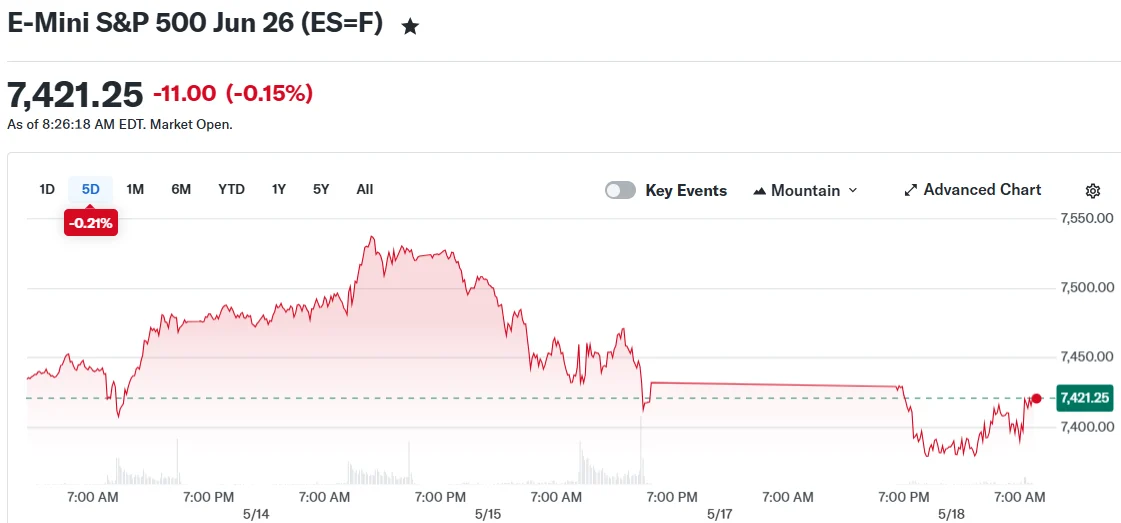
The morning weakness extended Friday’s pronounced decline, which was triggered by advancing government bond yields. Each of the three principal equity benchmarks has now retreated from recently established all-time peaks.
The 10-year Treasury yield advanced to 4.61% during Monday’s session. This movement is creating headwinds for equities, as elevated yields increase borrowing costs and can compress corporate earnings margins.
Oil prices also experienced upward momentum. Brent crude futures advanced to $110.25 per barrel, marking a 0.9% gain. West Texas Intermediate climbed 1.3% to reach $106.80 per barrel.
The crude oil rally is directly linked to the escalating US-Iran confrontation. Disruptions to maritime traffic through the Strait of Hormuz persist. This situation is fueling concerns that energy expenses may sustain inflationary pressures.

Iran Standoff Revives Federal Reserve Tightening Speculation
During the weekend, President Donald Trump intensified his warnings directed at Iran. He posted on Truth Social that Iran “better get moving, FAST, or there won’t be anything left of them.” This statement followed a drone strike that ignited a blaze near a nuclear facility in the United Arab Emirates.
Financial markets responded swiftly. According to the CME FedWatch tool, traders now assign a 54% likelihood that the Federal Reserve will implement at least one interest rate increase before year-end 2026. Merely seven days earlier, this probability registered under 1%.
Newly appointed Fed Chair Kevin Warsh is increasingly viewed as potentially needing to tighten monetary policy instead of easing it. This represents a dramatic shift from market expectations that prevailed only days ago.
“The stock market is coming to the sudden realization that new Fed Chair Kevin Warsh may need to raise rates rather than lower them, and the market hates that,” said Richard Reyle, chief investment officer at Questar Capital Partners.
Fixed income markets are already adjusting. Yields continue their upward drift, applying additional downward pressure on equity valuations.
Retail sector earnings from Target and Walmart scheduled for later this week will provide investors with important insights into consumer resilience amid elevated price levels.
Market attention, however, remains fixated on Nvidia. The semiconductor giant is scheduled to release first-quarter financial results on Wednesday. Considering its status as a leading indicator for the artificial intelligence sector, its performance could meaningfully influence Wall Street sentiment, at least over the near term.
Currently, markets maintain a cautious posture. Crude oil trading above $110, ascending bond yields, and the absence of resolution to the Iran crisis are keeping prospective buyers hesitant.
Get 3 Free Stock Ebooks
Discover top-performing stocks in AI, Crypto, and Technology with expert analysis.
- Top 10 AI Stocks - Leading AI companies
- Top 10 Crypto Stocks - Blockchain leaders
- Top 10 Tech Stocks - Tech giants


