



Key Highlights
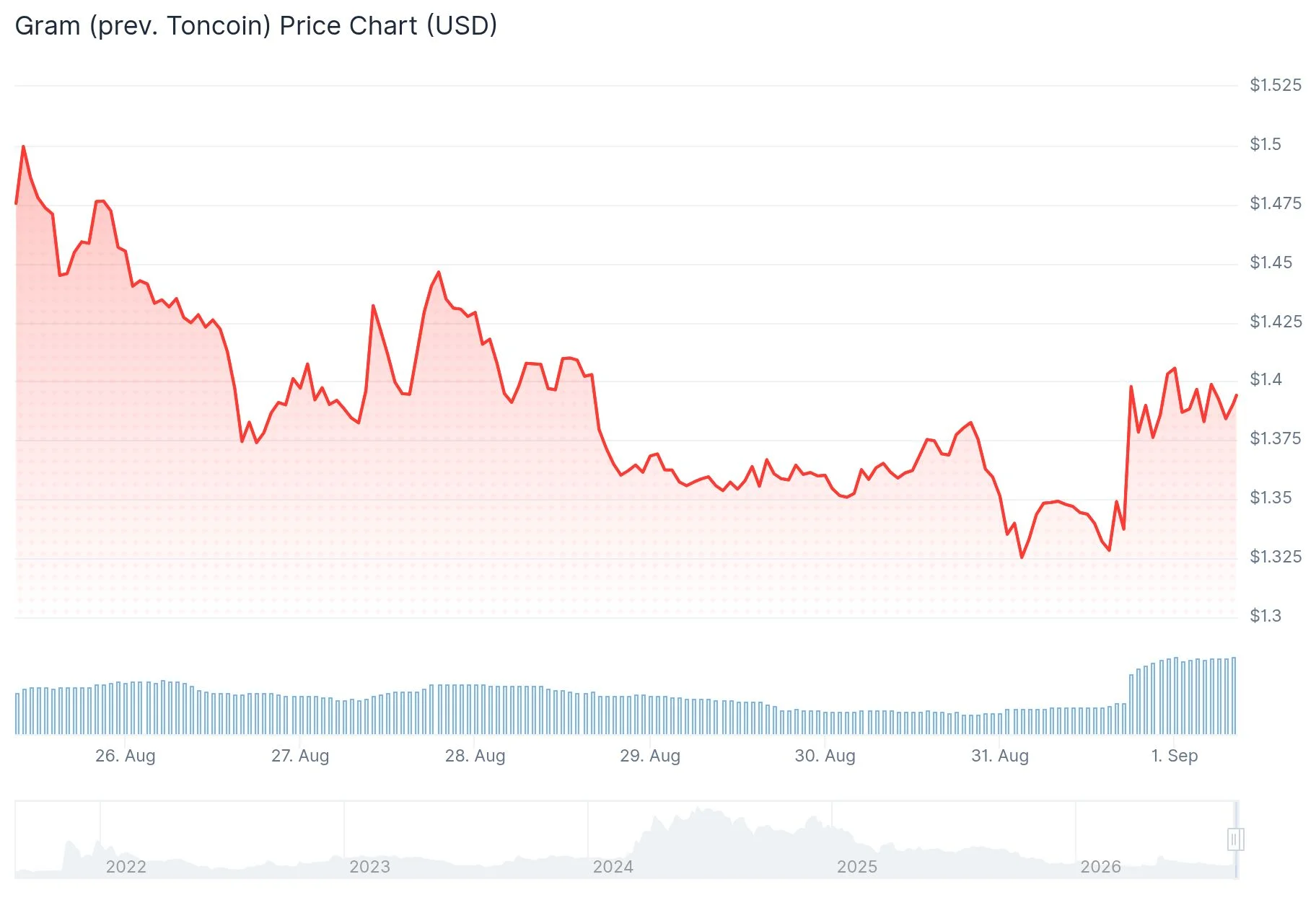
- GRAM token climbed approximately 2% to around $1.40 following Telegram’s Gram Wallet launch for select users
- Trading activity skyrocketed 137% in response to the wallet announcement
- Gram Wallet serves as Telegram’s native self-custodial solution, enabling fee-free transactions and payments
- Validators on the network greenlit the underlying smart contract prior to deployment
- Technical analysis shows GRAM encountering resistance between $1.39–$1.45, with downside support at $1.33–$1.36
The GRAM token experienced a 2% price increase, reaching approximately $1.40, after Telegram’s founder Pavel Durov revealed the staged deployment of Gram Wallet to chosen users on August 31. The digital asset momentarily peaked at $1.46 before market pressure drove prices lower, while trading volumes exploded by roughly 137% following the news.
Speaking through Telegram’s platform, Durov announced that the company plans to “gradually roll it out to our billion+ users over the next couple of weeks.”
The Gram Wallet represents a native integration within Telegram’s messaging application and is positioned to become the standard wallet choice in user preferences. The wallet operates on a self-custodial framework, ensuring users maintain full ownership of their digital assets instead of entrusting them to third-party custodians.
This integrated wallet facilitates zero-cost transfers, transactions, and commerce within Telegram’s ecosystem. Additionally, users gain access to Telegram Collectibles, encompassing digital presents, custom usernames, and virtual phone numbers.
Before the incremental release commenced, network validators authorized the smart contract infrastructure supporting Gram Wallet. The contract architecture enables seamless upgrades without forcing users through fund migration processes, thereby minimizing complications and mitigating exposure to fraudulent migration schemes.

Telegram’s user base surpassed one billion monthly active participants in 2025. However, the messaging platform has not published specific adoption benchmarks or disclosed the number of accounts granted initial access.
Evolution From Toncoin to GRAM
This wallet introduction arrives roughly ten weeks following Toncoin’s official transformation to GRAM. Community members voted overwhelmingly in favor of the rebrand with 81.22% approval, implementing the change on June 15. The rebranding maintained the existing token infrastructure without generating a new asset or mandating holder exchanges.
GRAM experienced an earlier rally of nearly 19% when Durov initially floated the renaming proposal in early June, climbing to approximately $2.21 before experiencing a partial retracement.
Technical Analysis and Critical Price Zones
Examining the four-hour timeframe, GRAM recovered from a bottom of $1.332 to reach approximately $1.385. The upper Bollinger Band hovers around $1.386, establishing the $1.385–$1.40 range as the initial resistance threshold.
Breaking decisively above $1.40 would bring the $1.45–$1.46 region into focus, where profit-taking emerged during the wallet announcement-induced rally. The ADX indicator registers near 29, reflecting moderate directional momentum.
Cryptocurrency market observer CryptoJack highlighted on X that GRAM operates within a descending wedge formation on the 4-hour timeframe, identifying the configuration as either a legitimate breakout opportunity or a potential false signal, emphasizing close monitoring of any breakout attempt.
The Awesome Oscillator continues registering in negative territory at approximately minus 0.029, suggesting bearish pressure persists despite the recent price recovery.
Get 3 Free Stock Ebooks
Discover top-performing stocks in AI, Crypto, and Technology with expert analysis.
- Top 10 AI Stocks - Leading AI companies
- Top 10 Crypto Stocks - Blockchain leaders
- Top 10 Tech Stocks - Tech giants


