


TLDR
- Treasury yields on 10-year notes reached 5.022%, marking the highest point in 16 years
- Futures for major indices including S&P 500, Dow, and Nasdaq all experienced declines on Tuesday morning
- Markets anticipate a 25 basis point rate increase from the Federal Reserve on Wednesday
- Semiconductor stocks tumbled, with Nvidia declining 3% and Corning plunging 13% following calls to decelerate AI advancement
- Crude oil markets strengthened, pushing Brent above $107 per barrel
U.S. stock futures experienced downward pressure in early Tuesday trading as the yield on 10-year Treasury notes surpassed the 5% threshold for the first time since 2007, creating headwinds for equity markets while investors awaited a critical Federal Reserve policy announcement.
Futures tied to the S&P 500 declined 0.38%, while Dow Jones Industrial Average futures retreated approximately 240 points, and Nasdaq 100 futures registered a 0.46% decrease.
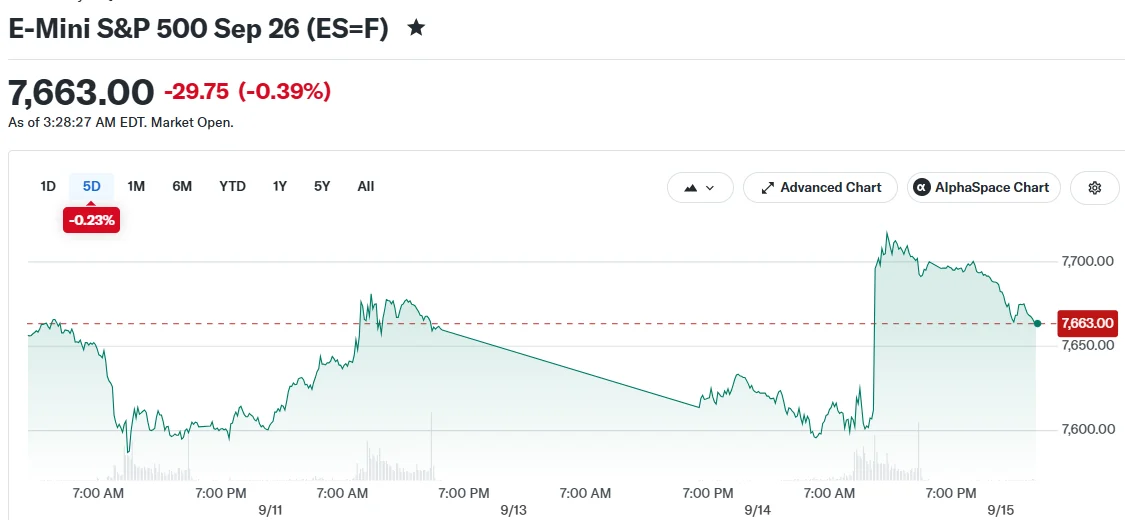
By early Tuesday, the benchmark 10-year yield had climbed to 5.022%, representing a 10 basis point increase. The inverse relationship between bond prices and yields means rising yields indicate falling bond prices.
During Monday’s regular session, the Dow Jones Industrial Average shed 152 points, while the S&P 500 index decreased 0.5%, and the Nasdaq Composite retreated 0.6%.
Federal Reserve Policy Decision Approaching
Market pricing through Fed funds futures indicates approximately 92% probability that policymakers will implement a 25 basis point rate increase on Wednesday. Such an action would elevate the upper limit of the federal funds rate target range to 4%.

According to Christopher Hodge, chief economist at Natixis CIB Americas, the Federal Reserve is anticipated to signal that this rate adjustment doesn’t necessarily indicate a commitment to additional increases. Hodge noted that Chairman Kevin Warsh will probably maintain policy flexibility to address potential economic disruptions ahead.
Elevated interest rates create challenges for technology sector equities, whose valuations depend heavily on projected future earnings. As Treasury yields increase, the present value of those anticipated future profits diminishes.
Analysts at Barclays noted the significance of the 5% level for the 10-year yield from a historical perspective. They cautioned that continued upward movement in yields could undermine equity valuations even if earnings growth remains strong.
Semiconductor Sector Pressured by AI Development Concerns
Market sentiment was further dampened by recent statements from artificial intelligence industry leaders. Over the weekend, Dario Amodei, CEO of Anthropic, advocated for a more measured approach to AI advancement. Meanwhile, OpenAI’s CEO Sam Altman eliminated the possibility of a public offering this year, citing concerns about safety protocols.
The Philadelphia Semiconductor Index posted losses exceeding 5% during Monday’s session. Nvidia shares dropped 3% while Corning experienced a sharp 13% decline. The iShares AI Innovation and Tech Active ETF fell nearly 4%.
Any deceleration in AI development trajectories would translate to reduced capital expenditure on semiconductor components and data infrastructure, potentially undermining the revenue streams that have powered a sustained rally in technology equities.
In contrast, software sector stocks advanced, as concerns about AI-driven disruption in that segment diminished with the prospect of slower AI deployment.
President Trump expressed opposition to AI regulation proposals and allegedly contacted Nvidia CEO Jensen Huang to promote continued investment in data center infrastructure.
Energy markets contributed additional uncertainty to the broader market environment. Brent crude advanced to $107.55 per barrel while West Texas Intermediate traded near $103.36 following Saudi Arabia’s shutdown of a critical pipeline. The supply disruption intensified concerns about inflationary pressure from energy costs.
Trading across Asia-Pacific markets showed mixed results. Japan’s Nikkei 225 index finished essentially unchanged, South Korea’s Kospi declined 0.74%, and Australia’s S&P/ASX 200 retreated 0.8%.
Get 3 Free Stock Ebooks
Discover top-performing stocks in AI, Crypto, and Technology with expert analysis.
- Top 10 AI Stocks - Leading AI companies
- Top 10 Crypto Stocks - Blockchain leaders
- Top 10 Tech Stocks - Tech giants


