



Key Takeaways
- The benchmark 10-year Treasury yield surpassed 5.041%, marking the highest level since the 2007 financial crisis
- Fed rate hike probability stands at over 92% for a 25 basis point increase this week
- Persistent inflation running above the Federal Reserve’s 2% goal continues to fuel rate expectations
- Elevated oil prices are strengthening their correlation with bond yields, creating additional upward momentum
- Equity markets reacted negatively with S&P 500 futures declining 0.3% following the surge
Treasury markets experienced significant turbulence on Tuesday as the 10-year Treasury yield surpassed the psychologically important 5% mark for the first time in more than sixteen years, signaling growing expectations for continued Federal Reserve tightening.
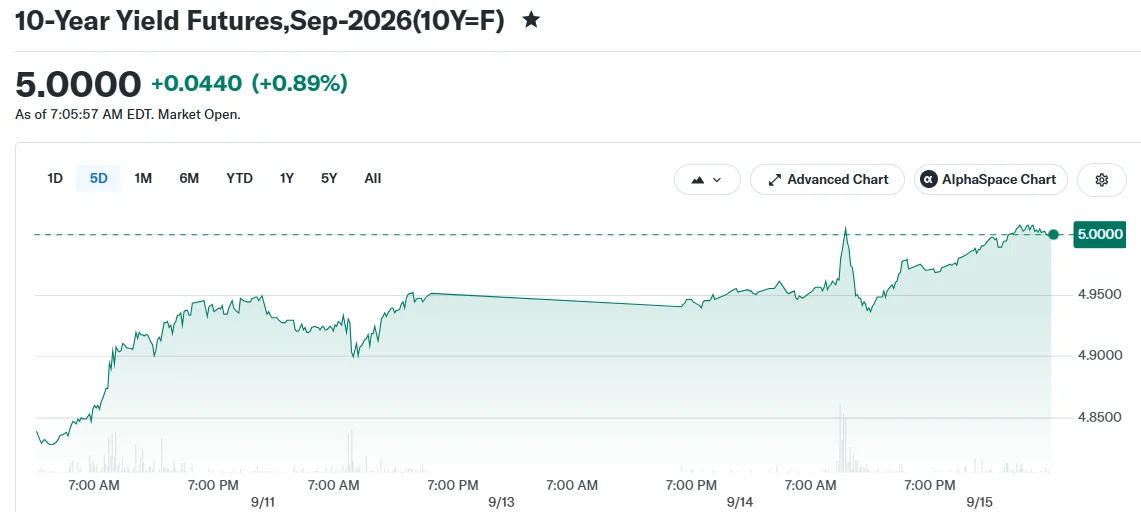
During Tuesday’s trading session, the yield peaked at 5.041% before moderating slightly to approximately 5.014% in morning activity. Meanwhile, the longer-dated 30-year Treasury bond yield advanced to 5.381%, while the shorter-term 2-year note climbed to 4.663%.
Market participants are currently assigning greater than a 92% probability to a 25 basis point rate increase at the Federal Reserve’s monetary policy meeting, which commenced on Tuesday, based on data from the CME FedWatch tool.
The primary catalyst behind this bond market movement remains stubbornly elevated inflation. Recent data from August revealed price pressures continue to exceed the Federal Reserve’s 2% annual inflation objective, providing justification for additional monetary tightening.
Additionally, anxieties surrounding America’s fiscal position are contributing to upward yield pressure. An expanding federal budget deficit coupled with mounting debt obligations have led certain investors to demand higher compensation for purchasing U.S. government securities.

Energy Markets Amplifying Yield Pressure
Complicating the situation further is the strengthening relationship between crude oil valuations and Treasury yields. Analysis from BMO Capital Markets indicates the one-month rolling correlation between West Texas Intermediate crude and the benchmark 10-year yield has climbed to 0.96.
According to Steve Sosnick, chief strategist at Interactive Brokers, the current connection between oil markets and inflation expectations represents an unusually strong coupling. Sosnick emphasized that sustained elevated energy prices will maintain pressure on interest rates.
Jonathan Liang, serving as Standard Chartered’s CIO of fixed income and FX, indicated this correlation between inflation expectations and Treasury yields appears poised to continue as long as price pressures remain above the Federal Reserve’s stated target.
Equity Markets Show Vulnerability
The 5% threshold on the 10-year Treasury yield represents a critical psychological benchmark for financial markets. At this level, investors can secure attractive risk-free returns in government bonds, potentially redirecting capital away from equity investments.
This dynamic became immediately apparent on Tuesday morning, with S&P 500 futures dropping 0.3% in response to the yield breakthrough.
Equity markets were already experiencing headwinds entering this week. Elevated yields increase corporate borrowing costs while simultaneously diminishing the relative attractiveness of stocks when fixed-income instruments offer compelling returns.
Bond yields and prices maintain an inverse relationship. As yields increase, the market value of existing bonds decreases, compelling investors to seek higher returns on newly issued debt securities.
The Federal Reserve’s policy meeting extends through Wednesday, with a rate determination anticipated. Market participants will scrutinize any communication regarding the trajectory of monetary policy beyond the current meeting.
The current positioning of the 10-year yield represents the most elevated reading for this benchmark rate in more than sixteen years, creating ripple effects throughout both fixed-income and equity markets.
Get 3 Free Stock Ebooks
Discover top-performing stocks in AI, Crypto, and Technology with expert analysis.
- Top 10 AI Stocks - Leading AI companies
- Top 10 Crypto Stocks - Blockchain leaders
- Top 10 Tech Stocks - Tech giants


