


Key Takeaways
- Trump administration officials pledge continued negotiations with Senate Democrats through September to advance the CLARITY Act.
- Senate Majority Leader John Thune triggered a cloture filing, scheduling a procedural test for September 15.
- Passage requires 60 Senate votes, forcing Republicans to court Democratic lawmakers who remain divided.
- Unresolved disputes center on ethics provisions related to Trump-associated crypto ventures and stablecoin interest payment regulations.
- Betting platforms assign only a 25% probability to the legislation being enacted in 2026.
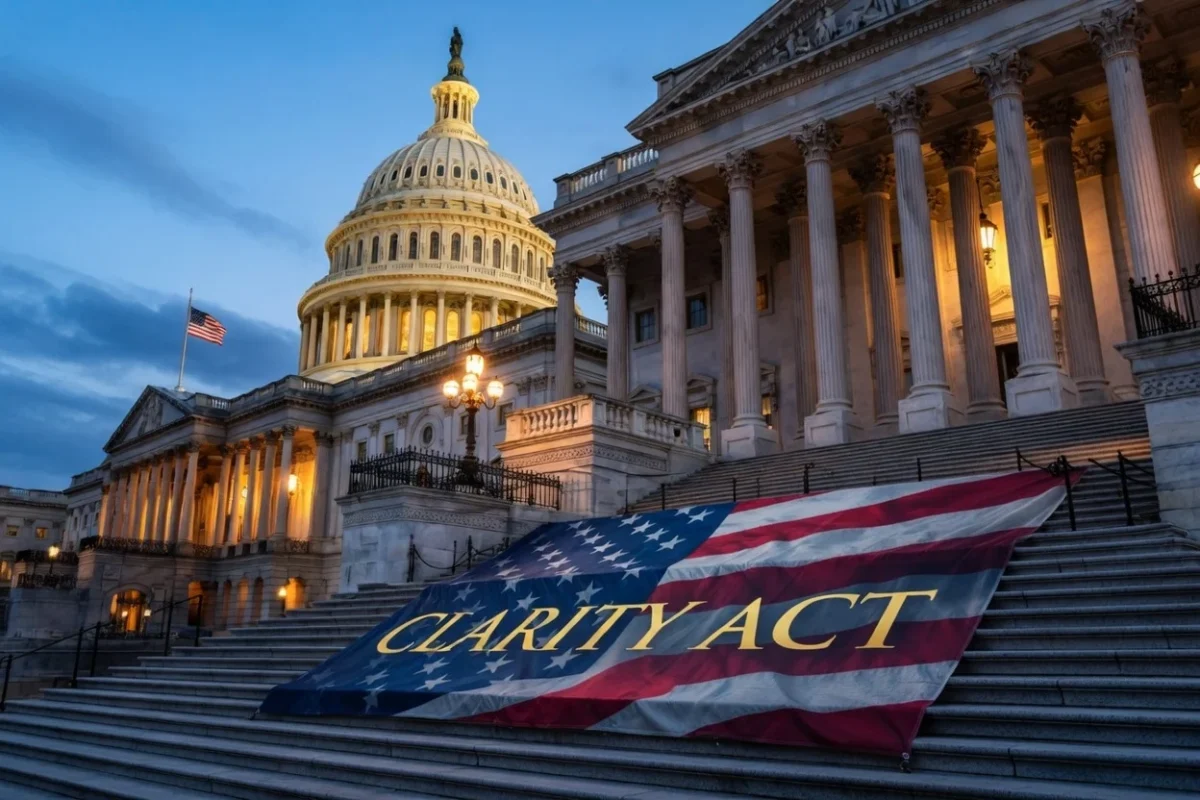
The U.S. Senate departed for its August recess without holding a vote on the CLARITY Act, delaying critical legislative action until mid-September. The Trump White House insists the fight continues.
🚨🗞️NEW: Clarity Gets a September Lifeline as SEC Tees Up Proposal for Crypto Offering Rules
The Senate punted a procedural vote on the Clarity Act. How it happened and what comes next as regulators prepare to move ahead with crypto rules of their own.https://t.co/B9EKDgFUdE
— Eleanor Terrett (@EleanorTerrett) August 11, 2026
Patrick Witt, who leads the President’s Council of Advisors for Digital Assets, stated Tuesday that negotiations with Democratic senators would persist “right through to the September vote.” He emphasized that America “cannot sit idle indefinitely.”
Before lawmakers departed Washington for their monthlong August break, Senate Majority Leader John Thune filed a cloture motion on the Digital Asset Market Clarity Act. This procedural step establishes a critical test once the Senate reconvenes on September 14.
The scheduled September 15 action represents a procedural hurdle rather than final passage. It functions as a cloture vote that would merely open the door for formal Senate floor debate on the legislation.
The CLARITY Act seeks to establish a comprehensive federal regulatory structure for digital assets. The legislation would define criteria determining whether cryptocurrency tokens qualify as securities or commodities and establish oversight standards for digital asset exchanges.
The House of Representatives approved the measure with a 294-134 tally on July 17, 2025. The Senate Banking Committee moved its version forward in May 2026, with two Democratic committee members crossing party lines to support it.

Cross-Party Coalition Remains Essential
Advancing past the cloture stage demands a minimum of 60 Senate votes. With Republicans lacking sufficient numbers independently, securing Democratic backing becomes mandatory.
Multiple Democratic senators maintain opposition to the current draft. Senator Elizabeth Warren has publicly rejected the legislation, citing concerns about potential corruption, inadequate consumer safeguards, national security vulnerabilities, and threats to financial system stability.
The most contentious issue involves ethics requirements. Democratic negotiators are demanding tougher restrictions addressing crypto business connections to Trump, particularly his ties to World Liberty Financial and the Official Trump memecoin project.
Traditional banking institutions are simultaneously exerting pressure from an alternative angle. Industry groups want senators to eliminate what they characterize as stablecoin interest-bearing loopholes that could enable crypto firms to siphon deposits from regional and community banks.
Sector Leaders React to Legislative Stalemate
Digital asset industry executives expressed visible disappointment following the pre-recess postponement. Senator Cynthia Lummis acknowledged her frustration while pledging continued work on the measure, declaring the legislative push “nowhere near finished.”
Coinbase CEO Brian Armstrong characterized the postponement as discouraging. He maintained that stablecoin proliferation and asset tokenization would advance with or without congressional action.
Coinbase equity showed resilience despite the legislative setback. Shares closed Friday trading at $153.60, registering approximately 5.7% gains for that session.
BitMine Chair Tom Lee observed that market participants were prioritizing inflation trends and employment statistics over the CLARITY Act complications.
Prediction market data reveals traders anticipate a September Senate action. A Kalshi futures contract assigned 88% probability to a vote occurring before October 1. However, a Polymarket contract indicated just 25% odds of the bill receiving presidential signature and becoming law in 2026.
Get 3 Free Stock Ebooks
Discover top-performing stocks in AI, Crypto, and Technology with expert analysis.
- Top 10 AI Stocks - Leading AI companies
- Top 10 Crypto Stocks - Blockchain leaders
- Top 10 Tech Stocks - Tech giants


