


Key Takeaways
- Recent financial disclosures reveal Trump generated approximately $1.4 billion from cryptocurrency-related activities, triggering ethics concerns in Congress
- Senate Democrats insist on adding provisions to the Clarity Act that would prohibit government officials and their relatives from holding or earning profits through digital assets
- The Republican Senate advantage has narrowed to 51-47 after Senator Graham’s passing and Senator McConnell’s medical hospitalization
- Majority Leader Thune is pushing for a vote this month, though critical portions of the legislation remain incomplete
- Trump referenced Senator Graham’s death to advocate for the bill’s approval, though Graham had minimal involvement in Clarity discussions
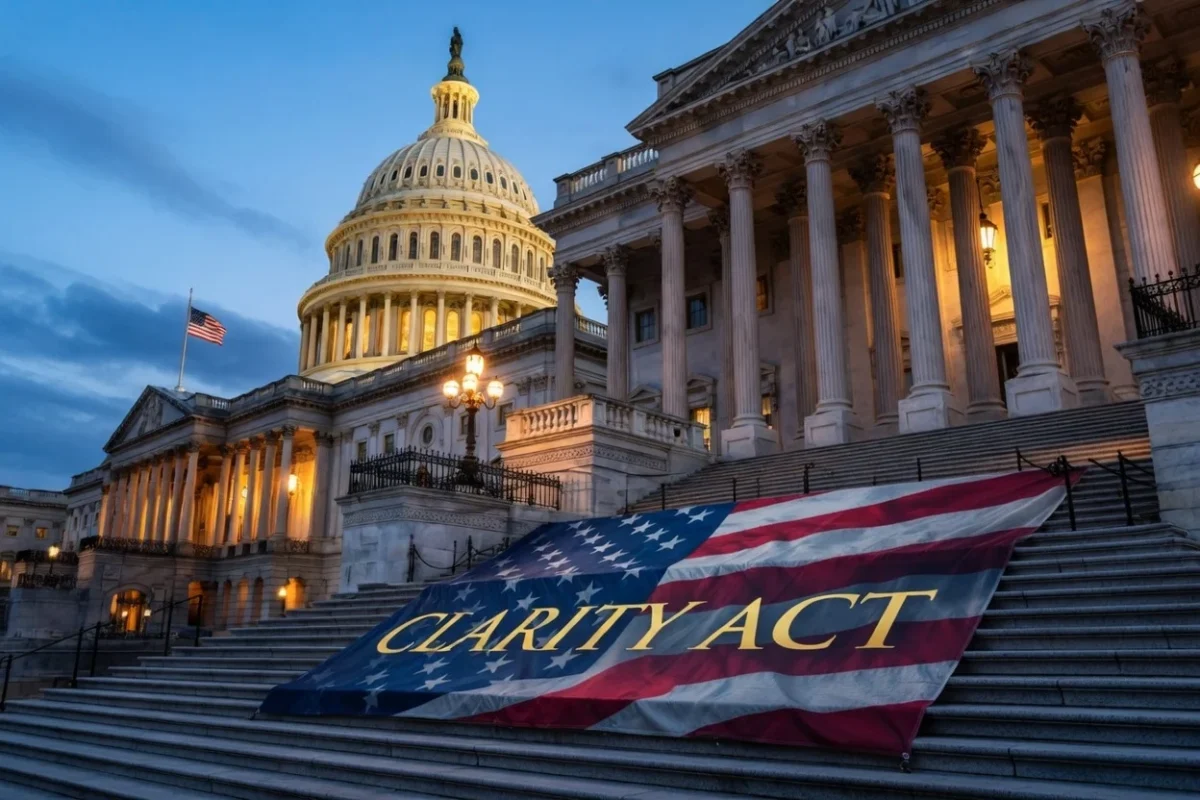
The Digital Asset Market Clarity Act faces significant obstacles in the U.S. Senate as Democratic lawmakers refuse to advance the legislation without comprehensive ethics provisions specifically designed to prevent conflicts of interest among officials profiting from cryptocurrency ventures — particularly aimed at the former president.
According to Trump’s 2025 financial filing, he generated roughly $1.4 billion through various crypto-related income streams. The most substantial portion came from his proprietary memecoin, which alone produced $636 million. Democratic senators view this disclosure as a prime example of why robust conflict-of-interest safeguards are essential in the pending legislation.
Senator Kirsten Gillibrand revealed that she and her Democratic colleagues have been advocating for language that would criminalize presidential issuance or endorsement of any digital currencies. Meanwhile, Senator Chris Murphy organized an informational session for Senate Democratic staff last week, featuring ethics experts who emphasized that the bill’s ethics component must extend to family members and incorporate both ownership prohibitions and transparency requirements.
Multiple Democratic senators have announced plans to hold a media briefing this week to formally object to the Clarity Act in its present form, characterizing it as inadequate to prevent what they describe as Trump’s “corrupt crypto schemes.”
Republican Majority Shrinks Following Graham’s Passing
The legislation was already navigating a challenging route through the chamber. Senate passage requires 60 affirmative votes, necessitating Republican recruitment of multiple Democratic supporters. Recent developments have complicated this strategy further.
Senator Lindsey Graham passed away this past weekend at 71 years old. Senator Mitch McConnell remains under hospital care. These circumstances have diminished the Republican voting margin to 51-47, amplifying the importance of Democratic cooperation.

In response, Trump issued a statement urging senators to approve Clarity as a tribute to Graham. However, Graham held no positions on the committees handling the bill, cast no votes on Clarity itself, and never issued public remarks directly endorsing the legislation. He did support the GENIUS Act stablecoin measure in 2025.
Senator Cynthia Lummis endorsed Trump’s sentiment, asserting Graham “was passionate about ensuring American leadership stayed at the forefront of everything, including digital assets.”
White House cryptocurrency advisor Patrick Witt characterized this as a “critical week” for the legislation on Monday, highlighting the timing coincides with the one-year milestone of the GENIUS Act’s enactment.
Major Provisions Remain Unsettled
The Senate calendar shows approximately four weeks remaining before lawmakers depart for their month-long August break. Senate Majority Leader John Thune has indicated his intention to schedule a floor vote this month, regardless of whether the bill reaches its final form.
A revised version of the Clarity Act is anticipated in the coming days, though sources suggest it will lack completed text for the ethics section and several other contentious areas.
The proposed Clarity Act would transfer primary cryptocurrency regulatory authority from the SEC to the CFTC. However, without Democratic agreement on ethics standards, the legislation may fall short of the 60-vote supermajority required for passage.
Get 3 Free Stock Ebooks
Discover top-performing stocks in AI, Crypto, and Technology with expert analysis.
- Top 10 AI Stocks - Leading AI companies
- Top 10 Crypto Stocks - Blockchain leaders
- Top 10 Tech Stocks - Tech giants


