


Key Takeaways
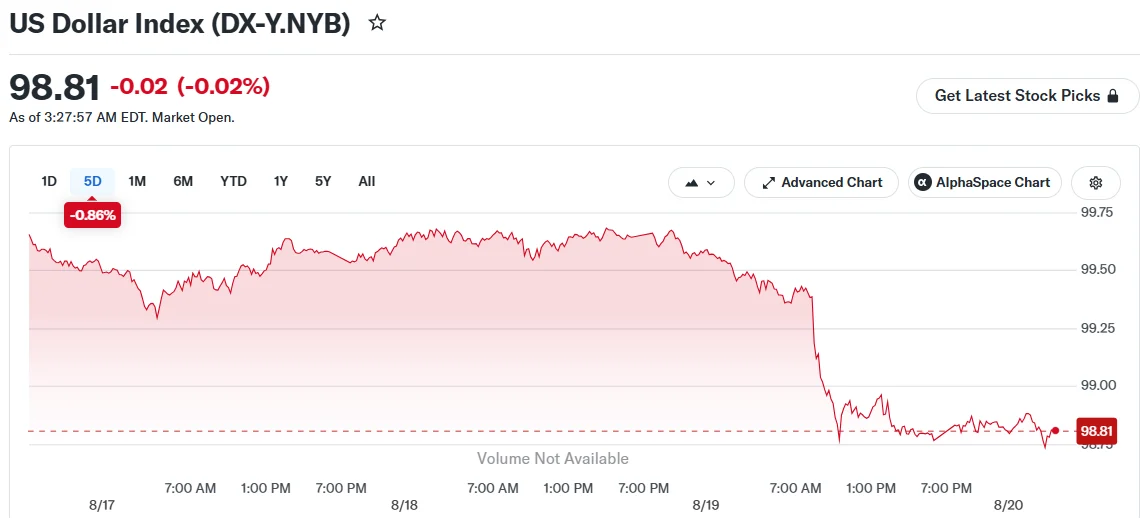
- The dollar index tumbled to approximately 98.80, marking its weakest performance since the final days of May
- Treasury officials revealed plans to expand bond repurchase operations to $4 billion per transaction for securities with extended maturities
- Long-term Treasury yields retreated sharply, with the 30-year rate falling from 5.337%—a level not seen since 2004—to approximately 5.18%
- The yen stepped back from the critical 160 threshold, settling near 158.55 against the greenback
- Federal Reserve meeting records from July revealed ongoing inflation worries among officials, with some considering additional rate increases
The greenback experienced a significant decline on Thursday, reaching its lowest valuation in three months following a strategic intervention by the U.S. Treasury Department aimed at alleviating stress in government bond markets.
The benchmark dollar index descended to the 98.80 range, representing its most subdued level since the closing days of May. Meanwhile, the euro surged to $1.1674, touching heights not witnessed since late spring.
Bond markets had faced intense selling activity throughout the week. Market participants expressed mounting anxiety regarding expanding federal debt obligations and elevated crude oil prices linked to escalating tensions involving the United States and Israel in their confrontation with Iran.
Earlier in the week, the yield on 30-year Treasury securities surged to 5.337%, representing the highest point recorded in nearly two decades. This spike created ripple effects across international financial markets.

Treasury Expands Bond Repurchase Initiative
In response to market conditions, Treasury officials announced Wednesday that they would significantly expand certain buyback programs focused on longer-duration securities, elevating the maximum purchase amount to $4 billion per operation from the previous $2 billion ceiling. The program specifically targets bonds with remaining terms of a decade or longer.
Market reaction was swift—the 30-year yield declined to the 5.18% area, representing a decrease of roughly 9 basis points. The benchmark 10-year yield similarly retreated from elevated levels.
Market strategists at TD Securities observed that although the buyback program differs fundamentally from quantitative easing policies, the announcement’s timing carried significant implications. The move preceded a scheduled auction of 20-year Treasury securities.
Treasury officials additionally indicated that comprehensive details regarding subsequent buyback operations would be disclosed on November 4, following the U.S. midterm electoral contests. Market observers noted this timing provides flexibility for potential program expansion.
The strategy essentially redirects government financing activities toward shorter-duration Treasury bills while simultaneously repurchasing longer-maturity obligations. This approach reduces upward pressure on extended-term yields without necessitating Federal Reserve balance sheet expansion.
Global Currency Movements
The dollar’s weakness provided temporary relief for the Japanese yen. Japan’s currency had been hovering dangerously near the significant 160 per dollar threshold and most recently traded around 158.55. A coordinated U.S.-Japan market intervention conducted in late July had proven ineffective in producing sustained currency stabilization.
South Korea’s won, which had depreciated 1.8% during overnight trading, managed to recoup some losses. The Australian dollar maintained stability following a 0.5% advance in the previous trading session.
The British pound strengthened to $1.3614, approaching a three-month peak. Switzerland’s franc softened marginally from two-month highs.
India’s rupee weakened slightly after recording gains across five consecutive sessions. Reports indicated the Reserve Bank of India had conducted interventions spanning spot markets, futures contracts, and offshore trading venues.
Separately, oil prices advanced toward $92 per barrel as prospects for rapid de-escalation of U.S.-Iran tensions diminished, intensifying inflationary pressures.
Federal Reserve meeting transcripts from July demonstrated that central bank officials maintain vigilance regarding inflation dynamics, with certain policymakers expressing willingness to implement additional interest rate increases should price growth fail to moderate toward the established 2% objective.
Get 3 Free Stock Ebooks
Discover top-performing stocks in AI, Crypto, and Technology with expert analysis.
- Top 10 AI Stocks - Leading AI companies
- Top 10 Crypto Stocks - Blockchain leaders
- Top 10 Tech Stocks - Tech giants


