


Key Highlights
- Geoffrey Kendrick of Standard Chartered believes his $100 price projection for UNI by 2030 may be overly cautious
- The protocol commands a dominant 76.5% market share on Robinhood Chain, capturing $1.81M from the network’s $2.28M daily fee generation
- Annual token burns have reached approximately $90M in value — representing roughly 4% of the circulating token supply each year
- Over the last week, Robinhood Chain has contributed 60% of Uniswap’s entire protocol revenue stream
- A competing launchpad platform supported by SushiSwap is under development to contest Uniswap’s dominance on the network
When Geoffrey Kendrick from Standard Chartered issued his $100 valuation forecast for UNI in June, he projected a potential 37-fold increase by the end of the decade, fueled by the expansion of decentralized finance protocols. Just six weeks after that prediction, the analyst has reconsidered his position — though not to lower expectations, but rather to question whether his target was ambitious enough.
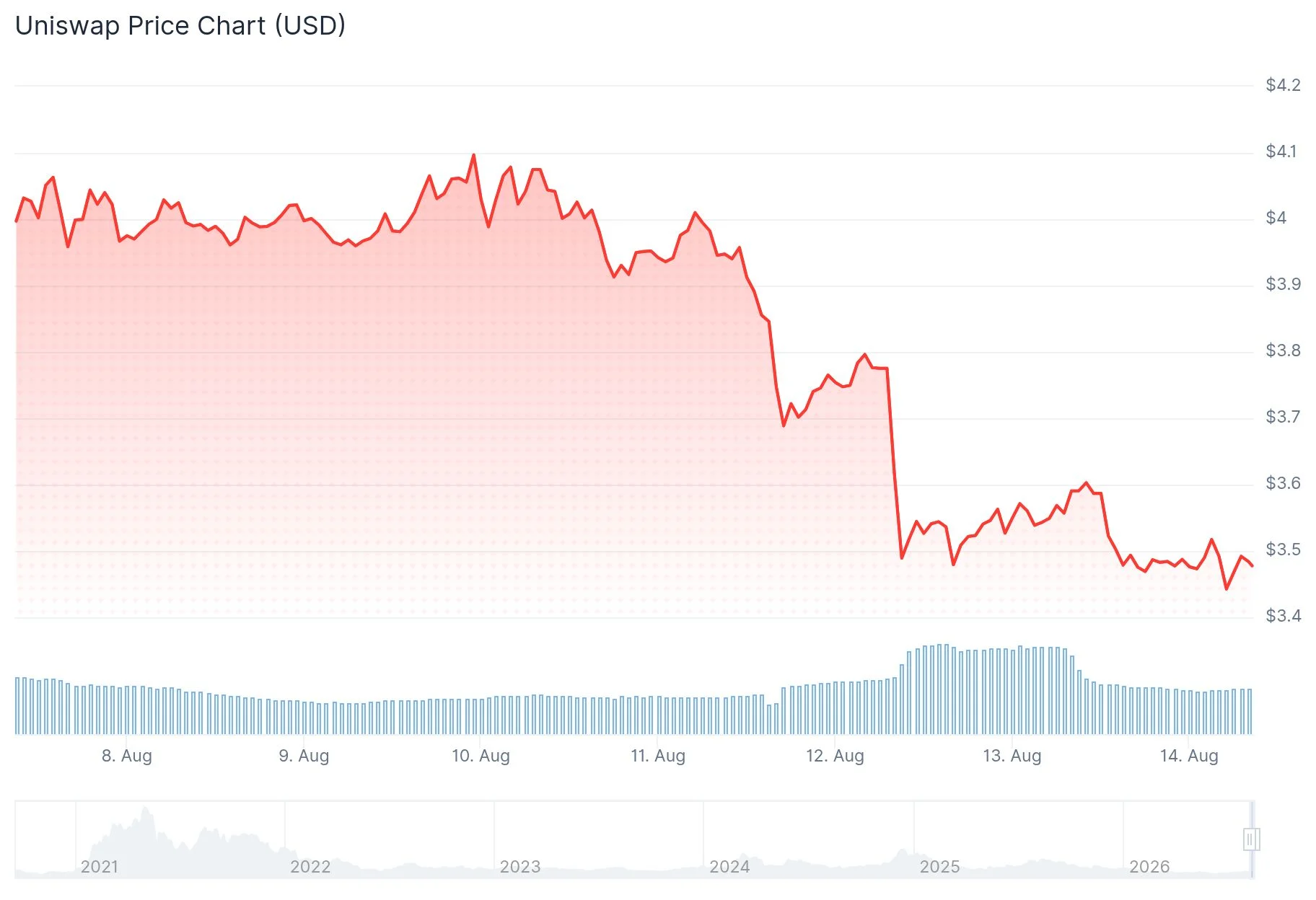
The token was changing hands around $3.48 on Thursday, experiencing a roughly 3% decline during the trading session. Blockchain analytics reveal that whale-level accumulation patterns have reached their highest point in five years this month.
Following Robinhood Chain’s debut on July 2, Uniswap achieved remarkable dominance within just 42 days, securing 76.5% of the blockchain’s entire trading activity according to DefiLlama metrics. During peak activity, the platform’s liquidity pools handled an impressive $409 million in single-day transaction volume.
This substantial trading activity translates directly into fee revenue. The protocol captured $1.81 million from the network’s combined $2.28 million in daily fees — representing a 78.8% revenue share despite controlling merely 16.3% of the chain’s total value locked.
The Significance of Token Burn Mechanics
Following the December 2025 activation of a fee-redistribution protocol, a portion of Uniswap’s revenue stream now funds programmatic token buybacks and permanent burns. A second activation specifically for Robinhood Chain went operational on July 27, effectively doubling the destruction rate.

According to Kendrick’s calculations, the annualized burn velocity now approaches $89–90 million. Based on the current $3.48 valuation, this translates to approximately 25.7 million UNI tokens being permanently removed from circulation annually — roughly 4% of the 624 million tokens currently in circulation.
The protocol began operations with a 1 billion token genesis supply. To date, approximately 109 million tokens have been destroyed through burn mechanisms.
Even assuming Kendrick’s end-of-2026 projection of $6.50 per token, the burn mechanism would still eliminate approximately 2.2% of circulating supply each year. During the previous week alone, Robinhood Chain generated $925,000 of Uniswap’s combined $1.55 million protocol revenue.
Emerging Competitive Landscape
Uniswap introduced its proprietary token launchpad platform, Pools.trade, on Robinhood Chain on August 5. The platform implements a zero-fee launchpad structure beyond the standard 0.25% allocation for liquidity providers — significantly undercutting the approximately 1% fees charged by competing platforms.
A developer operating under the pseudonym 0xDeployer is constructing a competing launchpad infrastructure in collaboration with SushiSwap, criticizing Uniswap for attempting to monopolize the entire blockchain infrastructure layer. A separate token issuance is planned to finance this competitive initiative.
Currently, SushiSwap processes only 0.45% of Robinhood Chain’s trading volume, contrasted sharply with Uniswap’s commanding 76.5% market share.
During the period spanning July 27 through August 12, Uniswap’s average daily revenue reached $244,000 — representing a 2.4-fold increase compared to the preceding 17-day average of $99,800.
Get 3 Free Stock Ebooks
Discover top-performing stocks in AI, Crypto, and Technology with expert analysis.
- Top 10 AI Stocks - Leading AI companies
- Top 10 Crypto Stocks - Blockchain leaders
- Top 10 Tech Stocks - Tech giants


