


Key Takeaways
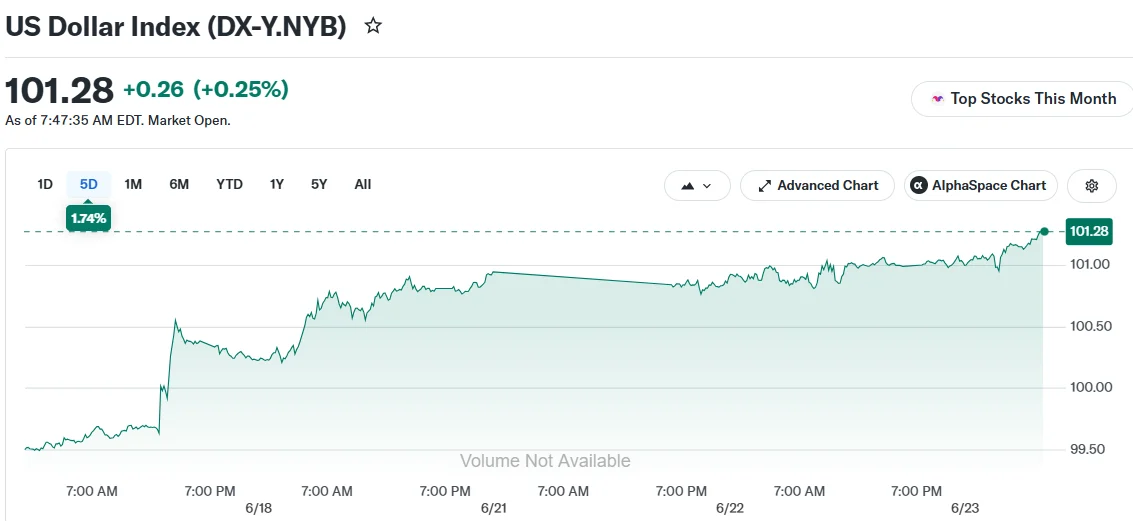
- The US Dollar Index surged to 101.25, marking its strongest performance in more than twelve months
- Market expectations now reflect an 80–85% probability of a Federal Reserve rate increase by fall
- Japan’s currency is trading dangerously close to its 1986 lows, sparking intervention speculation
- Political upheaval in Britain following Keir Starmer’s resignation has weighed on sterling
- The euro dropped to its weakest level since August 2025 following dovish ECB commentary
The greenback surged to its strongest level in a year this Tuesday, fueled by mounting expectations that the Federal Reserve will tighten monetary policy before year-end. The benchmark Dollar Index touched 101.25, a peak not seen since May of last year.
Market pricing through fed funds futures contracts now indicates approximately 80 to 85% odds of a 25-basis-point rate increase arriving by September or October. Major financial institutions including BofA Global Research and Deutsche Bank have adjusted their outlooks, abandoning previous predictions of unchanged policy in favor of anticipating a rate hike within 2025.
“Currently, the dollar is benefiting from expectations of higher interest rates,” explained Tommy von Bromsen, foreign exchange strategist at Handelsbanken.
Persistent geopolitical instability stemming from unresolved conflicts in the Middle East is providing additional tailwinds for dollar strength, von Bromsen noted.
Japanese Currency Approaches Four-Decade Nadir
Japan’s currency is trading in precarious territory. The yen touched 161.93 against the dollar during Monday’s session, and any breach above 161.96 would mark its feeblest position since the mid-1980s.
Traders are closely monitoring for possible government intervention. Japanese officials deployed tens of billions in dollar sales during April and May to support their currency, though these measures proved largely ineffective.

The Bank of Japan implemented a rate increase last week and communicated intentions for additional policy tightening. Despite this hawkish shift, the yen has continued depreciating, undermined by the substantial interest rate differential between American and Japanese monetary policy.
Japanese Finance Minister Satsuki Katayama conducted discussions with US Treasury Secretary Scott Bessent on Monday. The conversation centered on coordinated responses to the yen’s deterioration, including the possibility of direct market intervention.
Sterling Slides on Political Chaos, Euro Weakens Further
The British pound declined between 0.2 and 0.3% on Tuesday following UK Prime Minister Keir Starmer‘s resignation announcement, injecting fresh political instability into British financial markets. Health Minister Wes Streeting’s endorsement of Andy Burnham as a successor has helped contain some of the uncertainty surrounding the leadership vacuum, according to market observers.
“Streeting’s support for Burnham means this period of uncertainty will likely be short-lived,” noted Michael Pfister, foreign exchange analyst at Commerzbank.
Meanwhile, the euro continued its downward trajectory, sliding to $1.1395—its lowest valuation since August of last year. European Central Bank President Christine Lagarde dismissed concerns about persistent inflation pressures on Monday, while fresh economic data revealed the eurozone’s private sector contracted for the third consecutive month in June.
The Australian dollar weakened by 0.7 to 0.8%, reaching its lowest point since April.
Investors are now focusing intently on forthcoming American economic releases. Wednesday will bring the May Personal Consumption Expenditures price index, the Federal Reserve’s preferred inflation metric. Additional data including June PMI figures and a revised first-quarter GDP estimate are scheduled for release this week. These indicators will likely shape whether the dollar’s upward momentum can sustain itself in the coming sessions.
Get 3 Free Stock Ebooks
Discover top-performing stocks in AI, Crypto, and Technology with expert analysis.
- Top 10 AI Stocks - Leading AI companies
- Top 10 Crypto Stocks - Blockchain leaders
- Top 10 Tech Stocks - Tech giants


