


Key Highlights
- XRP is currently priced at $1.52, posting a modest 1% gain over the last 24 hours while maintaining support around $1.50.
- Daily trading volume reached approximately $1.51 billion, representing a 33.70% increase from the previous session.
- On October 1, Ripple unlocked 1 billion XRP tokens from escrow, valued at roughly $1.49 billion at the time.
- Ripple participated in a Seoul gathering with four South Korean financial players, including Woori Bank and KBank.
- XRP open interest on Binance stands at $516.6 million, remaining beneath the peaks seen in October 2025.
As of October 5, XRP is changing hands at $1.52, reflecting approximately a 1% uptick in the past 24-hour window. The digital asset has lingered close to the $1.50 mark for multiple trading sessions without establishing a definitive directional bias.
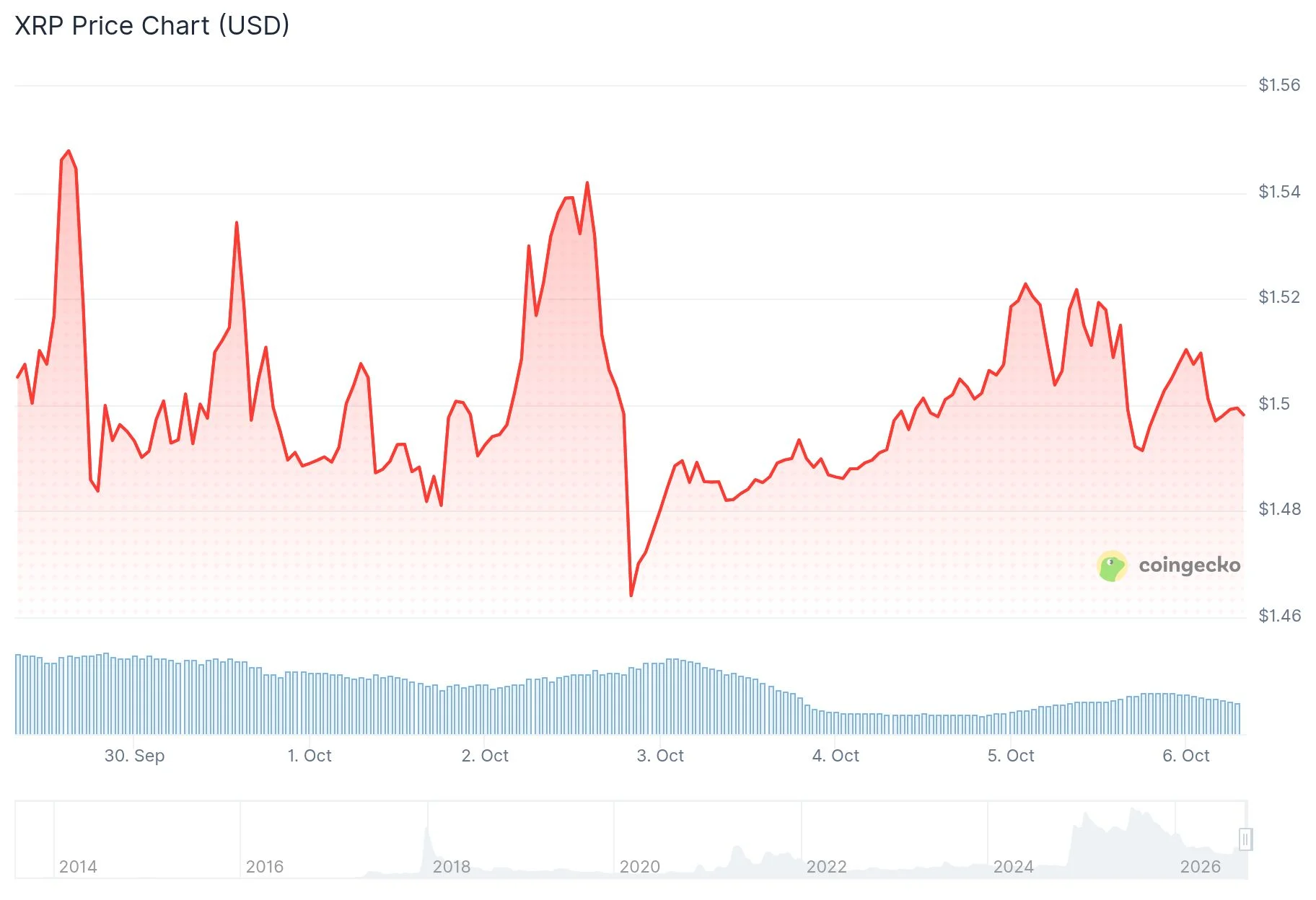
Market activity experienced a notable spike during this timeframe. According to CoinGecko metrics, 24-hour trading volume approached $1.51 billion, marking a 33.70% jump compared to the preceding day.
Elevated volume accompanied by sideways price action typically suggests growing trader engagement. However, this pattern alone doesn’t indicate whether the next move will be upward or downward.
A critical support band exists between $1.47 and $1.50. Market participants are monitoring whether this zone will continue to hold or give way to a potential decline toward $1.20.
Market observer Ali Charts published a technical analysis on X, highlighting that whale addresses have shown minimal activity throughout the past week. Large wallet holdings have remained stable at approximately 3.9 billion XRP. The analyst emphasized that XRP is trading within a triangle consolidation pattern as the price approaches the pattern’s convergence point, a formation frequently preceding significant volatility. A four-hour closing candle above $1.53 might trigger a rally toward $1.62, the post suggested.

Monthly Escrow Unlock and Korean Banking Partnership Event
On October 1, Ripple executed its scheduled monthly release of 1 billion XRP tokens from escrow. The unlocked supply carried an approximate market value of $1.49 billion.
This distribution aligns with Ripple’s established monthly protocol. The release itself doesn’t clarify whether tokens entered active circulation through sales or remained locked.
In a separate development, Ripple joined forces with four South Korean financial institutions at an event in Seoul. Confirmed participants included Woori Bank, KBank, and Kyobo Securities, with the fourth institution identified as either Jeonbuk Bank or Kakao Bank.
During the gathering, Ripple unveiled XRP Asia, a fresh regional program. While the event demonstrates institutional engagement with Ripple’s infrastructure, it doesn’t necessarily translate to direct XRP token acquisition or deployment by these banks.
Extended Chart Analysis and Derivatives Metrics
Several analysts are examining longer timeframes for perspective. Crypto commentator Moustache identified a multi-year descending broadening wedge formation on XRP’s weekly chart, a technical structure that has developed over nearly two years. Should XRP reach $10 from its current level, it would represent an approximate 560% appreciation.
However, not all market watchers anticipate an imminent surge. One analyst estimates the probability of an upward breakout at 65% to 70%, noting that XRP’s Relative Strength Index continues to trade below the neutral 50 threshold.
Seasoned trader Peter Brandt has identified an emerging cup-and-handle formation on the chart, a technical configuration frequently associated with bullish continuation.
Futures market data introduces a note of restraint. CryptoQuant analytics reveal that XRP open interest on Binance has risen to $516.6 million. While this represents growth from the $350 to $400 million range seen in 2026 lows, it falls significantly short of the $1.3 billion recorded during October 2025.
The token’s price has rebounded more aggressively than leveraged positions have accumulated. Futures traders have not yet returned to the participation levels observed in the previous year’s market cycle.
Get 3 Free Stock Ebooks
Discover top-performing stocks in AI, Crypto, and Technology with expert analysis.
- Top 10 AI Stocks - Leading AI companies
- Top 10 Crypto Stocks - Blockchain leaders
- Top 10 Tech Stocks - Tech giants


