



Key Takeaways
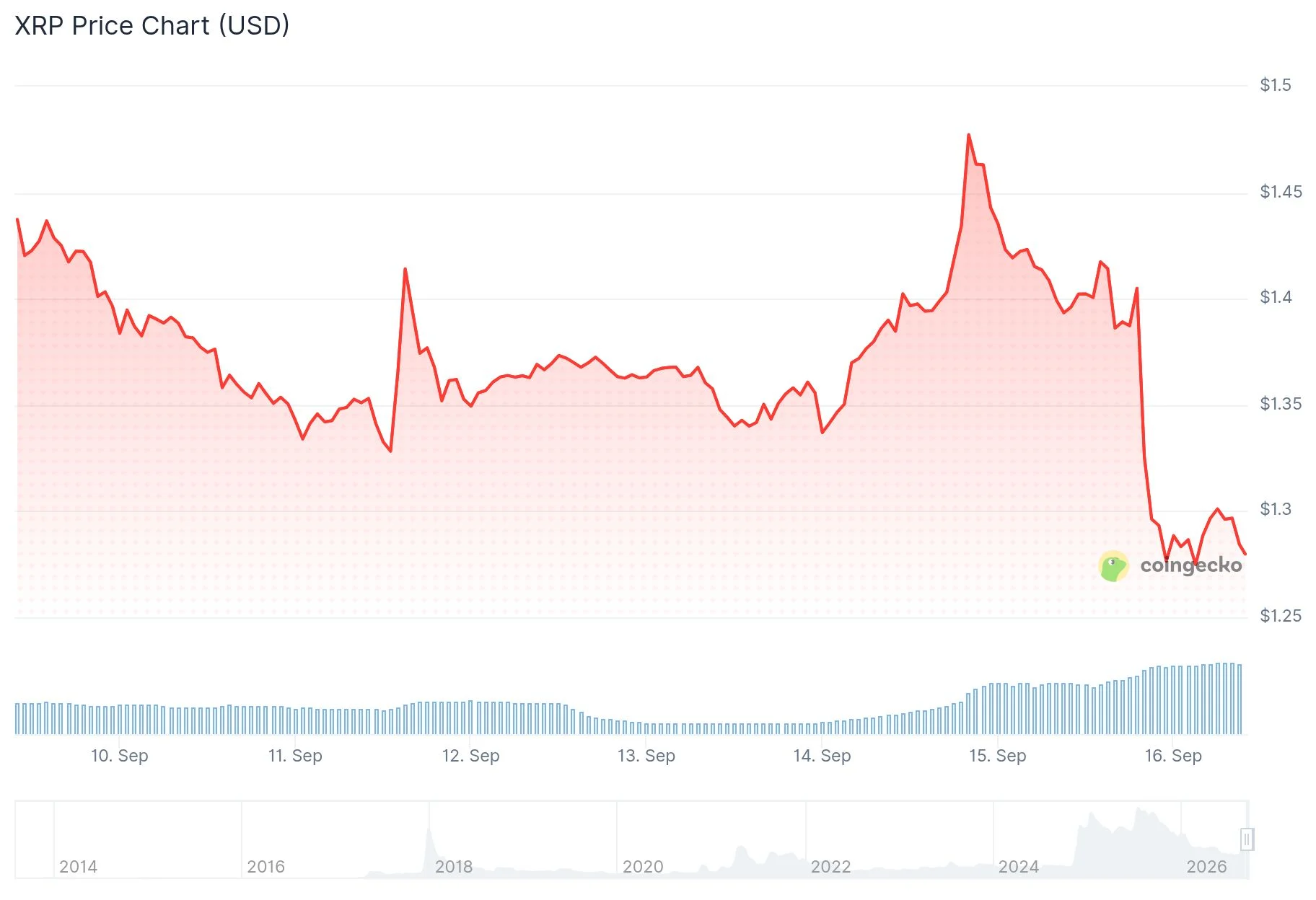
- XRP plummeted approximately 10% to reach $1.30 following the Senate’s failure to pass the Clarity Act in a procedural 49-50 vote
- Advancing the legislation required 60 affirmative votes; several Republican senators opposed the measure
- Controversy over ethics provisions concerning Trump administration officials’ cryptocurrency holdings derailed the bill
- Publicly traded crypto companies suffered steeper losses than digital assets — Coinbase declined nearly 9%, while Circle plunged over 9%
- Wednesday’s anticipated Federal Reserve interest rate announcement compounded selling pressure across markets
During Wednesday’s Asian trading session, XRP experienced a devastating decline of nearly 10%, sliding to $1.30 and establishing itself as the poorest performer among leading digital currencies. This dramatic selloff occurred immediately after the United States Senate blocked advancement of the Clarity Act, proposed legislation aimed at establishing a comprehensive regulatory framework for cryptocurrency markets.
Senators cast a 49-50 vote on the cloture motion, a critical procedural mechanism requiring 60 affirmative votes to advance the legislation for floor debate. The measure fell short by 11 votes.
The proposed legislation contained more than 600 pages of negotiated compromise language. However, the fatal flaw proved to be ethics-related provisions designed to prevent high-ranking government officials from maintaining financial interests in cryptocurrency ventures during their tenure.
Michigan Democrat Senator Elissa Slotkin numbered among the opposing votes. She characterized the ethics safeguards as inadequate, specifically referencing President Trump, his family members, and Cabinet officials benefiting financially from digital assets. Slotkin additionally raised alarm about the CFTC’s insufficient staffing to properly enforce the proposed regulations, alongside vulnerabilities related to anti-money laundering protocols and terrorist financing prevention.
Brad Garlinghouse, CEO of Ripple, described the legislative defeat as something that “stings” in a social media statement on X, representing an unusually candid expression of disappointment from an executive typically known for diplomatic communication.

Publicly Traded Crypto Companies Suffered Deeper Losses
Although XRP dominated losses within the token sector, cryptocurrency-related equities experienced more severe punishment. Coinbase shares tumbled nearly 9% to settle at $174.42. Circle’s stock plummeted over 9% to $88.26. Galaxy Digital surrendered 8% while Gemini declined 7%. Both Bullish and Riot Platforms recorded 5% losses.
Ethereum decreased close to 5%, trading around $2,410. Both Solana and Dogecoin registered approximately 5% declines. Bitcoin retreated nearly 3% to hover just above $76,000, momentarily dipping below $75,000 before staging a partial recovery.
Crypto analytics platform Santiment observed on X that whale-tier XRP wallets — addresses containing more than 1 million XRP — demonstrated elevated activity patterns preceding historical significant price movements. Santiment’s analysis revealed that 85 new wallets of this magnitude emerged just 48 hours before XRP’s remarkable 67% surge in August, indicating that major stakeholders frequently position themselves ahead of substantial price volatility.
Looking Forward
Following the Clarity Act’s defeat, the SEC’s proposed Reg Crypto framework alongside tokenized securities regulations now represent the primary avenue for achieving regulatory certainty. A fresh Congressional session begins in January 2027.
The Federal Reserve’s interest rate announcement scheduled for later Wednesday introduced additional market volatility. Market participants were anticipating a quarter-point rate increase approaching the decision.
Trading at $1.30, XRP currently occupies a crucial technical threshold. A 25 basis point Fed rate hike could drive the price toward $1.21 or potentially lower. Conversely, an unchanged rate policy might enable XRP to reestablish $1.30 as a support floor.
Get 3 Free Stock Ebooks
Discover top-performing stocks in AI, Crypto, and Technology with expert analysis.
- Top 10 AI Stocks - Leading AI companies
- Top 10 Crypto Stocks - Blockchain leaders
- Top 10 Tech Stocks - Tech giants


