



Key Highlights
- US spot XRP ETFs recorded $28.14 million in net inflows on August 26—marking the second-highest daily total this year
- Bitwise captured the lion’s share with $13.12 million, while Franklin Templeton and Canary Capital added $9M and $6.01M respectively
- Whale addresses accumulated approximately 460 million XRP tokens—the most aggressive buying since early February
- The token breached its 200-day exponential moving average for the first time since October 2025, sparking a rally to $1.70
- Critical support now established between $1.35 and $1.40, with traders eyeing the $1.48–$1.52 range as the next breakout zone
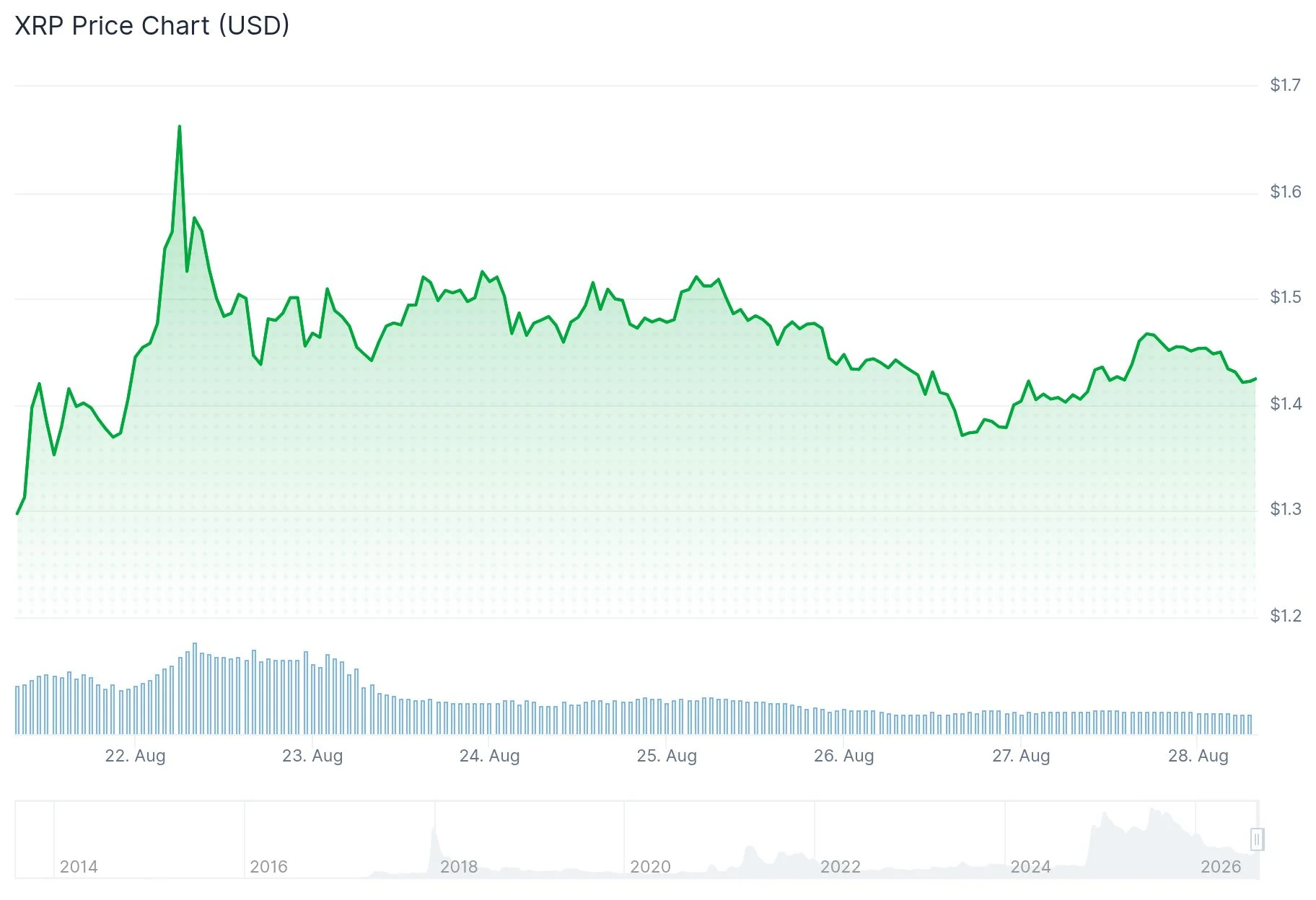
XRP staged a notable recovery, climbing back above the $1.40 threshold following seven consecutive days of institutional capital inflows and heightened ETF participation. The digital asset gained approximately 20% across a week-long period before encountering resistance near $1.70.
Data from SoSoValue reveals that US-based spot XRP exchange-traded funds captured $28.14 million in capital on August 26. This figure represents the second-strongest single-session performance recorded in 2026, trailing only the January 5 surge when inflows reached $46.1 million.
Bitwise’s XRP ETF dominated the session, securing $13.12 million—representing 46% of aggregate inflows. Franklin Templeton’s XRPZ vehicle contributed $9 million to the total, while Canary Capital’s XRPC fund attracted $6.01 million. Neither 21Shares nor Grayscale reported activity during this period.
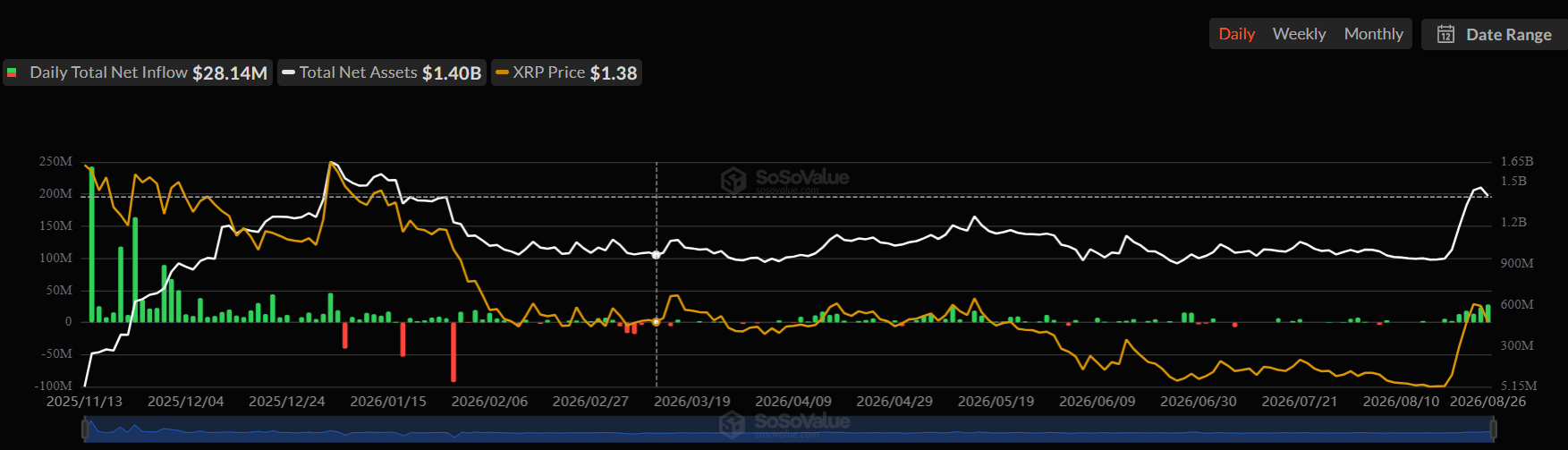
The consecutive week of positive ETF flows has channeled a cumulative $106 million into XRP investment products. This sustained momentum signals a resurgence of appetite among institutional participants who appear to be capitalizing on recent price corrections.
Large Holders Increase Positions During Consolidation
Blockchain data indicates that major XRP holders added roughly 460 million tokens to their portfolios during the recent consolidation phase—representing the most substantial whale accumulation since February. This behavior pattern typically reflects conviction among sophisticated market participants, even amid short-term price volatility.

Last week, XRP successfully crossed above its 200-day exponential moving average for the first time since October 2025. This technical breakthrough catalyzed a short-covering event that propelled prices toward $1.70 before profit-taking emerged.
Following the peak, the asset retraced and tested the 200-day EMA from above—a classic validation pattern where demand resurfaced. The $1.35–$1.40 range has now established itself as a critical support floor.
Market observer Jules (@JulesNetX) characterized the move from $1.00 to $1.70 as a liquidity capture at the upper boundary. He highlighted that the subsequent correction landed within the $1.36–$1.40 demand area, suggesting that defending this zone would bring the $1.48–$1.52 resistance back into focus on sustained 4-hour chart closes. He cautioned that failure to maintain this support could trigger a more substantial retracement.
Market Sentiment and Broader Conditions
The wider cryptocurrency market received support from favorable macroeconomic developments. The US Treasury’s announcement of expanded bond repurchase programs helped temper interest rate increase expectations in advance of the September Federal Reserve policy meeting.
The Crypto Fear and Greed Index surged into “Extreme Greed” territory at 80—a threshold last reached in December 2024. During that previous instance, XRP was changing hands near $3.40 amid the post-election market surge.
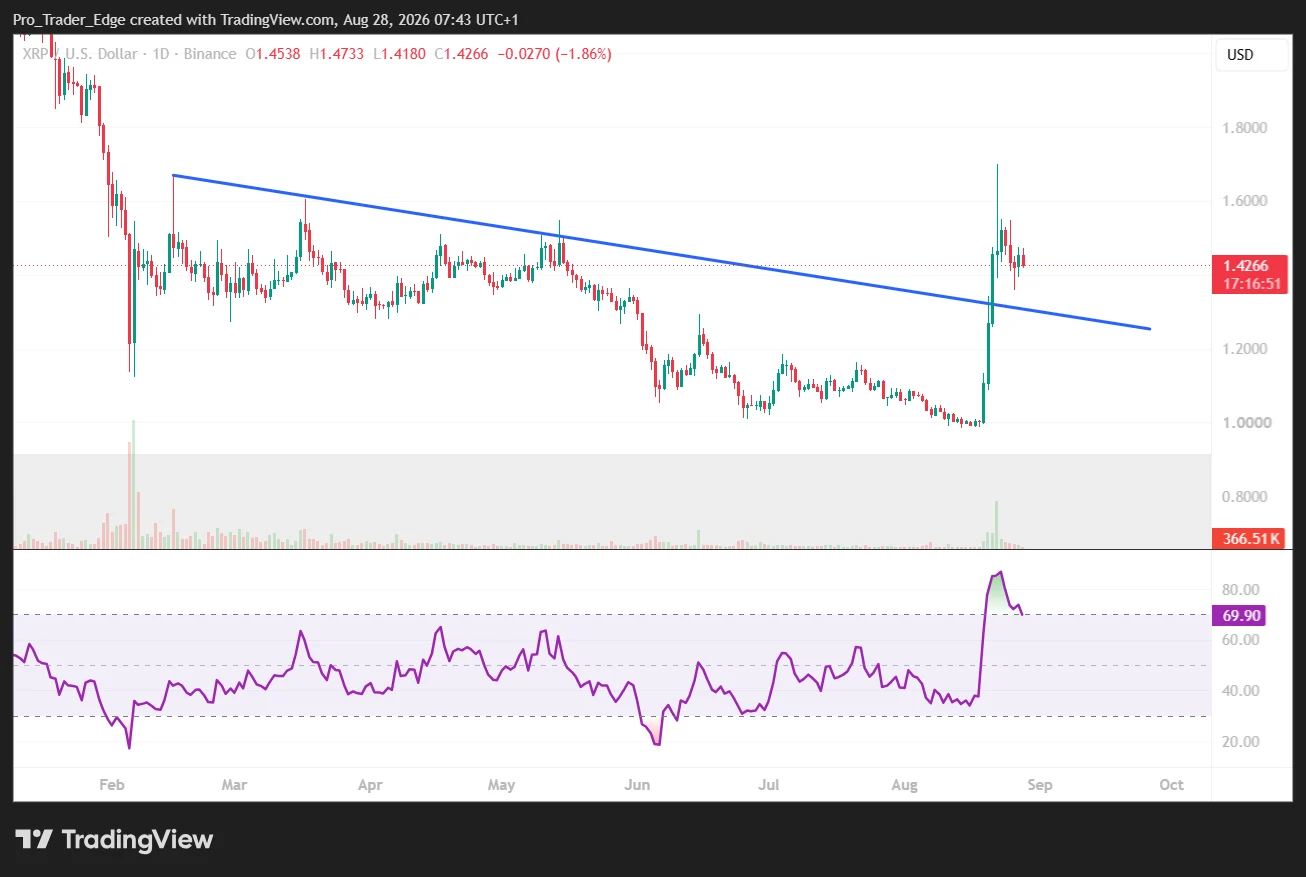
As of August 27, XRP traded at $1.4634. The Relative Strength Index registered 56.48, positioned above neutral territory without reaching overbought conditions. The Chaikin Money Flow indicator showed a reading of 0.04, marginally above the neutral threshold.
Immediate resistance emerges at $1.50. A successful breach of this barrier would expose $1.60 as the next objective, representing approximately 9.3% upside from current levels. One technical strategist has identified $1.80 as an extended target, with protective stops placed beneath the 200-day EMA.
Get 3 Free Stock Ebooks
Discover top-performing stocks in AI, Crypto, and Technology with expert analysis.
- Top 10 AI Stocks - Leading AI companies
- Top 10 Crypto Stocks - Blockchain leaders
- Top 10 Tech Stocks - Tech giants


