


Key Highlights
- Zcash rallied 23% to approximately $1,369 while Bitcoin and leading cryptocurrencies posted modest gains
- Federal Reserve implemented a 0.25% rate increase, with markets interpreting the move as a dovish signal
- Approximately 2.4 million ZEC tokens participated in the NU7 governance referendum, with 99.9% supporting 25-second block intervals
- Community members representing 98.9% of votes opted to maintain the Bitcoin-aligned halving mechanism
- Matt Huang from Paradigm disclosed his firm’s ZEC holdings and characterized the asset as “a private complement to Bitcoin”
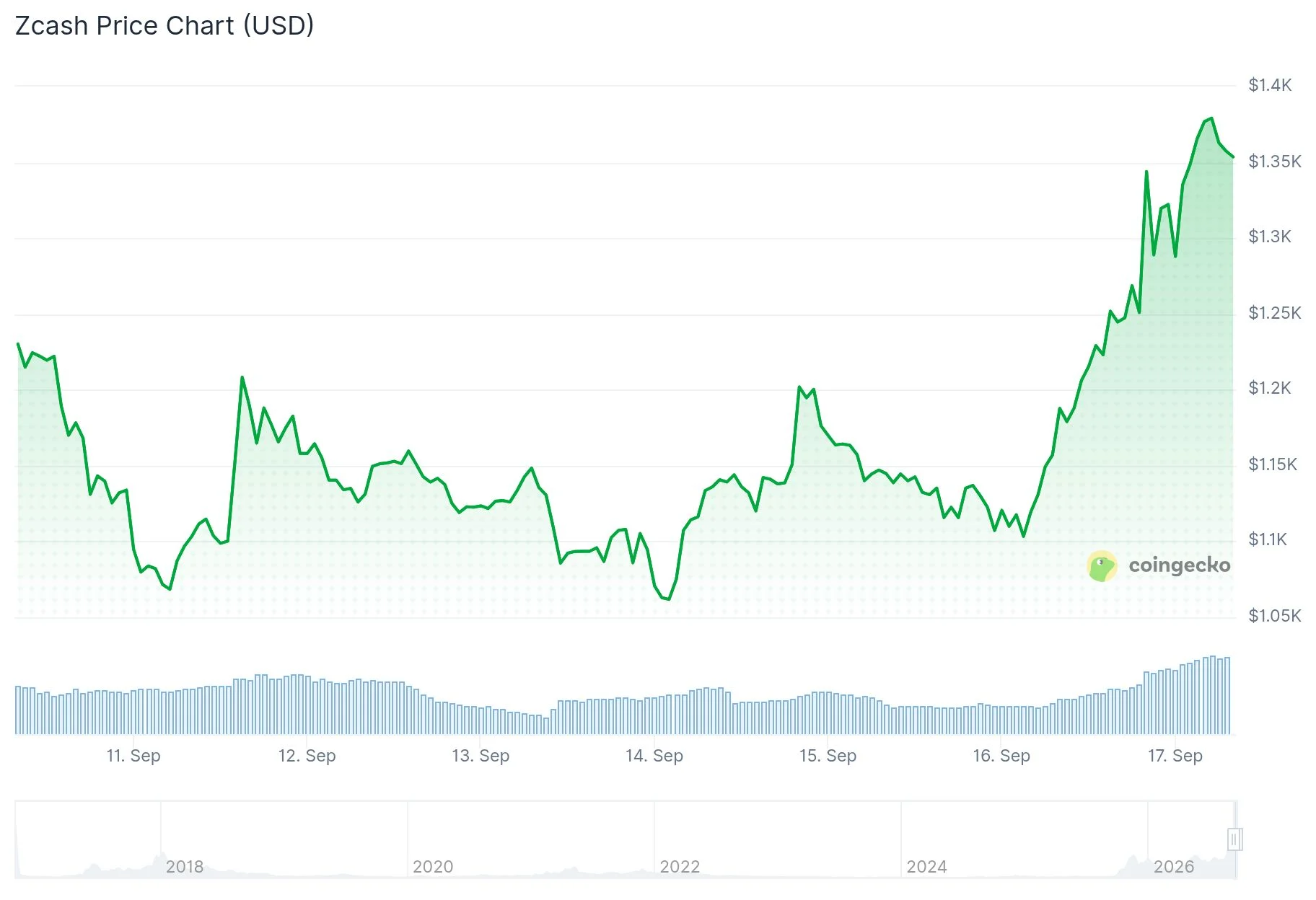
Zcash (ZEC) experienced a significant 23% price increase over a 24-hour window, reaching approximately $1,369 and outperforming the majority of digital assets. In comparison, Bitcoin registered a modest uptick of under 1% to settle around $76,258, while Solana climbed nearly 3% during the identical timeframe.
The cryptocurrency sector experienced upward momentum following the Federal Reserve’s decision to increase its benchmark interest rate by 25 basis points, elevating the range to 3.75%-4%. According to Jeff Ko, chief analyst at ViaBTC, the rate adjustment had been “largely priced in” by the market, and the central bank wasn’t signaling an intensified tightening campaign.
Federal Reserve projections indicated the policy rate would settle at 4.1% by the conclusion of 2026 and 2027, implying potentially only one additional increase during the current year. Following the announcement, S&P 500 futures climbed 0.6% while Nasdaq 100 futures advanced 0.7%.
The ZEC rally received additional momentum when Matt Huang, co-founder of Paradigm, revealed on X that his investment firm maintains ZEC positions. Huang characterized Zcash as “a private complement to Bitcoin” and expressed support for ongoing developer financing, while recommending that token-holder voting be integrated with alternative governance mechanisms.
Community Referendum Shows Overwhelming Consensus
The ZEC price surge also coincided with the completion of Zcash’s NU7 community governance referendum. Close to 2.4 million ZEC tokens took part from approximately 3.6 million qualifying tokens, significantly exceeding the 1 million ZEC minimum participation requirement.

Approximately 99.9% of voting ZEC tokens supported decreasing block generation time from 75 seconds to 25 seconds. Accelerated block production enables faster transaction finality and enhanced network efficiency.
Regarding monetary architecture, 98.9% of participants elected to preserve the Bitcoin-inspired halving mechanism. Mining incentives will continue declining at predetermined intervals instead of through gradual reduction.
Market analyst Crypto Patel highlighted a potential concern on X, observing that ZEC displayed bearish momentum divergence approaching the $1,300 all-time high resistance threshold. Patel pinpointed $800 as an initial support target and $500 as a substantial demand area, while indicating that a sustained break above $1,300 would negate the bearish scenario.
Hardware Wallet Development and Implementation Timeline
Zcash Labs revealed it secured financing to develop shielded pool functionality for Ledger hardware wallet devices. This integration would enable users to maintain ZEC holdings privately through conventional hardware wallet technology.
The NU7 referendum outcomes don’t automatically initiate a network modification. Ratified components require additional testing and development prior to mainnet activation.
CoinGecko observed on X that ZEC momentarily surpassed a $23 billion valuation following the referendum announcement, attributing the price movement directly to the governance decision and its Bitcoin-aligned halving framework.
The 99.3% of participants who supported expedited NU7 deployment also consented that components not finalized by September 30 could be postponed rather than delaying the comprehensive upgrade rollout.
Get 3 Free Stock Ebooks
Discover top-performing stocks in AI, Crypto, and Technology with expert analysis.
- Top 10 AI Stocks - Leading AI companies
- Top 10 Crypto Stocks - Blockchain leaders
- Top 10 Tech Stocks - Tech giants


