


Key Highlights
- Zakura has launched Zakura Common, a freely available cryptography toolkit for Zcash that slashes private transaction generation time from over 3 seconds to below 200 milliseconds
- Performance gains include mobile proof generation accelerated by more than 14x, while desktop systems see over 5x improvement
- Wallet providers can integrate the library instantly without requiring a network upgrade or protocol modification
- Following the release, ZEC experienced roughly 5% gains before retreating slightly amid broader market weakness on Monday
- The new cryptographic framework is already integrated in Zakura v1.3.0, with Vizor Wallet being an early adopter
The development team behind Zcash has introduced Zakura Common, a freely accessible cryptography framework aimed at dramatically accelerating private transaction processing on the Zcash blockchain.
In the past, anyone initiating a shielded transaction — which conceals sender identity, recipient information, and transfer amounts — faced delays exceeding three seconds as their wallet executed necessary cryptographic operations. The introduction of Zakura Common has reduced this latency to under 200 milliseconds in optimal conditions.
Zakura, the organization responsible for this innovation, operates a Zcash full node implementation that debuted in July 2025. The company is led by co-founder Sean Bowe, an established researcher in zero-knowledge cryptography who has contributed to Zcash’s proof systems since before the network’s initial launch.
The performance improvements are substantial: mobile devices now generate proofs more than 14 times faster than before. Desktop machines experience over a fivefold speed enhancement. Sinsemilla hashing operations, integral to Zcash’s Orchard protocol, have accelerated by a factor of 21. Meanwhile, zk-SNARK verification — the foundation of Zcash’s privacy architecture — operates four to eight times more efficiently.
“Shielded wallets that use Zakura Common, and full nodes like Zakura itself, all benefit,” Bowe stated in a social media post on X.
Implementation Details for Wallets and Users
This enhancement requires no modifications to the underlying Zcash protocol. Development teams working on wallet software can incorporate the open-source library immediately, eliminating the need to wait for a coordinated network update or hard fork.

The latest version, Zakura v1.3.0, comes pre-configured with the enhanced cryptographic components. Vizor Wallet has emerged as one of the initial third-party applications to implement the technology. Additional benefits include faster wallet synchronization times and improved efficiency for full nodes in validating transactions, which should reduce orphaned block occurrences.
Developers have verified that the software is already compatible with the proposed 25-second block intervals planned for Zcash’s upcoming major protocol enhancement, designated as NU7.
Market Performance and ZEC Price Movement
Market analyst seth_fin commented on X that ZEC was experiencing a “nice breakout after ETF news” and projected the token was “on its way to $1000,” highlighting the growing positive sentiment surrounding the cryptocurrency.
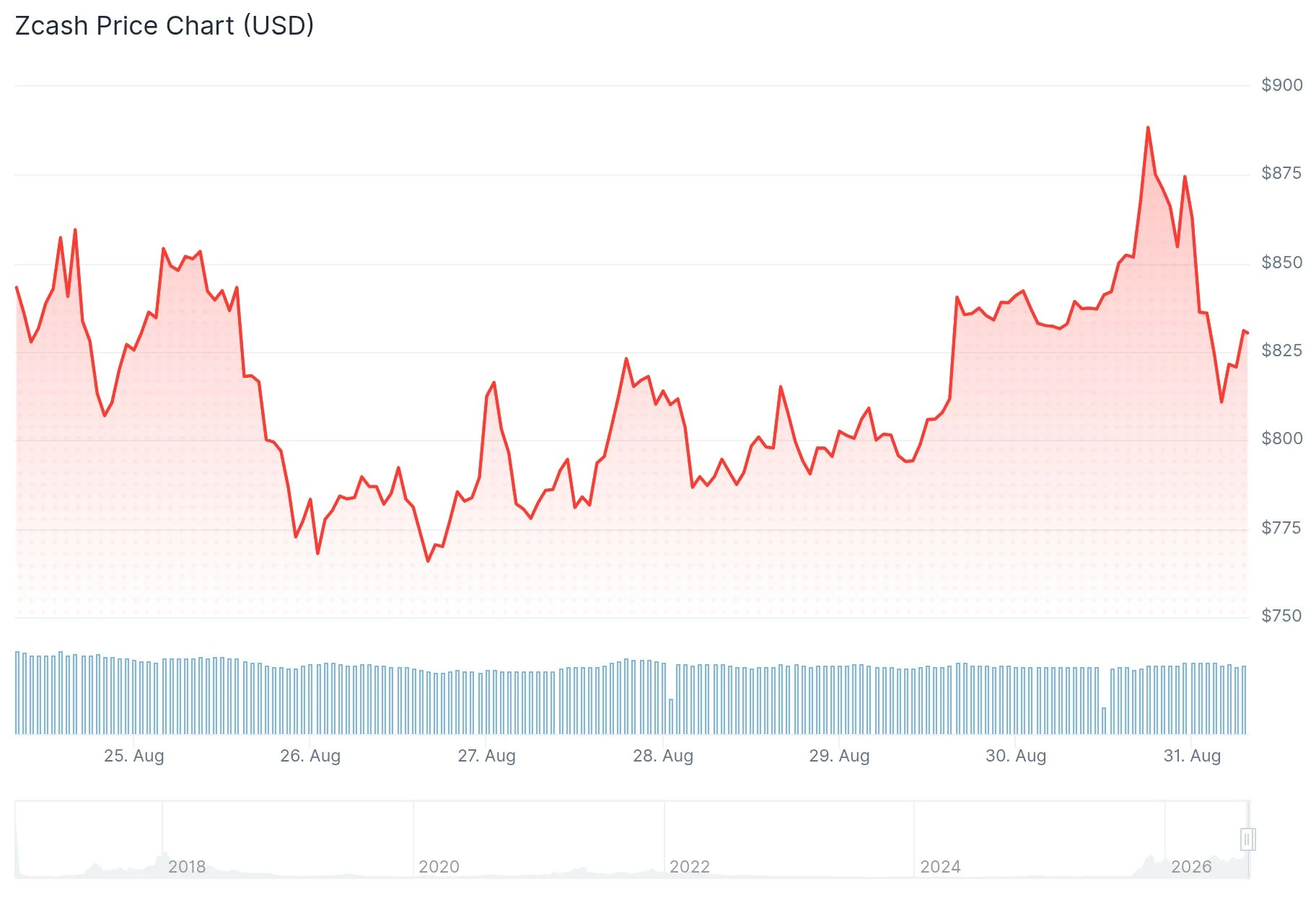
The ZEC token appreciated by approximately 5% to approach the $839 level after the Zakura Common announcement. The price retraced modestly on Monday morning as part of a wider cryptocurrency market correction.
The launch of Zakura Common represents one component of the broader Project Tachyon initiative, which targets scaling Zcash capacity to process more than 50,000 private transactions per second — performance levels comparable to leading payment card networks. This ambitious project has also transitioned to operating on the enhanced cryptographic infrastructure.
ZEC was trading around $839 when markets opened, reflecting approximately 5% daily gains prior to the Monday morning market downturn.
Get 3 Free Stock Ebooks
Discover top-performing stocks in AI, Crypto, and Technology with expert analysis.
- Top 10 AI Stocks - Leading AI companies
- Top 10 Crypto Stocks - Blockchain leaders
- Top 10 Tech Stocks - Tech giants


