


Most new crypto projects do not release all of their tokens on day one. Many start trading with only a small share of their total supply on the market.
The rest is often held back for founders, staff, early investors and community programs. These tokens are released later on a set schedule. Each release is called a token unlock.
Unlocks matter because they raise the number of tokens that could be sold. If demand does not keep up, the price can fall.
This article uses worked examples to show how unlocks change supply, market value and fully diluted valuation. All figures are hypothetical examples drawn from the source guides. They are not live market data.
Token Unlock Statistics at a Glance
| Example | Key figure |
|---|---|
| Tokens circulating at launch in a 1 billion token project | 150 million (15%) |
| Team allocation of 120 million vesting over 24 months | 5 million per month |
| AlphaToken unlock of 25 million on 100 million circulating | 25% supply increase |
| Unlock of 15 million on 200 million circulating | 7.5% supply increase |
| Token with 5% circulating and a $500 million market cap | $10 billion FDV |
| Early investor buying at $0.10, token later at $2 | 20x purchase price |
1. What Is a Crypto Token Unlock?
A token unlock happens when tokens that were locked become free to move, sell or use. The rules are usually set when a project launches or hands out tokens to investors and staff.
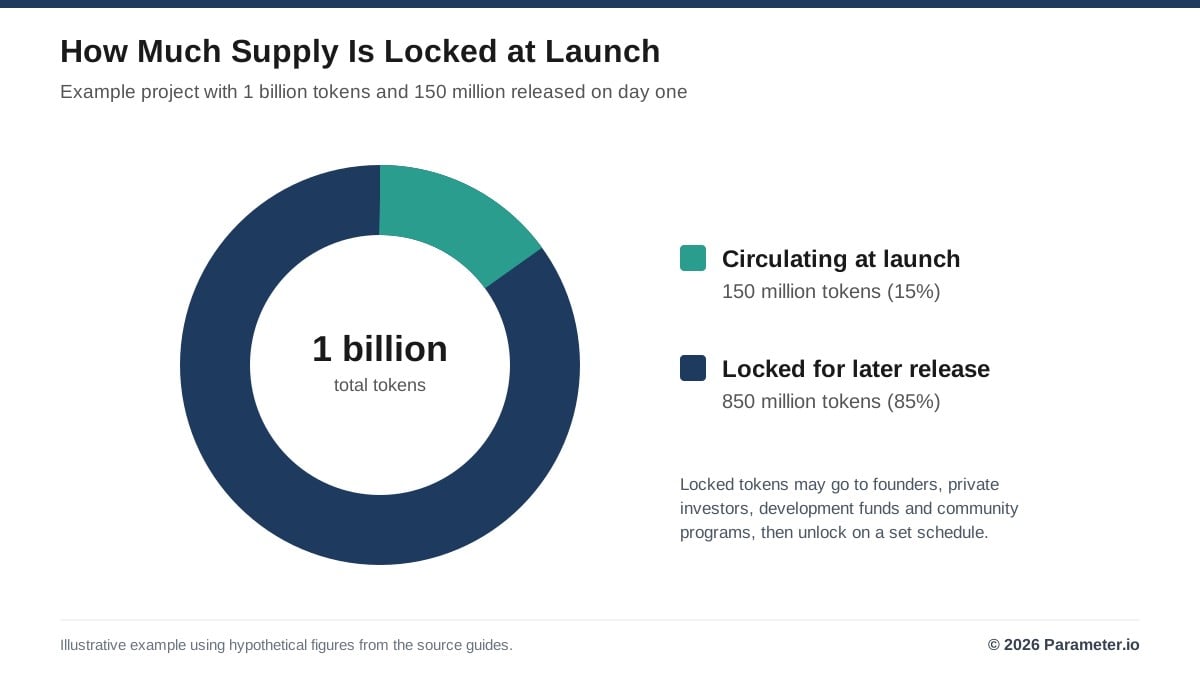
Take a project that creates 1 billion tokens. It might release only 150 million at launch. That is 15% of the supply.

The other 850 million, or 85%, could go to founders, private investors, a development fund and community programs. A schedule sets when each group gets access.
Binance Academy says lockups are often used to stop early backers from selling right away. They also aim to keep those backers committed for longer.
An unlock does not mean tokens are sold. Holders may keep them, stake them, move them to another wallet or use them inside the project.
This gap between tokens becoming available and tokens being sold is key. It explains why prices do not always move on an unlock date.
2. Why Crypto Projects Lock Tokens
Lockups have a few main goals. The first is to stop insiders from selling large amounts as soon as public trading starts.
Early investors often buy at much lower prices than the public. Without limits, they could sell right after launch and push the price down.
Lockups also try to tie the team’s rewards to the project’s future. A founder whose tokens vest over four years has a reason to stay involved. Still, a vesting plan does not promise the team will stay or that the project will succeed.
Projects also hold tokens back to pay for future work. These reserves can fund software development, grants, partnerships and community programs over several years.
Some projects use scheduled releases to reward validators, developers, liquidity providers or users. These rewards can boost activity. They can also attract people who only want to sell the rewards.
Lockups keep early supply small. That can limit selling at first, but it can also let a token reach a high value before demand is proven.
The source guide gives a simple case. A project has 100 million tokens circulating and 200 million more due over two years. If they are released evenly, supply triples.
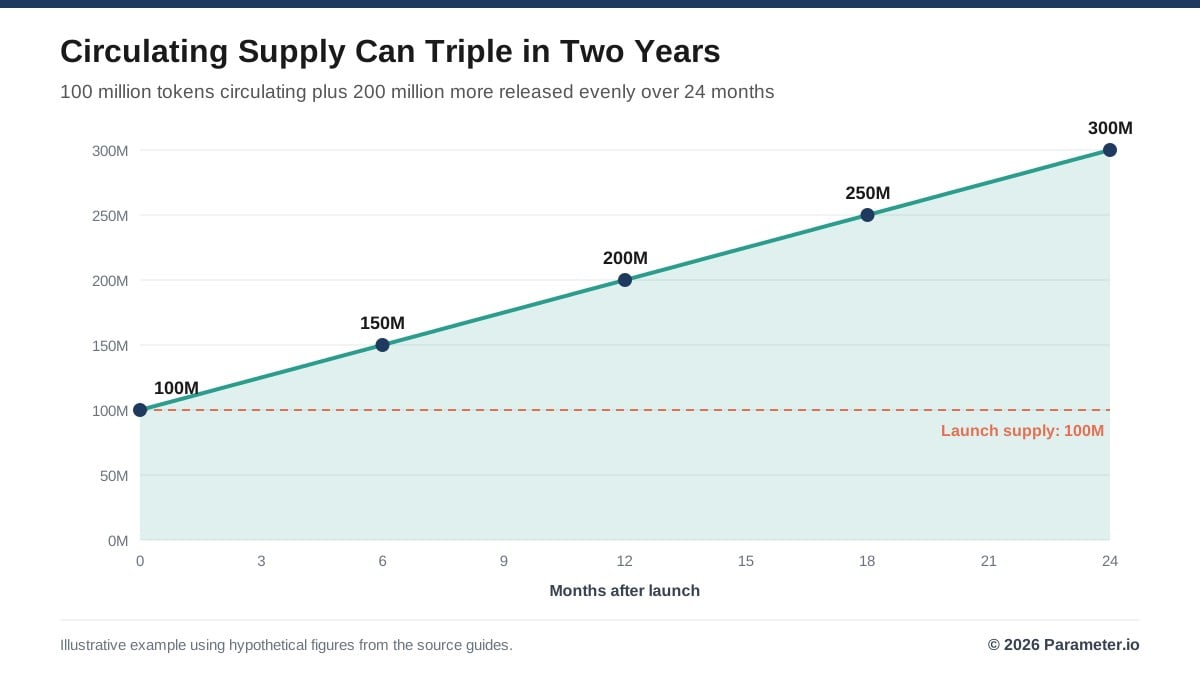
Even if the network gains users, holders in this case face heavy dilution. Each existing token would make up a smaller share of the total.
3. Cliff, Linear and Hybrid Vesting Schedules
A vesting schedule sets when people who receive tokens can access them. The two most common types are cliff unlocks and linear vesting. Many projects mix both.
The type matters because each one creates a different pattern of possible selling.
Cliff unlocks
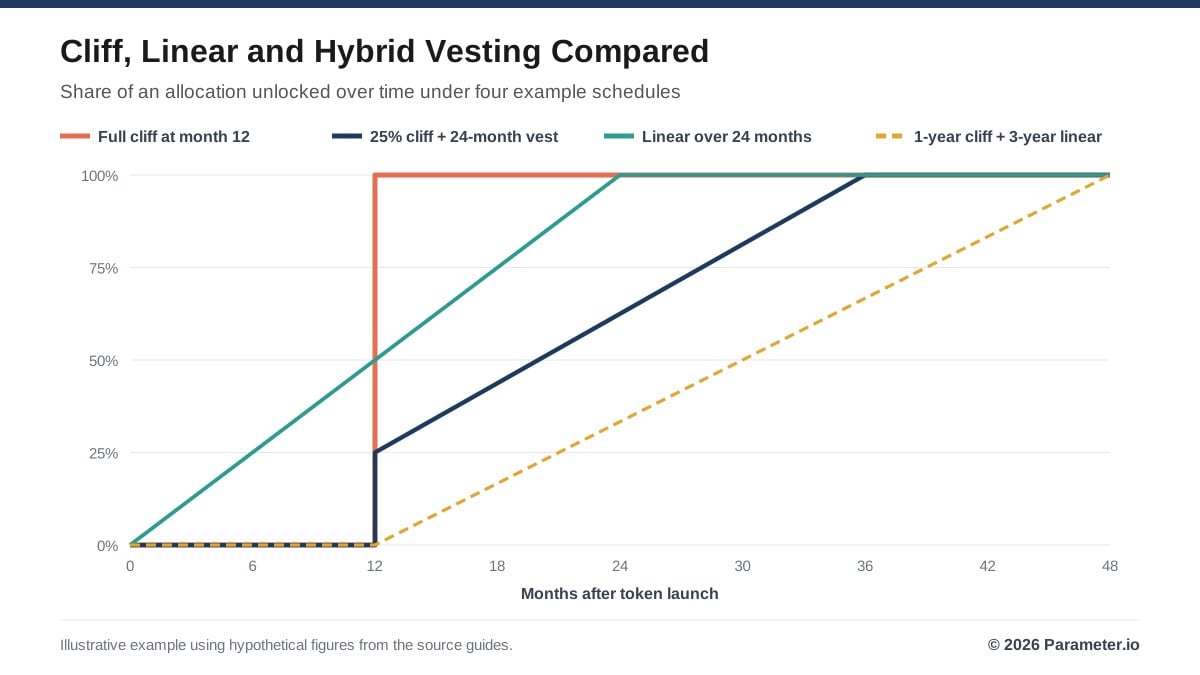
With a cliff unlock, tokens become available after a waiting period. In one example, early investors hold 100 million tokens that cannot move for 12 months.
At the 12-month mark, 25 million tokens unlock. The other 75 million then vest over the next two years. In some deals, the whole allocation unlocks at once when the cliff ends.
Large cliffs deserve close attention. A big block of tokens can become tradable on the same day.
Linear unlocks
Linear vesting releases tokens in small, even steps. If a team gets 120 million tokens that vest over 24 months, about 5 million unlock each month.
Releases can also happen daily or in a continuous stream. Each step is small, but the total added supply can still be large.
Hybrid schedules
A hybrid plan starts with a cliff and then moves to linear vesting. For example, an investor’s tokens might stay locked for one year and then unlock evenly over three years.
Tokenomist, a site that tracks token supply, separates cliff unlocks, linear releases and other types of issuance. The table below sums up the main types.
| Unlock type | How it works | What to watch |
|---|---|---|
| Cliff unlock | Tokens released at a set date or milestone | Selling pressure on one date |
| Linear unlock | Tokens released in small, even steps | Steady supply growth |
| Hybrid vesting | A waiting period, then gradual releases | Cliff timing and total dilution |
| Ecosystem emissions | Tokens paid out as rewards or incentives | Whether new demand offsets supply |
| Treasury releases | Tokens become available for project use | How and when the treasury sells |
No schedule guarantees a stable price. The result depends on how many tokens unlock, who gets them, market liquidity and what investors expect.
4. How Token Unlocks Affect Crypto Prices
Prices respond to supply, demand and expectations. When locked tokens are freed, the number of tokens that could be sold goes up.
If holders sell and buyers do not take up the extra supply, the price may fall. But this outcome is not automatic.
Consider a token with 100 million in circulation and an unlock of 20 million. That is a possible 20% jump in circulating supply.
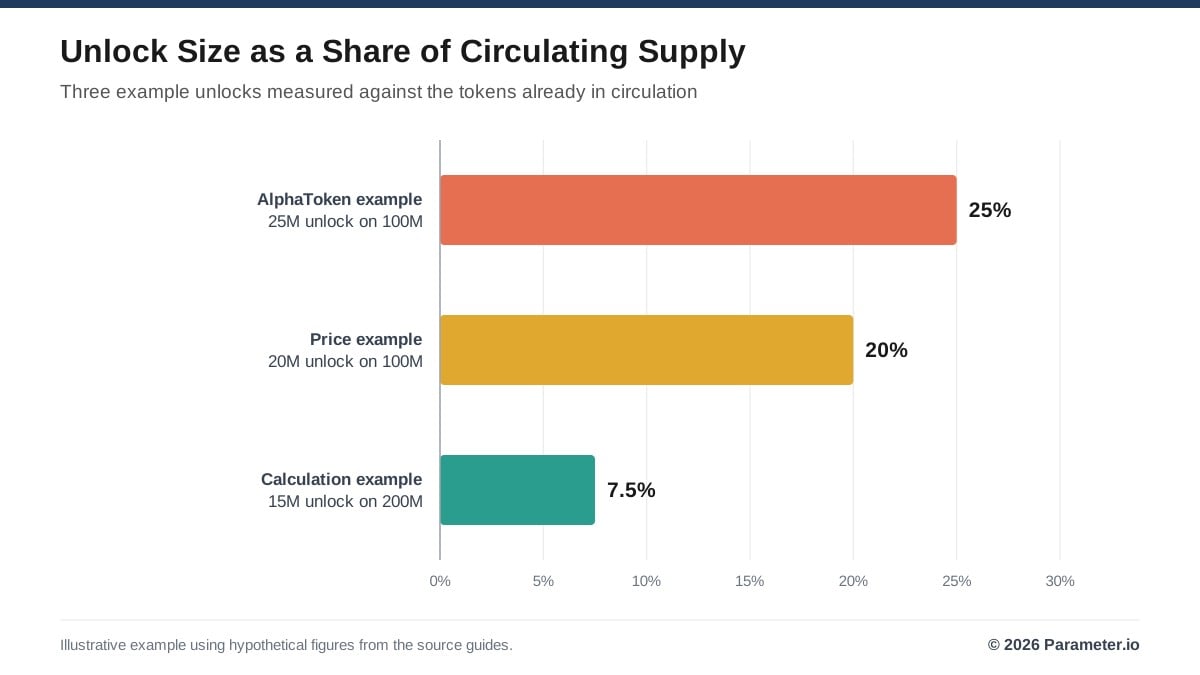
A token with deep liquidity and strong demand can take in that supply more easily than a small token with thin trading.
Timing also matters. Unlocks are usually announced ahead of time, so some traders sell early. Others wait for a dip before buying. The price effect can show up before the unlock date.
Who receives the tokens counts too. An early investor who bought very cheaply may act differently from a developer paid in tokens or a foundation funding growth.
The wider market can outweigh any single unlock. In a strong market, buyers may absorb extra tokens with little effect. In a weak market, even a small unlock can add to selling.
The main question is not how many tokens unlock. It is whether demand is large enough to absorb any selling that follows.
5. Worked Example: The AlphaToken Unlock
The source guide uses a made-up token called AlphaToken to show the math. Here are its numbers before an unlock.
| Metric | Before unlock |
|---|---|
| Token price | $2 |
| Circulating supply | 100 million |
| Circulating market cap | $200 million |
| Maximum supply | 500 million |
| Fully diluted valuation | $1 billion |
| Upcoming unlock | 25 million |
| Unlock as a share of circulating supply | 25% |
If all 25 million unlocked tokens count as circulating, supply rises to 125 million.
In Scenario A, demand holds up. The network keeps adding users and many holders keep their new tokens. The price stays near $2, so market cap rises to $250 million.
In Scenario B, early investors sell. The price falls 20% to $1.60. Market cap works out to 125 million times $1.60, or $200 million.
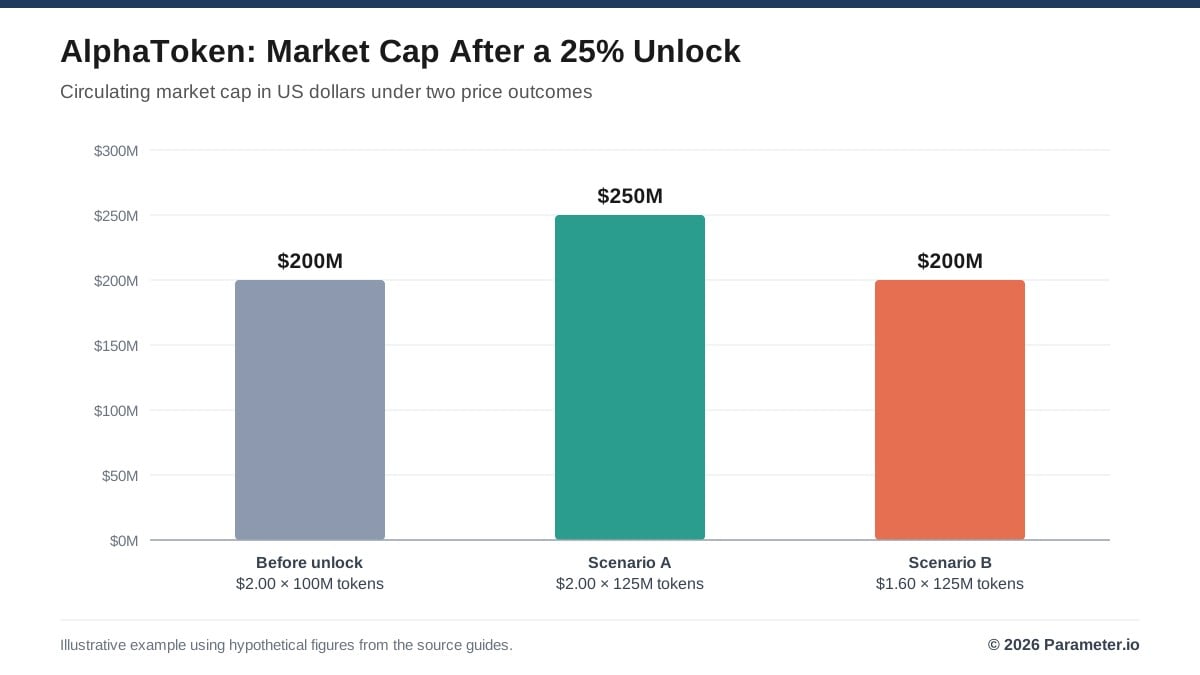
| Scenario | Price | Circulating supply | Market cap |
|---|---|---|---|
| Before unlock | $2.00 | 100 million | $200 million |
| A: demand absorbs the unlock | $2.00 | 125 million | $250 million |
| B: selling pushes price down 20% | $1.60 | 125 million | $200 million |
In Scenario B, supply grew 25% but market cap did not change. The lower price offset the extra tokens.
The 20% drop is only an example. It is not a fixed result of the unlock.
In Scenario C, the unlock lands during a wider market slump. Thin trading could deepen the fall, but it would be hard to tell how much came from the unlock alone.
6. Circulating, Total and Maximum Supply
Three supply numbers are needed to study unlocks.
Circulating supply is the number of tokens counted as available on the market. It is used to work out market cap.
Market cap equals token price times circulating supply. A token at $5 with 100 million in circulation has a market cap of $500 million.
Total supply is the number of tokens created so far, minus any that were burned. It can include tokens that are still locked.
Maximum supply is the most tokens that can ever exist under a project’s rules, if it has a cap. Some tokens have a fixed cap. Others keep issuing new tokens.
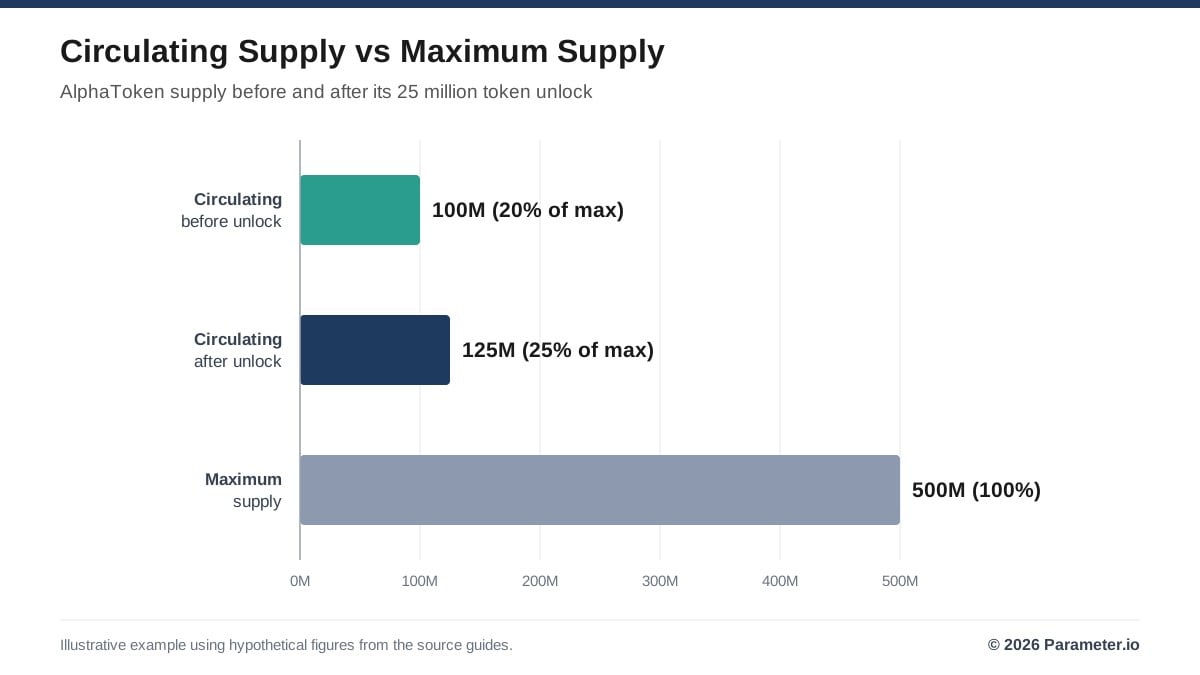
AlphaToken shows why this matters. Even after its unlock, only 25% of its maximum supply would be in circulation. Another 375 million tokens could still arrive later.
CoinGecko notes that the gap between these three numbers can point to future token inflation. But circulating supply is not measured the same way everywhere.
Data sites may treat treasury tokens, staked tokens and other restricted tokens in different ways. An unlocked token is not always counted as circulating right away.
7. Why Fully Diluted Valuation Matters
Fully diluted valuation, or FDV, estimates what a token would be worth if its full supply were valued at today’s price.
FDV equals token price times fully diluted supply. Some data sites use total supply and others use maximum supply, so it is worth checking which one is used.
The table compares two made-up tokens.
| Metric | Crypto A | Crypto B |
|---|---|---|
| Token price | $1 | $1 |
| Circulating supply | 100 million | 800 million |
| Maximum supply | 1 billion | 1 billion |
| Market cap | $100 million | $800 million |
| FDV | $1 billion | $1 billion |
| Share circulating | 10% | 80% |
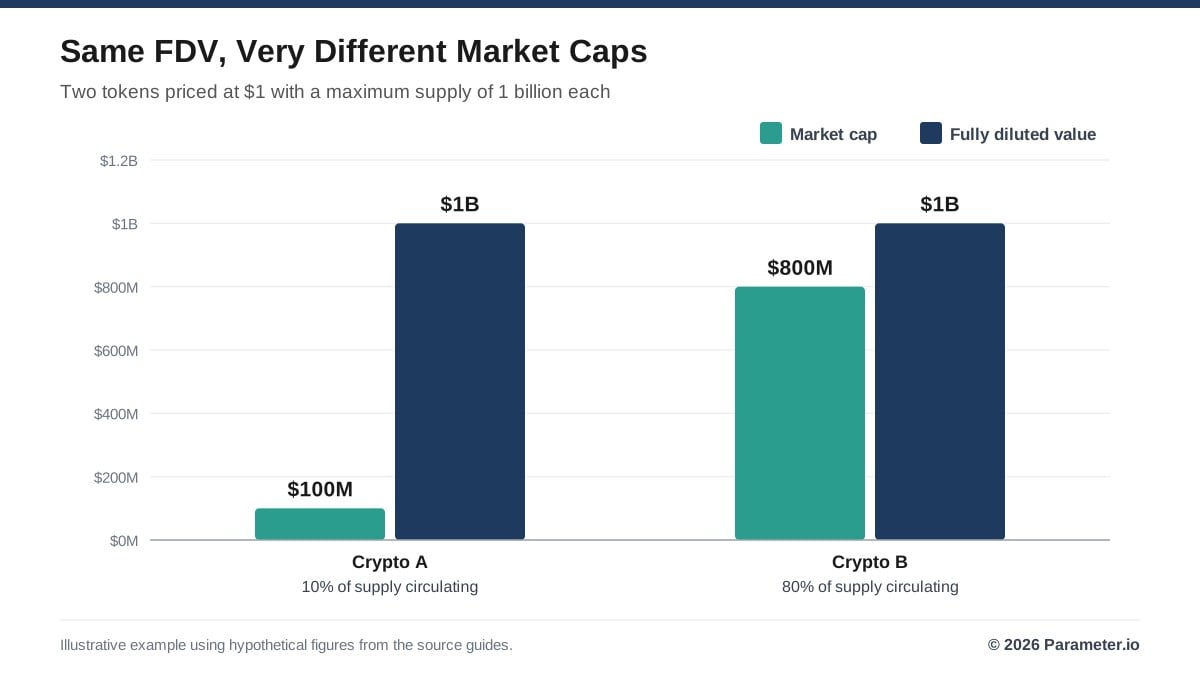
Crypto A looks much smaller by market cap. Yet both tokens have the same FDV of $1 billion.
Crypto A has 900 million tokens still to come, compared with 200 million for Crypto B. That means far more possible supply growth.
This does not make Crypto B the better buy. Crypto A could have better technology or faster growth. Investors should ask whether demand can grow fast enough to match the new supply.
CoinGecko describes FDV as a theoretical value. It is not a forecast of future market cap.
8. Low-Float, High-FDV Tokens
A low-float token has only a small share of its supply available to trade. When its price is high, its FDV can be very large.
Say a project launches with 5% of its maximum supply in circulation. Speculation pushes its market cap to $500 million. Its FDV would then be $10 billion, or 20 times its market cap.
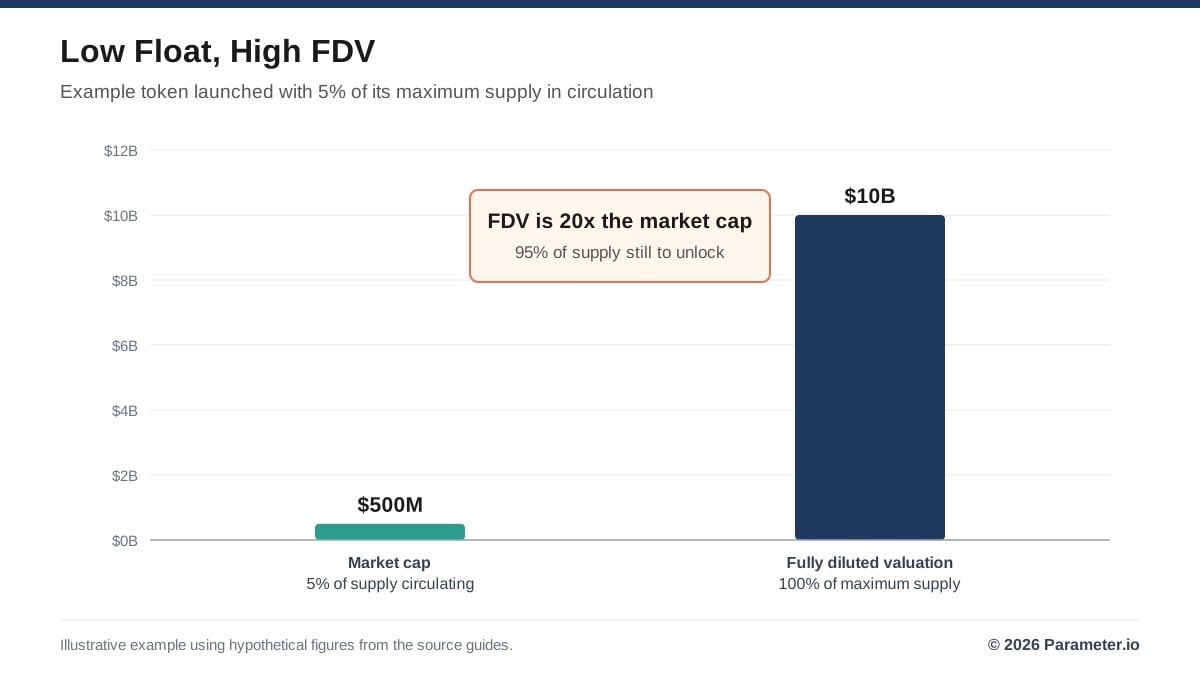
The project could carry a large paper value before showing real use. As more tokens unlock, the market must absorb them.
Small floats can make prices swing hard. A limited number of tokens can let the price climb fast during hype. That price can be hard to hold when large insider blocks unlock.
The risk grows when early investors paid far less than public buyers. They may still make a profit even after the public price falls sharply.
A low float alone does not prove a token is overpriced. Its fundamentals, activity and supply schedule all need to be checked together.
9. How to Measure an Upcoming Unlock
A simple formula shows the size of an unlock: tokens unlocking divided by current circulating supply, times 100.
Say a token has 200 million in circulation and 15 million are set to unlock. The result is 15 divided by 200, times 100, or 7.5%.
This is useful context. It does not mean the price will fall 7.5%.
A second check compares the unlock’s dollar value with trading volume. If the 15 million tokens trade at $2, the unlock is worth $30 million. If the token trades $10 million a day, the unlock equals three days of reported volume.
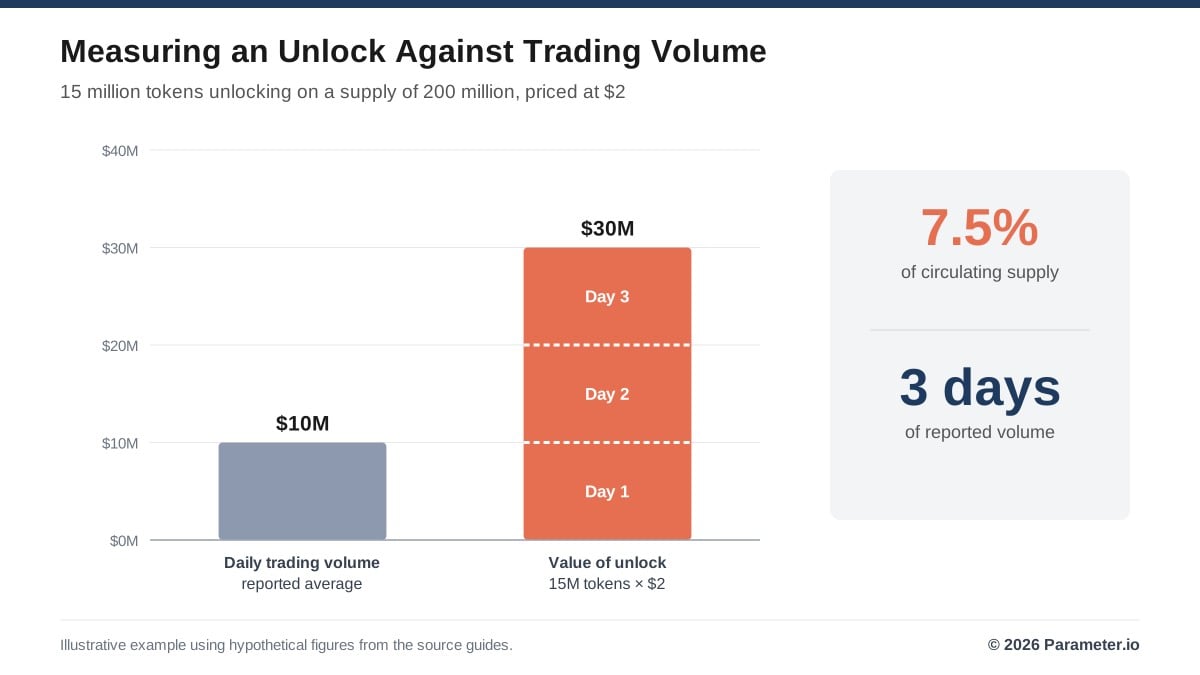
Volume is not the same as buying demand. It counts trades in both directions, can include the same tokens traded many times and can be inflated by fake activity. Order-book depth and market-maker activity can tell investors more.
| Measure | Formula or method | Example result |
|---|---|---|
| Unlock vs circulating supply | Unlocking tokens ÷ circulating supply × 100 | 7.5% |
| Unlock vs liquidity | Unlock value ÷ daily volume, plus order-book depth | 3 days of volume |
| Likely selling | Who receives the tokens and what they paid | Hardest to estimate |
Several sites track upcoming unlocks. Tokenomist lists release dates, allocation groups and the size of each unlock. It notes that some dates are estimates rather than confirmed.
CoinGecko shows circulating, total and maximum supply alongside FDV. Binance also publishes unlock schedules, and in February 2025 it changed its token data method to include more unlock information.
A project’s own whitepaper and governance posts explain the original plan. Schedules can change after votes or contract changes, so it helps to compare official documents with independent data.
10. Which Unlocks Are Most Likely to Move Prices?
Not every unlock carries the same weight. Size, recipients and the chance that tokens will be sold all matter.
Venture capital funds and private investors often buy before public trading. Their entry price may be far lower than what later buyers pay.
In one example, a fund buys at $0.10 and the token later trades at $2. That is 20 times the purchase price, a paper gain of 1,900% before costs.
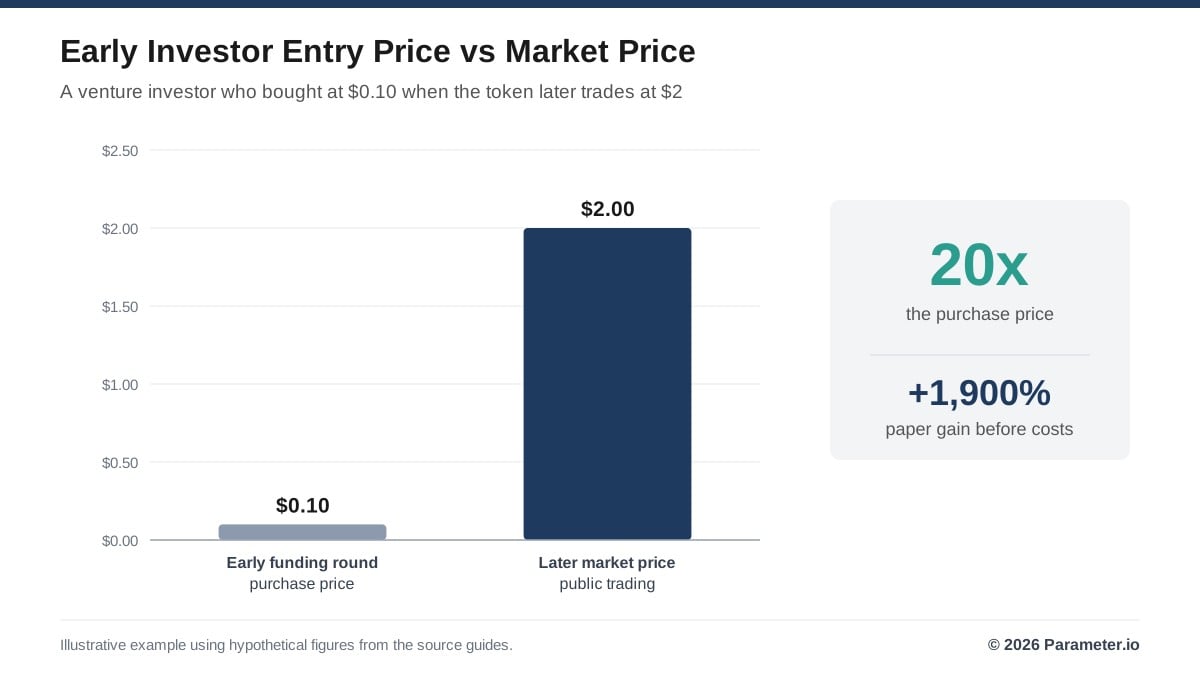
An unlock gives that investor a chance to take profit. It does not prove they will sell at once. Some funds hold for longer or hedge their positions.
| Recipient | Why they get tokens | Main risk |
|---|---|---|
| Venture and private investors | Early funding at low prices | Profit-taking after the cliff |
| Founders and team | Pay and long-term incentives | Selling by people with wealth tied up in the token |
| Ecosystem and community | Grants, staking and usage rewards | Rewards sold quickly if demand is weak |
| Project treasury | Funding for development and marketing | Ongoing sales to cover running costs |
11. Token Unlocks vs Token Burns
Unlocks and burns move supply in opposite directions. An unlock frees tokens that were locked. A burn removes tokens for good.
Some projects burn tokens to cut supply or offset new issuance. A blockchain might pay new tokens to validators while burning part of its fees.
Say a token releases 10 million tokens in a year and burns 5 million in the same year. The net change could be about 5 million, half the gross figure.
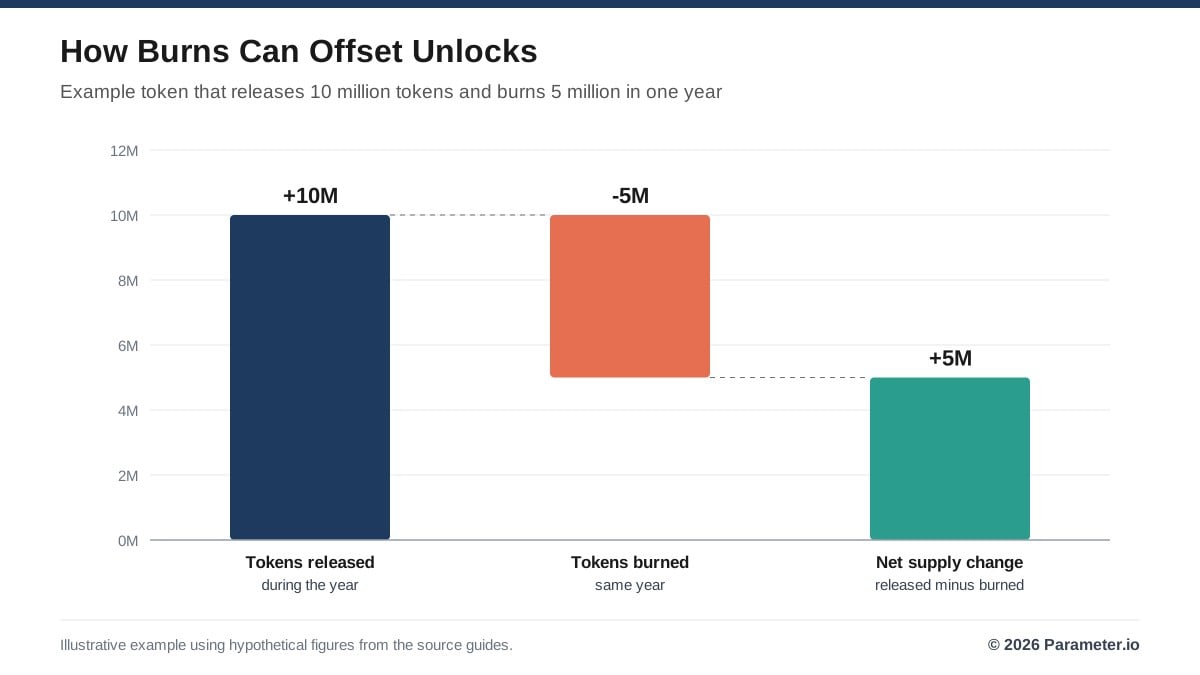
The exact math depends on whether the unlocked tokens were already in total supply and whether the burns hit circulating tokens.
Investors should keep three numbers apart: gross unlocks, new issuance and the net change in circulating supply. A token with large unlocks can still have modest net growth.
A token with no vesting schedule can still inflate through new issuance. Bitcoin has no founder or investor vesting, but new coins enter circulation through mining. That issuance is cut at each halving until the maximum supply is reached.
12. Can Token Unlocks Cause a Crash?
Large unlocks can add to steep price drops, mainly in thin markets. But saying unlocks always cause crashes would be wrong.
Three things usually need to happen together. The release must be large compared with market liquidity. Holders must sell a large share. Buyers must be unable to absorb the extra supply at current prices.
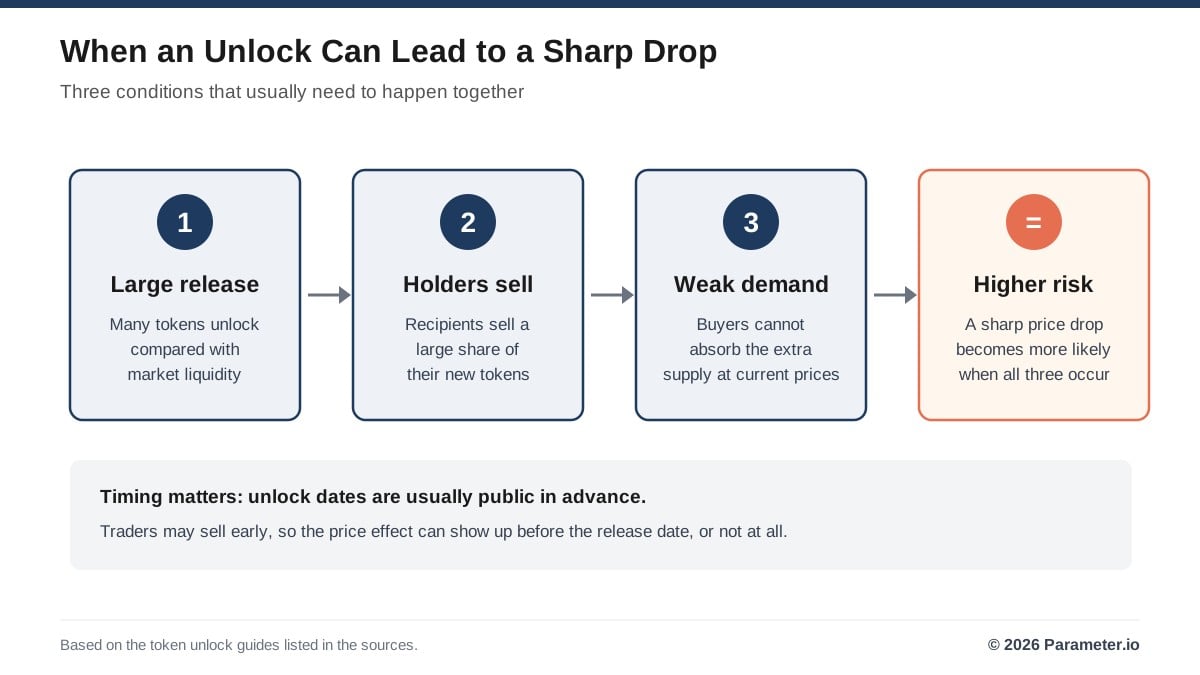
A well-known unlock may already be priced in. Traders may sell weeks ahead, and the price may steady or even rise on the day if selling is lighter than expected.
Trading around unlocks is hard. Selling ahead may not work if everyone expects the same thing. Buying after a drop does not mean a token is cheap, since more releases or weak demand can lead to further losses.
Short selling carries more risk. Leverage, funding costs and sudden reversals can cause large losses, especially when an unlock is widely expected.
For most long-term investors, unlock data works best as a risk tool rather than a trading signal.
13. Red Flags and a Checklist Before Investing
Some warning signs point to higher supply risk. No single one proves a token is a poor investment. Several together call for closer research.
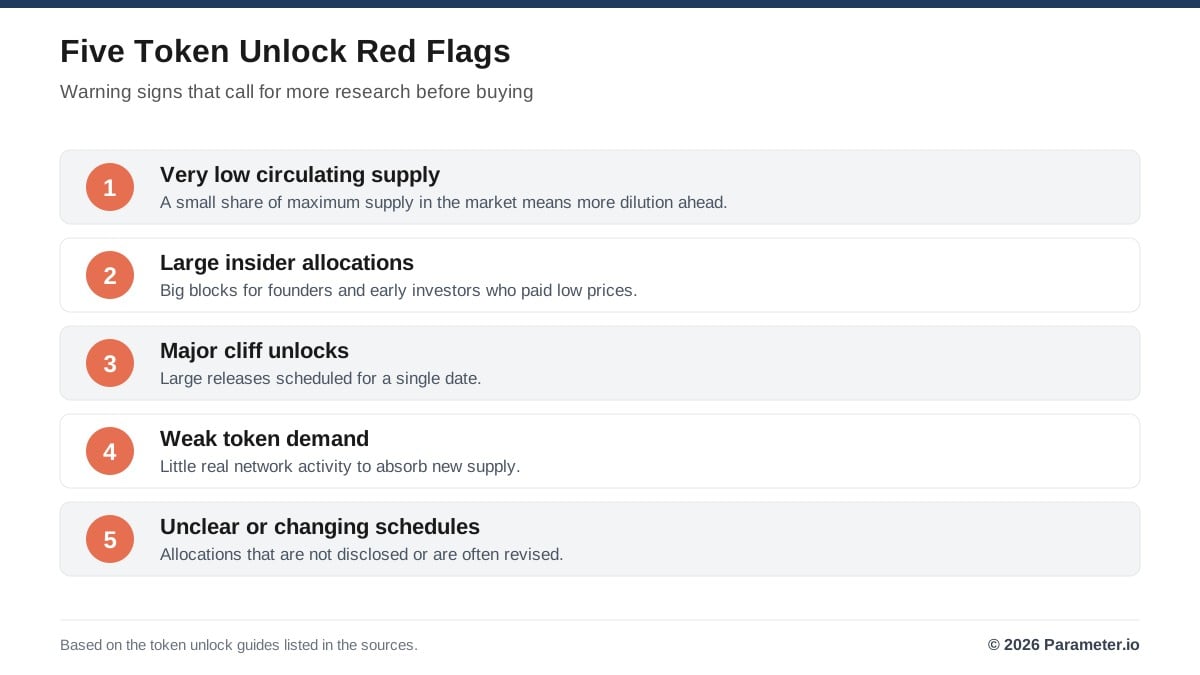
Very low circulating supply means more dilution may lie ahead. Large insider allocations can lead to concentrated selling, mainly when insiders paid low prices.
Major cliff unlocks bunch supply onto single dates. Weak demand leaves the market less able to absorb new tokens. Unclear or changing schedules add uncertainty about who controls future releases.
The checklist below sums up the main questions to ask.
| Question | Why it matters |
|---|---|
| When is the next unlock? | Shows the timing of supply changes |
| How many tokens will unlock? | Sets the size of the release |
| What share of circulating supply is it? | Measures relative supply exposure |
| Who receives the tokens? | Helps judge selling incentives |
| What did they pay? | Gives context for profit-taking |
| How liquid is the token? | Shows if the market can absorb selling |
| What releases follow? | Shows whether dilution is short-term or ongoing |
| What is the FDV? | Puts today’s value in a full-supply context |
| Is adoption growing? | Shows whether demand could offset new supply |
| Can the schedule change? | Flags governance and disclosure risks |
It helps to look at the next 12 months of supply changes, not just the next event. A small unlock next month could be followed by much larger releases the quarter after.
Demand matters just as much. A token with growing users, fees and activity is better placed to absorb new supply than one with falling use.
Final Thoughts
Token unlocks are a key part of how crypto supply changes over time. A project can have solid technology and growing use while still exposing holders to heavy dilution.
Unlocks do not predict falling prices on their own. Their effect depends on expectations, who receives the tokens, liquidity and demand.
The gap between market cap and FDV is one of the clearest signals to check. The useful question is whether a project’s demand can keep pace with its growing token supply.
Sources
- Binance Academy: Token Lockup
- CoinGecko: What Is Circulating Supply and Why It Matters?
- Tokenomist: Cliff, Linear and Emission
- CoinGecko: What Is Fully Diluted Valuation (FDV) in Crypto?
- Tokenomist: Supply Metrics
- Binance Academy: What Is Tokenomics and Why Does It Matter?
- Tokenomist: Token Unlock Tracker
- Binance: Token Unlock Schedule
This article is for information only and is not financial or investment advice. Crypto assets are speculative and can lose some or all of their value.
Get 3 Free Stock Ebooks
Discover top-performing stocks in AI, Crypto, and Technology with expert analysis.
- Top 10 AI Stocks - Leading AI companies
- Top 10 Crypto Stocks - Blockchain leaders
- Top 10 Tech Stocks - Tech giants


