


Crypto markets have made some early buyers rich. They have also cost many later buyers a great deal of money.
A big reason is fear of missing out, or FOMO. It is the urge to buy because prices are rising and other people seem to be making money.
Research shows this is more than a feeling. A study by the Bank for International Settlements (BIS) found that rising Bitcoin prices were followed by more people using crypto trading apps.
The same study estimated that 73% to 81% of retail investors likely lost money on their first Bitcoin purchase. Retail investors are everyday people investing their own money, not large firms.
This article looks at the numbers behind crypto FOMO. It covers who buys, when they buy, what it can cost and what the data says about avoiding the trap.
| Statistic | Figure | Source |
|---|---|---|
| Countries covered in the BIS crypto app study | 95 | BIS |
| Period covered by the study | 2015 to 2022 | BIS |
| New crypto app users who were men under 35 | About 40% | BIS |
| Retail investors estimated to have lost money on their first Bitcoin buy | 73% to 81% | BIS |
| Young investors who put in more than planned because of FOMO | 51% | FCA |
| Young investors who make investment decisions in under 24 hours | About two in three | FCA |
| Hours per week that crypto markets are open | 168 | Market hours |
What Is Crypto FOMO?
Crypto FOMO is the fear of missing gains from a coin that is rising fast. It happens when someone buys because others seem to be profiting, not because they have studied the asset.

Here is a simple example. A little-known token trades at $0.50, and an investor ignores it because they know nothing about it.
A few weeks later, the token reaches $2. Social media posts grow more excited, and popular crypto accounts predict more gains.
The investor now buys without doing any research. They are afraid the price will keep climbing without them.
The UK Financial Conduct Authority (FCA) warns that hype can lead people to overlook risk. Its guidance, updated in January 2026, names social media, investment promotions and a sense of scarcity as things that can make FOMO stronger.
FOMO does not only affect beginners. Experienced traders can feel it too, especially after they have missed an earlier rally.
The key sign is not simply buying something that has gone up. It is letting the fear of missing more gains replace a careful plan.
Markets That Never Close
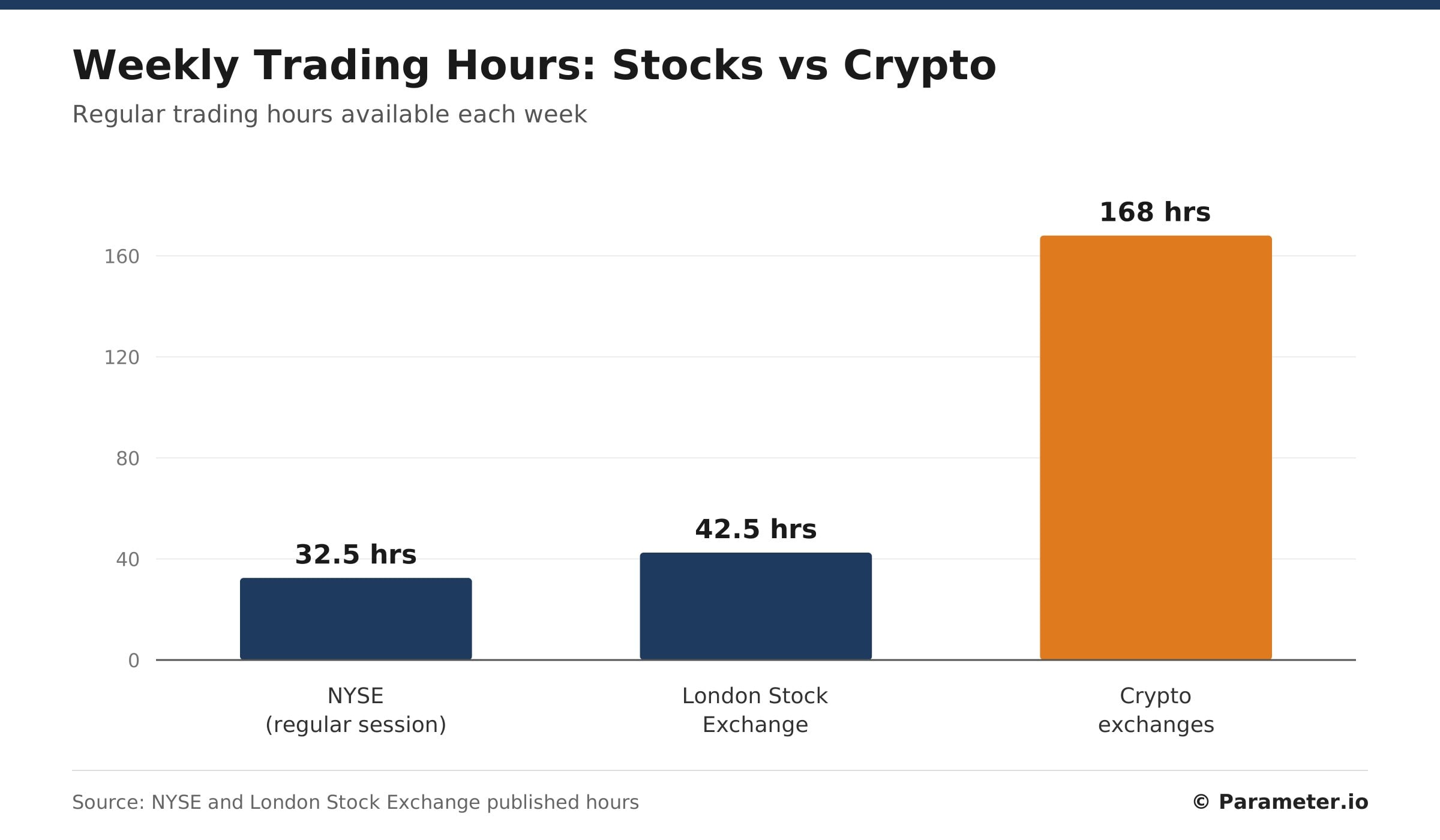
Crypto trades around the clock. Stock markets do not.
The New York Stock Exchange runs a regular session of 6.5 hours each weekday, or 32.5 hours a week. The London Stock Exchange runs about 8.5 hours a day, or 42.5 hours a week.
Crypto exchanges stay open 24 hours a day, seven days a week, including holidays. That adds up to 168 hours a week, about five times the regular trading time on the New York Stock Exchange.
Prices can move sharply while people sleep or work. This constant activity can create a feeling that chances are always slipping away.
What Drives the Feeling
Fear of regret. Investors picture how bad they would feel if a coin soared after they chose not to buy. That imagined regret can feel stronger than the risk of losing money.
Social comparison. When friends or online personalities talk about big profits, people may feel they are falling behind. This can push them to buy even when the investment does not fit their goals.
Perceived scarcity. Crypto promotions often stress limited supply or early access. Bitcoin does have a fixed maximum supply, but scarcity alone does not prove value.
An asset can be rare and still have little lasting demand. The FCA advises investors to question any message that says they must act now or miss out.
Who Buys and When: What the BIS Study Found
The Bank for International Settlements is an international body owned by central banks. In one major study, its researchers tracked crypto exchange app use across 95 countries from 2015 to 2022.
They found a clear pattern. When Bitcoin prices went up, more people downloaded and started using crypto trading apps.
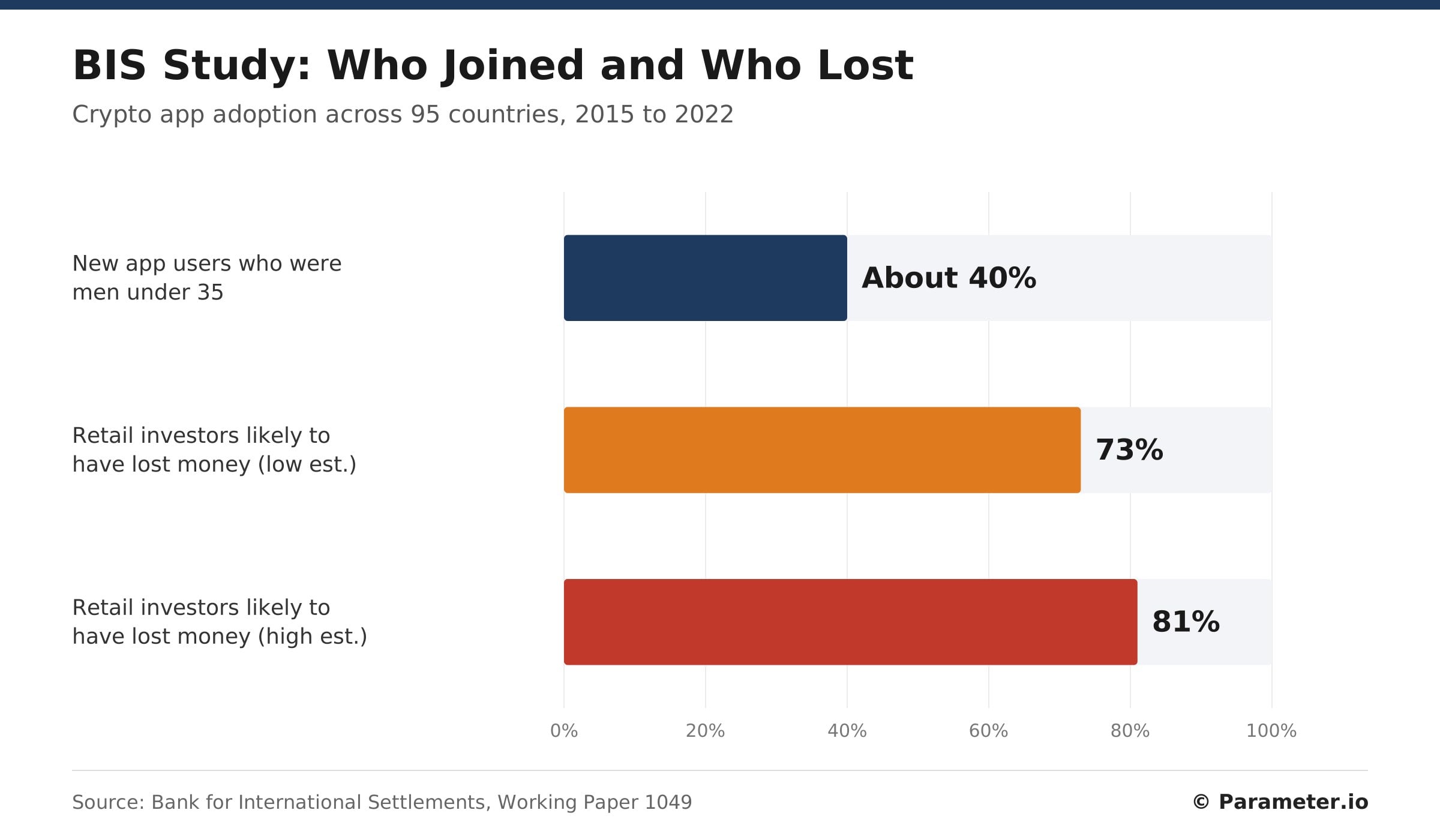
About 40% of the new users in the study period were men under 35. That group made up a large share of the people drawn in by rising prices.
The researchers also estimated that between 73% and 81% of retail investors had likely lost money on their first Bitcoin purchase. This figure comes from the study’s modeling, not from checking each investor’s actual returns.
Even so, the results point in one direction. Many everyday investors entered the market after prices had already climbed a long way.
| Study detail | Finding |
|---|---|
| Publisher | Bank for International Settlements |
| Data used | Crypto exchange app usage |
| Countries covered | 95 |
| Time period | 2015 to 2022 |
| Effect of rising Bitcoin prices | Followed by more app adoption |
| Share of new users who were men under 35 | About 40% |
| Estimated share losing money on first Bitcoin buy | 73% to 81% |
Retail Buyers During Market Shocks
A BIS bulletin published in February 2023 looked at two major crashes. The first was the collapse of the Terra and Luna tokens in May 2022. The second was the bankruptcy of the FTX exchange in November 2022.
The researchers found that smaller retail investors often bought crypto while larger, more experienced investors were selling. The two groups were frequently on opposite sides of the market.
This helps explain why people in the same market can have very different results. Timing and entry price matter a great deal.
Why Entry Price Matters So Much
People who buy after a big price rise have less room for error. Prices have to keep climbing just for them to make a profit.
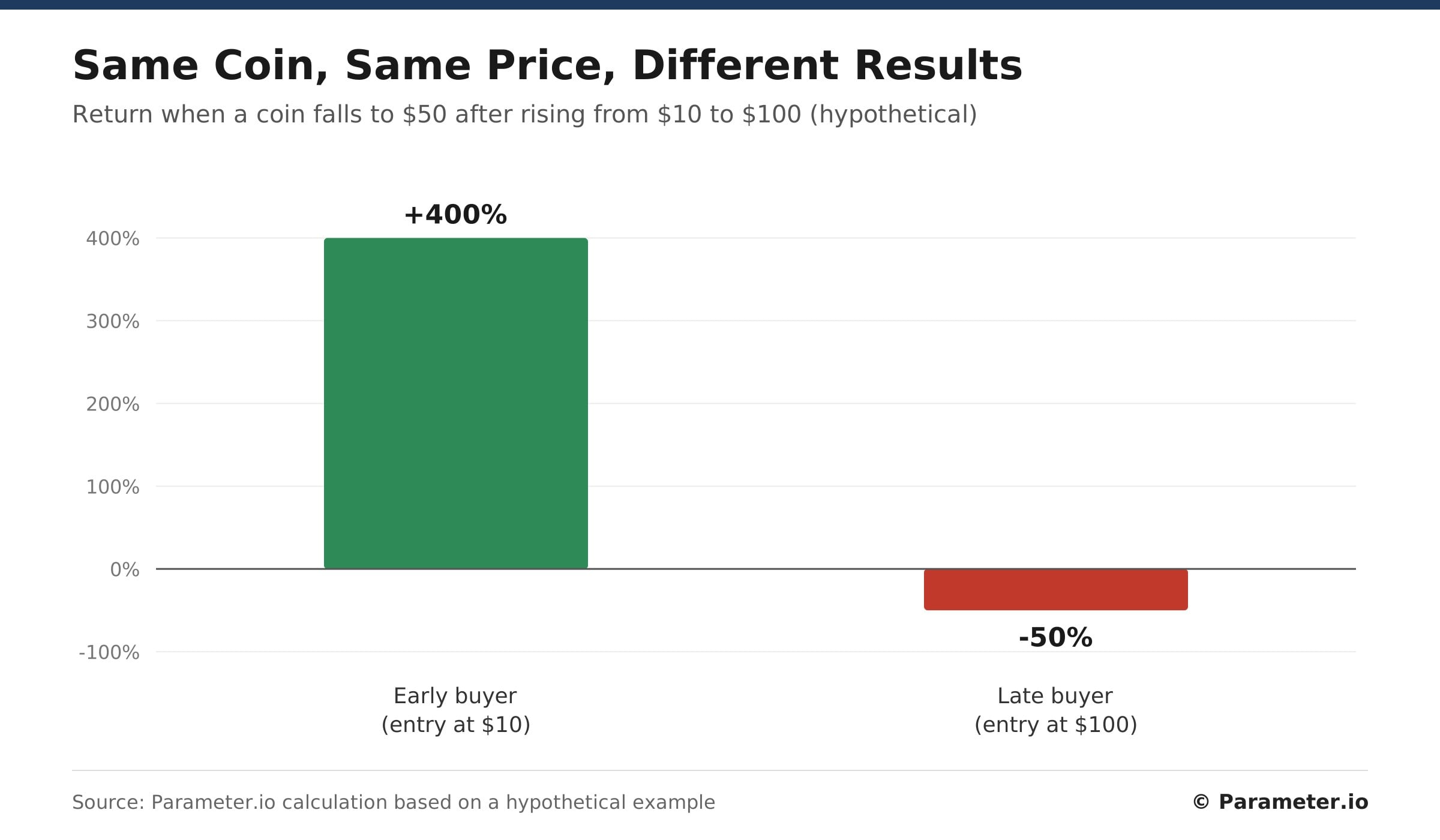
Take a coin that rises from $10 to $100. That is a 900% gain for anyone who bought at $10.
Now suppose the price falls back to $50. The early buyer is still up 400%, while the person who bought at $100 has lost half their money.
Both investors hold the same coin at the same price. The only difference is when they bought it.
| Buyer | Entry price | Current price | Result |
|---|---|---|---|
| Early buyer | $10 | $50 | +400% |
| Late buyer | $100 | $50 | -50% |
| Late buyer if price returns to $10 | $100 | $10 | -90% |
This math sits at the center of the FOMO problem. The urge to buy tends to be strongest after a large rise, which is also when a new buyer has the smallest cushion against a drop.
Social Media, Young Investors and Meme Coins
Platforms such as X, Reddit, Telegram, TikTok and YouTube spread crypto news and opinion to millions of people within minutes. Some of this content is useful research, but much of it is promotion.
During rallies, big price forecasts may spread further than careful analysis. Seeing the same prediction across many accounts can make it feel like a sure thing, even when there is little evidence behind it.
Influencers can also have hidden reasons to promote a coin. Some may already own it at a lower price and gain when followers buy.
Social media mostly shows winners. Screenshots of large profits get attention, while losing trades are rarely posted, a pattern known as survivorship bias.
A 2024 study of crypto posts on X found a link between unusual investor attention and short-term crypto returns. The study does not show that online buzz guarantees future gains, only that the two are connected.
What the FCA Found About Young Investors
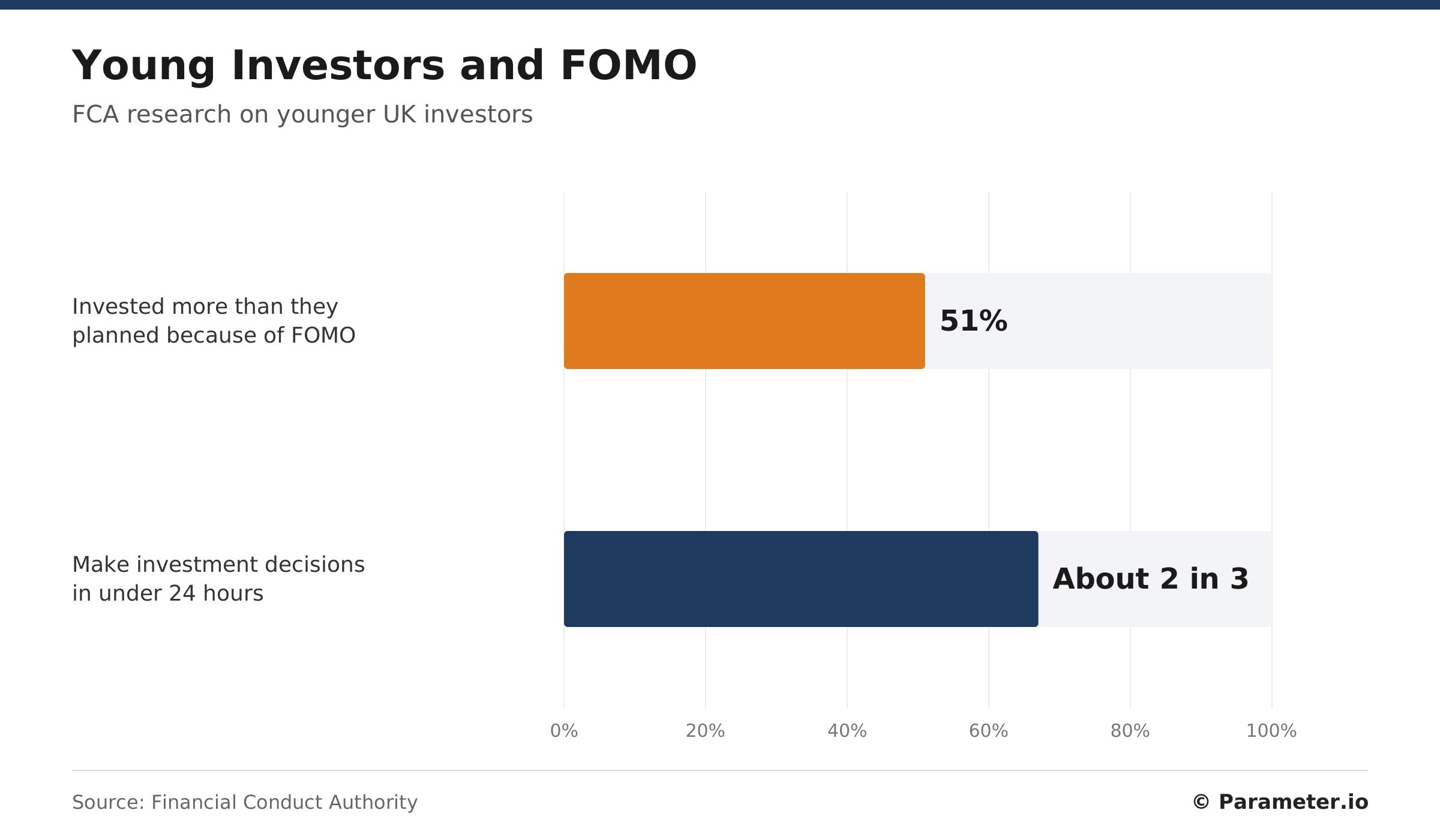
The FCA surveyed younger investors about how they make decisions. 51% said they had invested more money than they planned because of FOMO.
The FCA also found that about two in three young investors take less than 24 hours to make an investment decision. Social media played a large role in how many of them made choices.
Why Meme Coins Are Most Exposed
Meme coins are tokens whose popularity comes mostly from internet culture and online communities. Many have little practical use and depend heavily on market mood.
Small meme coins often have low liquidity, meaning there are few buyers and sellers. A small amount of buying can push the price up fast, and the same thin trading can make prices crash when holders try to sell.
Some meme coins are held mostly by a few wallets. If those holders sell, the price can drop quickly.
The FCA warns that meme coins can be targets for pump-and-dump schemes. Promoters buy early, hype the coin, then sell once prices rise, leaving later buyers with losses.
The US Securities and Exchange Commission (SEC) also warns that scammers use fear of missing out to draw people into crypto schemes.
How FOMO Builds During a Bull Market
FOMO usually grows in steps. Several well-known habits of mind feed it along the way.
Herd behavior. Rising prices draw new buyers, and their buying pushes prices higher. The same loop can run in reverse when the mood turns and people rush to sell.
Recency bias. After several weeks of gains, people start to assume the trend will continue. They may underestimate the chance of a sharp reversal.
Overconfidence. In a strong market, even poorly researched buys can make money. Investors may mistake luck for skill, then invest more or borrow to trade.
Loss aversion. Losses tend to hurt more than gains of the same size feel good. FOMO adds a twist, because people start to treat missed gains as if they were real losses.
| Market stage | Typical behavior | Main risk |
|---|---|---|
| Early recovery | Little public attention and cautious mood | Investors stay skeptical |
| Sustained rally | Growing optimism and more trading | Investors start to fear missed gains |
| Rapid appreciation | Heavy media coverage and viral price calls | Emotional buying increases |
| Speculative excitement | Aggressive targets and very high confidence | Valuation risks are ignored |
| Market reversal | Falling prices and rising doubt | Panic selling |
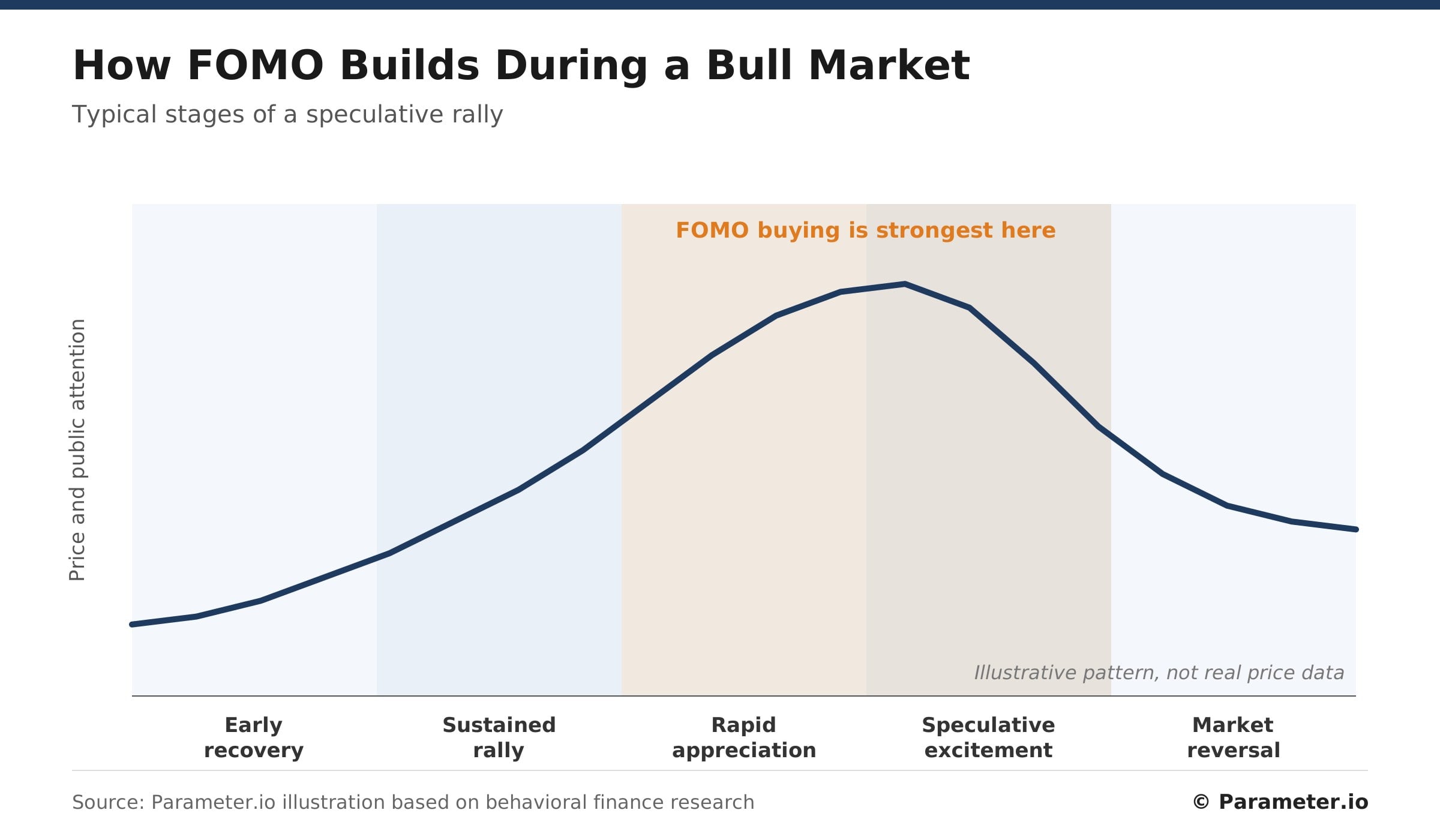
These stages are a general guide, not a tool for calling market tops. A rally can last far longer than skeptics expect, and a small dip can turn into a long bear market.
No one can know for sure when the mood has become too hopeful. Still, rising public excitement is a reason to look harder at prices and risk, not a reason to buy more.
Case Study: How a FOMO Buy Turns Into a Loss
Consider a made-up coin called NovaCoin. It starts the year at $1 and climbs to $5 over several months.
An investor ignores it at first. After seeing upbeat coverage and stories of big returns, they buy $5,000 worth at $8.
NovaCoin rises to $10 a few weeks later. At that point, the holding is worth $6,250. Then the price falls to $3.
| Metric | Value |
|---|---|
| Starting token price | $1 |
| FOMO purchase price | $8 |
| Amount invested | $5,000 |
| Tokens bought | 625 |
| Peak price after purchase | $10 |
| Price after correction | $3 |
| Final holding value | $1,875 |
| Unrealized loss | $3,125 |
| Percentage decline | 62.5% |
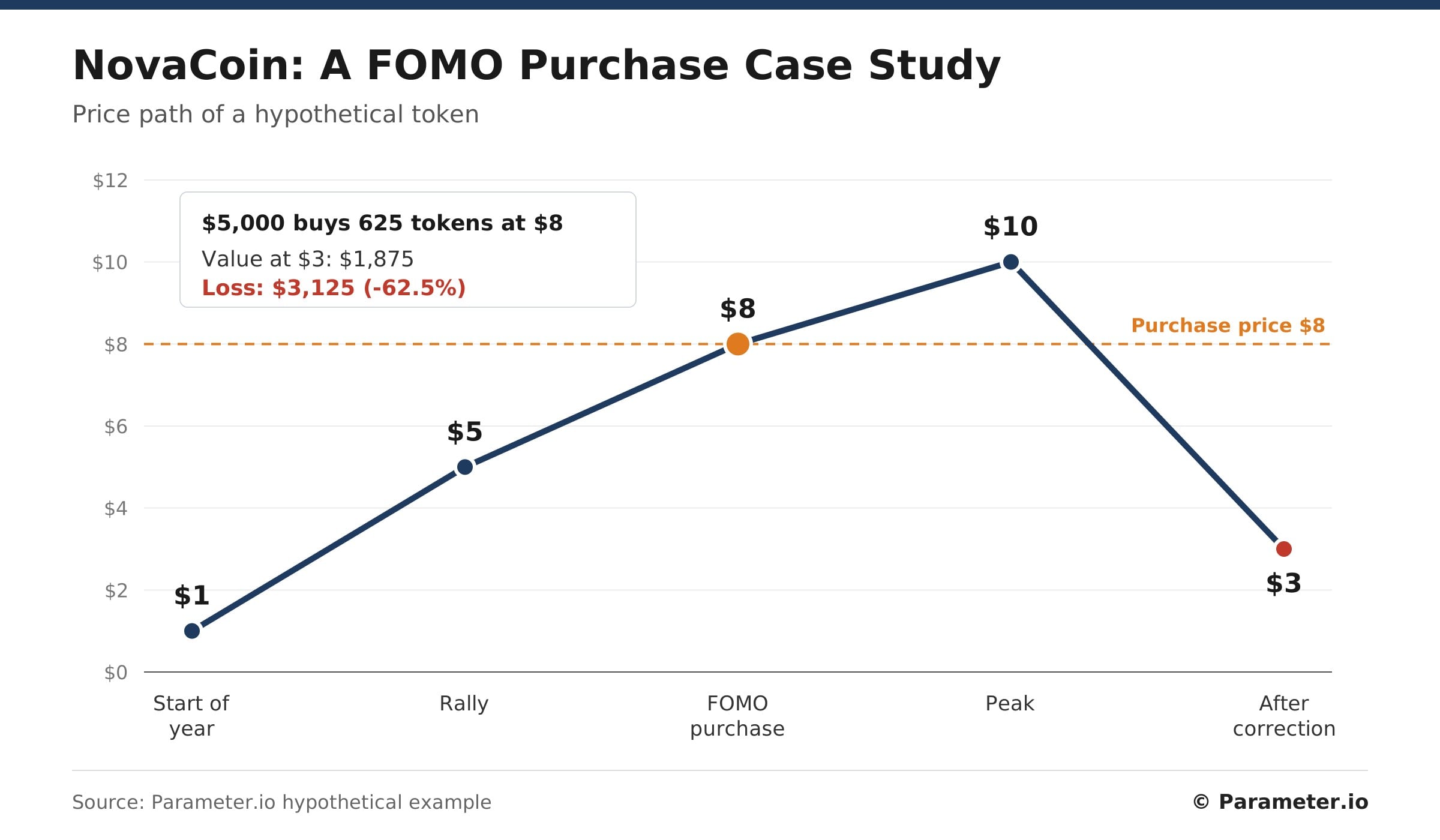
The investor bought after NovaCoin had already risen 700%. The coin did climb higher after the purchase, but the investor did not sell, so that gain existed only on paper.
After the drop, the $5,000 holding was worth $1,875. That is a loss of $3,125.
This does not mean buying after a rally is always wrong. The real question is whether the price is still backed by the asset’s use, demand and risks.
How Leverage Makes FOMO More Costly
Leverage means trading with borrowed money. It lets a trader control a position larger than the cash they put in.
With 10x leverage, about $1,000 of collateral can control a $10,000 position, depending on the platform. Gains are multiplied, and so are losses.
At 10x, a price drop of about 10% can wipe out the full $1,000 before fees. In practice, platforms often close, or liquidate, a position before that point to protect their loan.
| Leverage | Position size from $1,000 | Approx. drop that erases collateral |
|---|---|---|
| 2x | $2,000 | 50% |
| 3x | $3,000 | 33.3% |
| 5x | $5,000 | 20% |
| 10x | $10,000 | 10% |
| 20x | $20,000 | 5% |
| 50x | $50,000 | 2% |
| 100x | $100,000 | 1% |
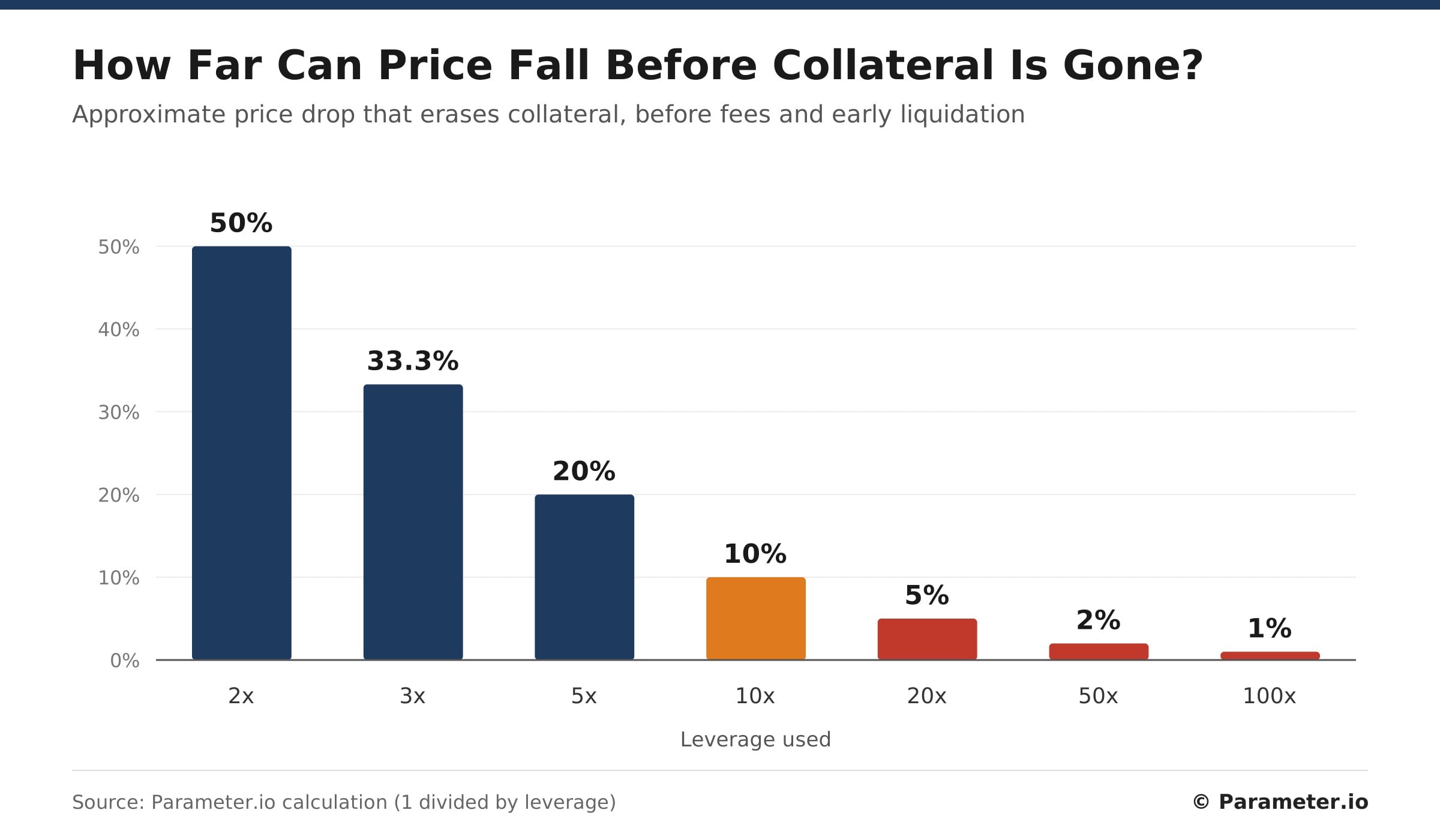
This creates a dangerous mix. FOMO pushes people to buy after big gains, when prices can swing hard, and leverage leaves them less able to ride out those swings.
A trader can be liquidated in a short dip and lose their stake, even if the coin later reaches new highs. For inexperienced investors, avoiding leveraged crypto trading is generally the safer approach.
The Math of Losses and How to Avoid FOMO
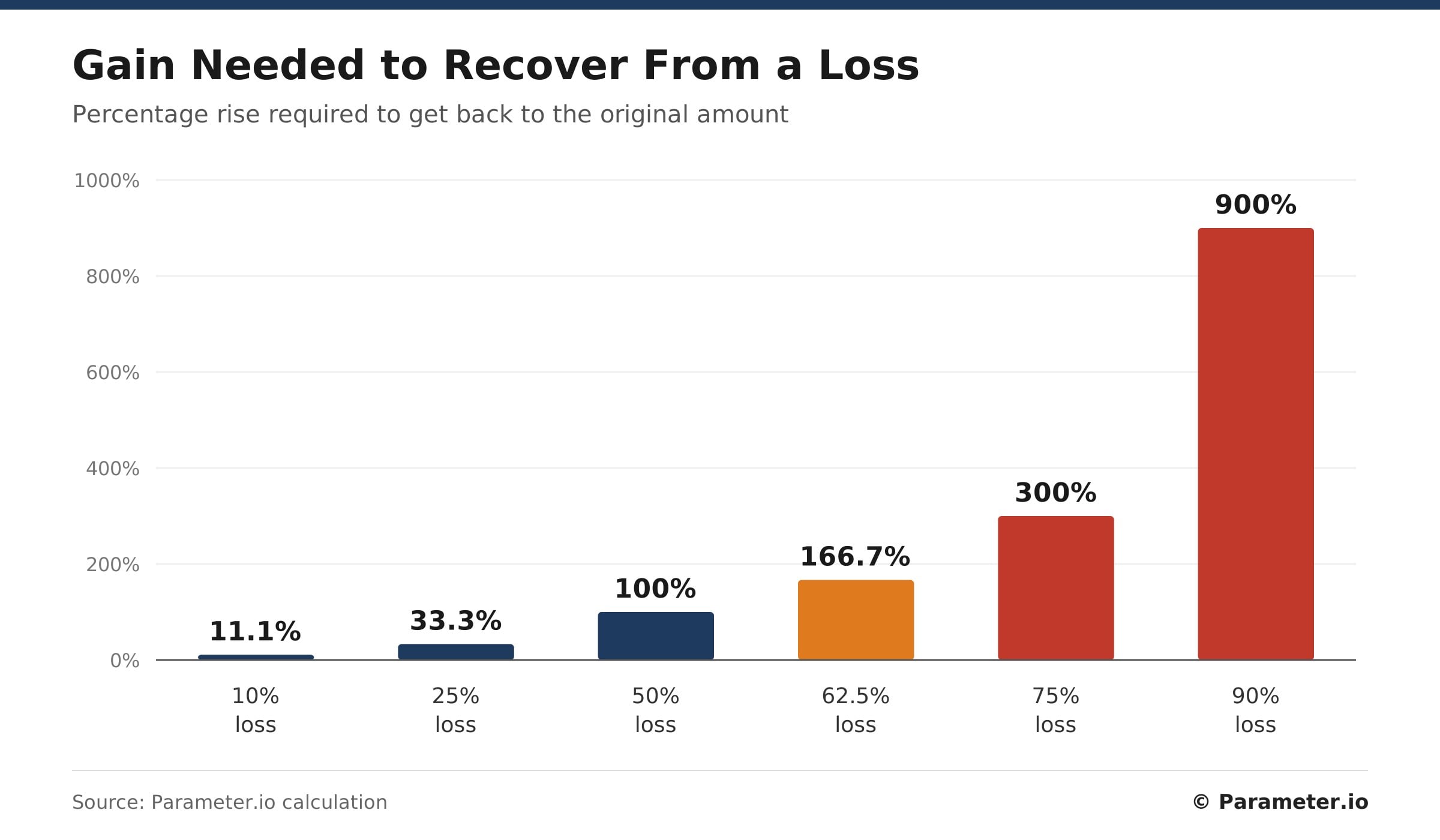
Losses are harder to recover from than many people expect. A 50% loss needs a 100% gain just to get back to even.
The NovaCoin investor lost 62.5%. To get back to $5,000, the coin would need to rise about 167%, from $3 back to $8.
| Loss | Gain needed to break even |
|---|---|
| 10% | 11.1% |
| 25% | 33.3% |
| 50% | 100% |
| 62.5% | 166.7% |
| 75% | 300% |
| 90% | 900% |
Practical Steps to Reduce FOMO
No one can remove emotion from investing. Regulators and investor guides point to several steps that can lower the risk of rushed choices.
- Write an investment plan. Decide in advance how much you can afford to put into crypto and what kinds of assets fit your goals.
- Set position limits. Cap how much goes into any single coin so one bad bet cannot do serious damage.
- Wait before buying. A cooling-off period, such as waiting until the next day, helps make sure a choice comes from thought rather than excitement.
- Check the fundamentals. Look at the project’s technology, token supply, real-world use and any large token releases still to come.
- Consider dollar-cost averaging. Investing a fixed amount on a schedule, such as $100 a month, removes the pressure to find one perfect entry point. It does not guarantee profits and can trail a single lump-sum buy during a long rally.
- Cut back on hype. Following fewer promotional accounts can help keep things in perspective.
- Accept missed chances. No one can catch every rally, and missing one is not a mistake in itself.
A Checklist Before Buying a Rising Coin
| Question | Why it matters |
|---|---|
| Why has the price risen? | Separates real progress from speculation |
| Is there real adoption? | Shows whether demand can last |
| What is the market cap and fully diluted value? | Gives context for the price and future supply |
| Are large token unlocks coming? | Flags possible selling pressure |
| Is there enough trading liquidity? | Affects how easily you can sell |
| Are influencers pushing it? | Points to possible conflicts of interest |
| Can I afford a large drop? | Tests your position size |
| Would I buy it without the recent rally? | Helps expose FOMO |
The last question is the most telling. If you would have no interest in a coin without its recent rise, FOMO may be driving the choice.
Missing a Rally Is Not the Same as Losing Money
Say an investor thinks about buying Bitcoin at $40,000 but decides not to. Bitcoin later reaches $80,000.
The investor may feel they lost the chance to double their money. But their account has not dropped by a single dollar.
A decision should be judged by the reasoning and risk control behind it, not only by what the price did next. A well-researched buy can lose money, and a rushed one can get lucky.
FOMO and FUD
FOMO has an opposite in crypto slang: FUD, which stands for fear, uncertainty and doubt. FOMO tends to drive buying in rising markets, while FUD tends to drive selling in falling ones.
Not all bad news is FUD, and not all good news is hype. Security problems or new regulations can be real reasons to rethink an investment, so the goal is to separate evidence from emotion.
The Bottom Line
The data paints a consistent picture. BIS research shows retail interest in crypto rises after prices climb, and it estimates that most retail buyers lost money on their first Bitcoin purchase.
FCA research shows many young investors decide quickly and put in more than they planned because of FOMO. Leverage and meme coins raise the stakes further.
Controlling FOMO does not guarantee profits. It can help investors avoid one of the most expensive habits in crypto: buying mainly because everyone else seems to be getting rich.
Sources
- Bank for International Settlements: Crypto Trading and Bitcoin Prices, Evidence From a New Database of Retail Adoption
- Bank for International Settlements: Crypto Shocks and Retail Losses
- Financial Conduct Authority: Hype, Spot the Signs and Manage Your FOMO
- US Securities and Exchange Commission: Digital Asset and Crypto Investment Scams
- Financial Conduct Authority: Pump-and-Dump Schemes
- Financial Conduct Authority: Two-Thirds of Young Investors Take Less Than 24 Hours to Make Investment Decisions
- US Securities and Exchange Commission: Technology and Digital Finance, World Investor Week 2024
- Twitter-Based Attention and the Cross-Section of Cryptocurrency Returns (SSRN)
Disclaimer: This article is for information only and is not financial or investment advice. Crypto investments are highly volatile and can result in large or total losses.
Get 3 Free Stock Ebooks
Discover top-performing stocks in AI, Crypto, and Technology with expert analysis.
- Top 10 AI Stocks - Leading AI companies
- Top 10 Crypto Stocks - Blockchain leaders
- Top 10 Tech Stocks - Tech giants


