


TLDR
- Micron finished trading down 1.2% at $1,063.96 on October 5 despite maintaining strong analyst support.
- Susquehanna maintained its “Positive” rating with a $2,000 price objective, suggesting potential upside of approximately 88%.
- Morgan Stanley retained an “Overweight” stance with a $1,200 target, indicating roughly 10% potential gains.
- Fiscal 2026 sales reached an all-time high of $133.2 billion, representing a 256% year-over-year increase.
- The consensus rating on Wall Street stands at Strong Buy with an average target price of $1,581.40.
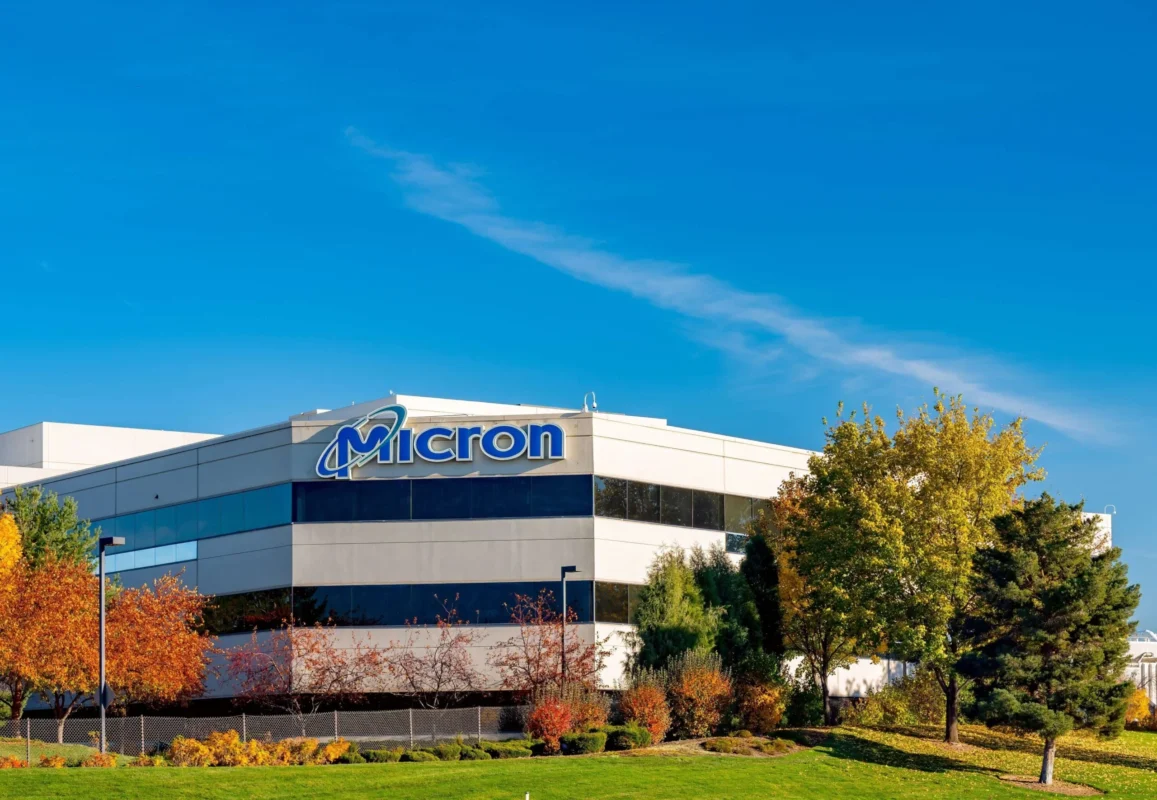
Shares of Micron Technology (MU) declined 1.2% to settle at $1,063.96 on October 5. The modest pullback occurred despite renewed confidence from two prominent Wall Street firms regarding the semiconductor manufacturer’s prospects.
Susquehanna Financial Group reaffirmed its “Positive” stance and maintained a $2,000 price objective. This target represents approximately double the company’s current trading level and indicates potential upside of around 88%.
Morgan Stanley adopted a slightly more conservative but still optimistic position. The investment bank preserved its “Overweight” rating alongside a $1,200 price objective, pointing to about 10% upside potential.
These bullish views come on the heels of exceptional fiscal 2026 performance. The company posted record sales of $133.2 billion, representing a 256% surge compared to the previous fiscal year.

Gross profit margin widened to 81.1%, marking a 40-percentage-point improvement. Per-share earnings skyrocketed 811% to reach $75.52.
The fourth fiscal quarter alone generated $54.2 billion in sales, climbing 379% year over year. This achievement represented the company’s sixth consecutive quarterly record.
What’s Driving Analyst Confidence
Susquehanna projects Micron will deliver earnings of $176.39 per share on sales of $284.56 billion during fiscal 2027. These projections represent a significant leap from the $75.52 per share recorded in fiscal 2026.
The brokerage cites robust memory chip demand combined with restrained capital expenditure across the industry. Increasing prices for high-bandwidth memory, commonly referred to as HBM, should provide additional tailwinds.
Nvidia’s forthcoming Rubin platform and expanded adoption of specialized AI processors are anticipated to amplify HBM requirements. As pricing rises for these products, Micron’s profitability metrics could approach company-wide averages.
Susquehanna anticipates gross margin will temporarily decline during the November quarter before resuming its upward trajectory. Looking further ahead, the firm believes the memory supply shortage will persist through 2028.
Morgan Stanley analyst Joseph Moore echoed similar sentiments in his October 1 research note. He observed that the conversation has evolved from questioning peak performance to assessing sustainability.
Moore highlighted that Micron’s earnings surprises have moderated recently. The company exceeded Wall Street expectations by only 5% this quarter, down from the 20% to 40% beats in earlier periods.
Rather than viewing this as problematic, he characterized it as “the new normal as Micron’s visibility improves.”
Memory Supply Constraints Expected Until 2028
During the earnings conference call, Micron CEO Sanjay Mehrotra spoke candidly about market conditions. He stated the company cannot yet identify when memory supply and demand dynamics will reach equilibrium.
Customers are reacting by securing supply commitments well in advance. Micron has executed 26 strategic partnership agreements representing a total of $32 billion in guaranteed purchases.
According to Mehrotra, over 75% of Micron’s planned 2027 production volume is already committed to customers. Moore interpreted these extended agreements as evidence of customer concerns about obtaining adequate memory supplies years down the road.
Expanding production capacity requires substantial time investment. Cleanroom facilities take years to construct, and Susquehanna identified this as a critical constraint for the coming years.
Disciplined capital spending throughout the industry is expected to prevent rapid supply increases. Micron’s diversified customer relationships and product portfolio should also provide cushioning against potential future market downturns.
Regarding capital allocation, Micron intends to begin distributing all surplus cash to shareholders starting in early December. Susquehanna projects approximately $100 billion in average annual free cash flow for the combined 2027 and 2028 fiscal years.
Should the company allocate this capital toward share repurchases, Susquehanna calculates Micron could potentially buy back roughly 16% of its current share count.
Wall Street presently maintains a Strong Buy consensus recommendation on the stock, supported by 25 Buy ratings alongside one Hold.
The mean analyst price objective stands at $1,581.40, suggesting approximately 49% upside potential from present trading levels.
Get 3 Free Stock Ebooks
Discover top-performing stocks in AI, Crypto, and Technology with expert analysis.
- Top 10 AI Stocks - Leading AI companies
- Top 10 Crypto Stocks - Blockchain leaders
- Top 10 Tech Stocks - Tech giants


