


Key Takeaways
- Samsung and TSMC have pledged to deploy ASML’s High NA EUV lithography systems, becoming the latest customers alongside Intel for these $400 million machines.
- Samsung intends to implement High NA EUV technology for DRAM chip manufacturing beginning in 2028, while TSMC targets deployment by 2030.
- The four industry players reached consensus on transitioning from 6-inch to 12-inch photomasks, potentially increasing machine throughput by 40%.
- ASML shares have surged approximately 120% in the last year, with analysts maintaining a Strong Buy rating and an average price target of $2,468.
- Barclays characterized the developments as “a positive,” noting they enhance clarity around High NA technology adoption timelines.
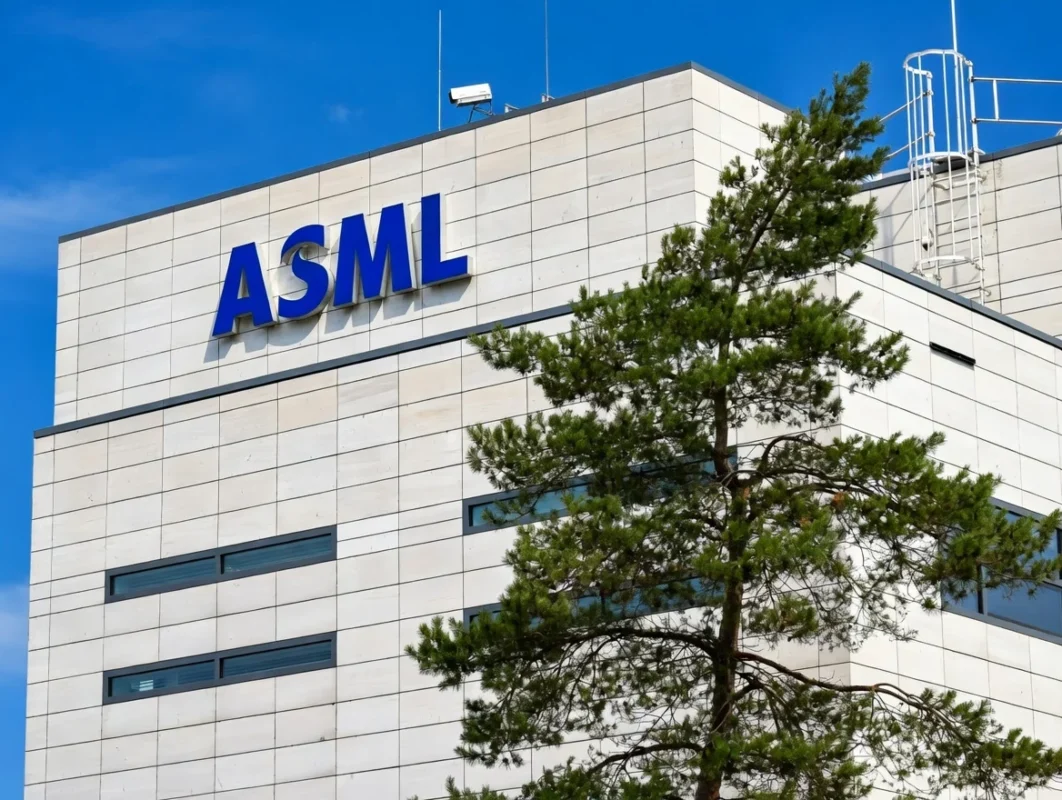
ASML secured commitments from two semiconductor industry titans on Tuesday when Samsung and TSMC announced their intentions to incorporate its High NA extreme ultraviolet (EUV) lithography systems into upcoming chip manufacturing operations.
Shares of ASML climbed approximately 1.6% during early market activity after the announcement, extending a remarkable 120% rally recorded over the previous twelve months.
These High NA systems carry a price tag of approximately $400 million per unit and utilize enhanced optical components to etch circuit patterns up to three times finer on silicon substrates in one operation. This level of accuracy has become increasingly critical as semiconductor manufacturers advance toward more sophisticated architectures for artificial intelligence processors.
Samsung announced its intention to deploy these systems for DRAM memory chip fabrication beginning in 2028, seeking to advance its memory scaling capabilities and enhance manufacturing productivity. TSMC established a 2030 timeline for implementation, focusing on cutting-edge processors where transistor structures are growing more intricate due to AI computing demands.

TSMC’s CEO C.C. Wei emphasized the company’s philosophy of addressing technical obstacles proactively, before they escalate into financial challenges. TSMC represents approximately 16% of ASML’s overall revenue, according to Bloomberg data, making this pledge a significant indicator for investors monitoring High NA technology uptake.
Larger Photomask Format Promises Additional Benefits
In addition to the equipment commitments, all four corporations—ASML, TSMC, Samsung, and Intel—reached agreement to transition from the existing 6-inch photomask specification to an expanded 12-inch configuration.
Photomasks function as templates, employing light to transfer microscopic circuit designs onto silicon substrates. ASML’s Chief Technology Officer Marco Pieters indicated that the expanded mask dimensions could increase High NA system productivity by 40% while simultaneously simplifying chip architecture development.
Intel has been developing the 12-inch mask initiative for more than three years as it expands its production infrastructure. TSMC intends to begin utilizing High NA equipment with conventional 6-inch masks in 2030, followed by establishing a pilot facility for 12-inch masks by 2031.
Analyst Perspective
Barclays indicated the developments “should provide more visibility on adoption which has been a key debate,” characterizing the announcement as “a positive” for ASML shares.
The investment bank also highlighted that ASML confronts a strategic choice regarding whether to increase EUV production capacity beyond previously announced objectives, observing that market demand is “clearly strong.”
ASML has disclosed plans to boost total EUV capacity by approximately 30% in 2027 but has not recently updated forecasts specifically for High NA unit production volumes.
Financial analysts maintain a Strong Buy consensus rating on ASML stock, supported by six Buy recommendations issued within the last three months. The consensus 12-month price target stands at $2,468 per share, suggesting potential upside of roughly 44% from present trading levels.
ASML shares traded on the Amsterdam exchange showed minimal movement to slightly negative performance during early European market hours prior to the opening of US trading.
Get 3 Free Stock Ebooks
Discover top-performing stocks in AI, Crypto, and Technology with expert analysis.
- Top 10 AI Stocks - Leading AI companies
- Top 10 Crypto Stocks - Blockchain leaders
- Top 10 Tech Stocks - Tech giants


