


TLDR
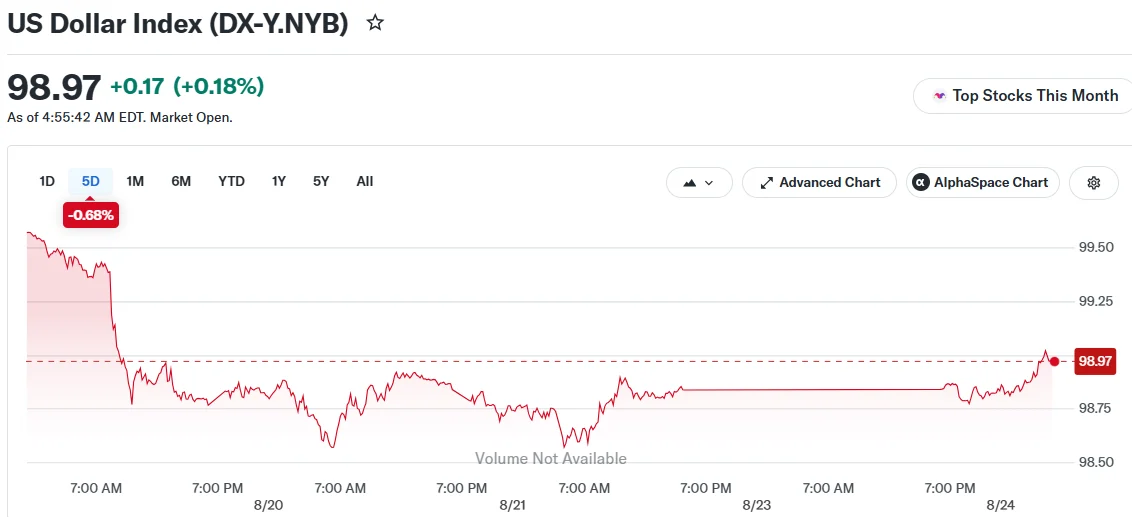
- The U.S. Dollar Index dropped to approximately 98.88, marking its weakest position since mid-May
- Treasury officials expanded long-term bond buyback programs to $4 billion per operation, triggering market concerns
- Federal government debt crossed the $40 trillion threshold, while the deficit approaches $1.8 trillion
- Canada’s currency declined following U.S. implementation of 50% tariffs targeting $20 billion in Canadian imports
- Gold and bitcoin experienced significant gains as market participants sought refuge from dollar-denominated assets
On Monday, the U.S. dollar remained anchored near multi-month lows. The U.S. Dollar Index hovered around the 98.88 mark, maintaining proximity to its weakest performance since mid-May. The index had already shed nearly 1% during the prior week’s trading.
This dollar deterioration reflects mounting investor anxiety regarding America’s fiscal health. The federal government’s debt burden has now eclipsed $40 trillion, while the annual deficit threatens to reach $1.8 trillion.
During the previous week, Treasury officials announced plans to expand their long-dated bond repurchase program to $4 billion per operation. This initiative was designed to enhance market functioning and alleviate upward pressure on longer-dated Treasury yields.
Though yields temporarily declined following the announcement, the Treasury’s direct market intervention alarmed many participants. Several market observers suggest the strategy may be producing unintended consequences.
“The more Bessent tries to push back, the more markets will push against him,” said Marc Ostwald, chief economist at ADM Investor Services International. He added that the situation is pushing investors toward gold and bitcoin over fears of currency debasement.
Alternative Assets Capitalize on Greenback’s Decline
The greenback experienced its steepest weekly decline versus bitcoin in approximately three and a half years. Meanwhile, gold prices have surged as market participants pursue alternatives to dollar-based holdings.

According to Ostwald, investors are actively reallocating capital away from G7 sovereign bonds, motivated by concerns that government spending imbalances remain unchecked.
The euro was changing hands at $1.1665, near its three-month peak from last week. The British pound maintained levels close to a six-month high at $1.3628. China’s yuan traded near a three-and-a-half-year high relative to the dollar.
Trade Tensions and Global Risks Compound Dollar Stress
The Canadian dollar lost ground after Washington implemented 50% tariffs on $20 billion worth of Canadian exports amid collapsed trade negotiations. Canadian officials pledged equivalent retaliatory measures beginning September 8.
Investors were also awaiting action from U.S. Treasury Secretary Scott Bessent, who was anticipated to unveil fresh Iran sanctions on Monday. Bessent had previously warned of implementing “the toughest sanctions in history” against Iran, with market observers monitoring whether Chinese entities might face penalties.
Oil prices dropped over $1 per barrel in advance of the sanctions announcement as traders locked in gains, although concerns about disruptions through the Strait of Hormuz persisted.
Federal Reserve Chair Kevin Warsh is scheduled to deliver remarks at Jackson Hole on Friday. Financial markets will scrutinize his commentary for insights on monetary policy direction and perspectives on the Treasury’s buyback initiative. Bank of Japan Deputy Governor Ryozo Himino addresses markets Thursday, with participants seeking clues about Japan’s rate normalization timeline.
Nvidia’s quarterly earnings report is also expected this week, introducing additional volatility to global risk sentiment.
Get 3 Free Stock Ebooks
Discover top-performing stocks in AI, Crypto, and Technology with expert analysis.
- Top 10 AI Stocks - Leading AI companies
- Top 10 Crypto Stocks - Blockchain leaders
- Top 10 Tech Stocks - Tech giants


