


Key Highlights
- Bitcoin climbed toward $67,000, reaching seven-week peaks despite heightened US-Iran tensions and fresh tariff announcements
- Investors appear to be overlooking geopolitical concerns, anticipating favorable outcomes in the near term
- The $68,000 level represents critical resistance — aligned with the average acquisition cost for investors over the past five months
- Spot Bitcoin ETF inflows have turned positive but remain significantly lower than early 2026 peaks
- Current trading volumes stand at approximately 62% of yearly averages, consistent with historically slow late-July activity
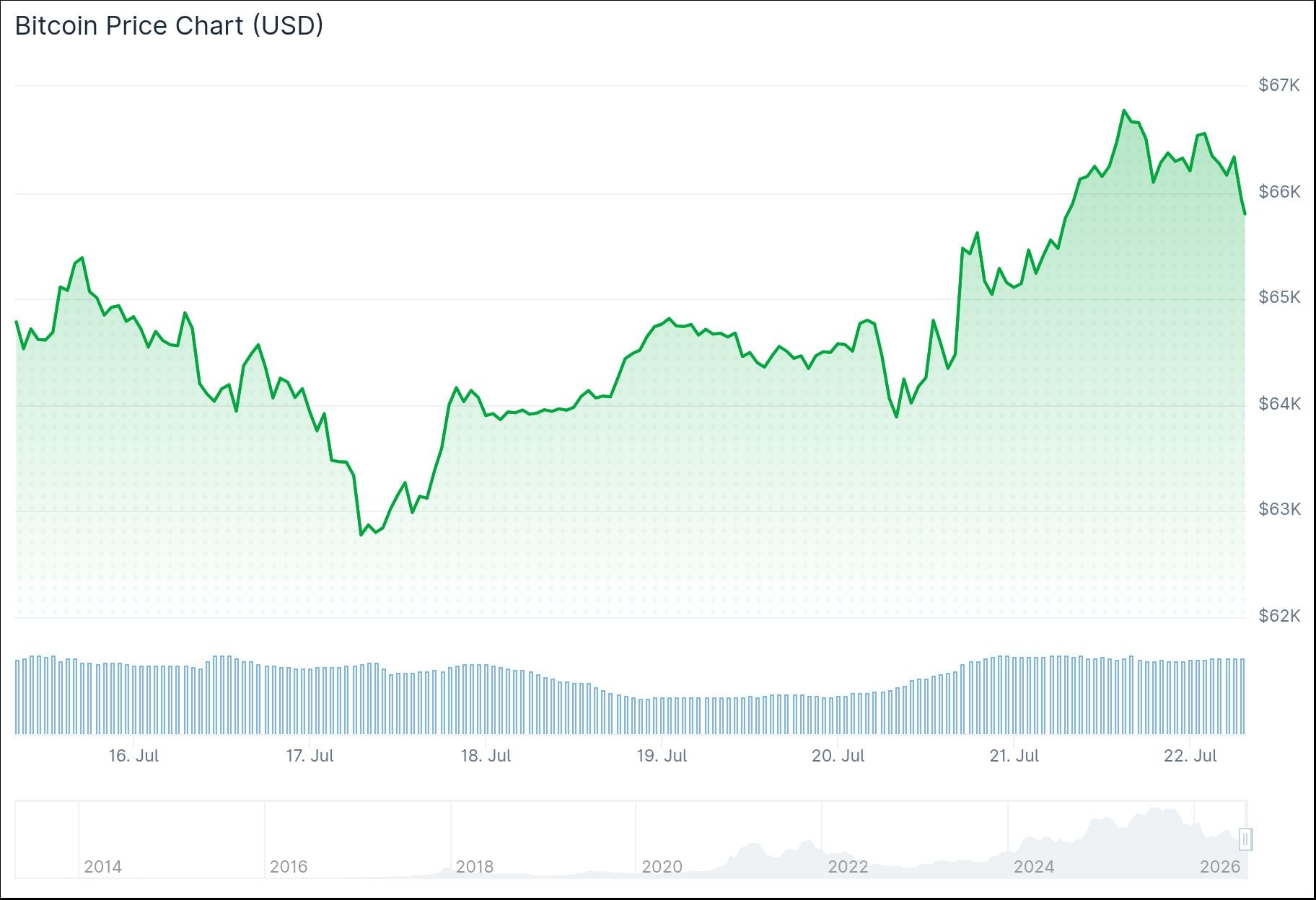
Bitcoin has surged past $66,600, marking its highest level in more than seven weeks as it approaches the $67,000 threshold. This represents approximately a 15% recovery from early July’s cyclical lows.
The rally persisted despite fresh headwinds impacting global markets. Iranian forces targeted Amazon infrastructure in Bahrain amid escalating US-Iran hostilities. With the Strait of Hormuz remaining shut, WTI crude oil prices have climbed close to $85 per barrel.
Additionally, President Trump is expected to unveil new 10% tariffs on international commerce, following the implementation of 50% tariffs on Canadian imports earlier in the week.
Nevertheless, cryptocurrency markets and US equities maintained their strength. Market participants seem to be wagering on an eventual de-escalation. Popular YouTube analyst Crypto Rover shared with his 1.6 million subscriber base: “Markets are pricing in peace.”
Technical analyst Ted (@TedPillows) observed that BTC has successfully recaptured the $65,000 threshold and identified the next significant barrier at $67,500–$68,000. He indicated that breaking above $68,000 could trigger an additional 5–6% upward movement in short order.

Critical $68,000 Resistance Zone
Bitfinex analysts are paying particular attention to the $68,000 area. This price point corresponds closely with the mean cost basis for investors who accumulated BTC during the previous five-month period. These holders, currently underwater on their positions, may view a return to their entry price as an opportunity to exit.

This identical level also marked the point where June’s mid-month recovery effort collapsed, preceding Bitcoin’s descent to fresh cycle lows beneath $58,000. Bitfinex characterized the ongoing bounce as “fragile but constructive,” noting that the initial challenge of this resistance zone is “expected to catalyze a sharp response.”
Spot Bitcoin ETF activity has transitioned from sustained outflows to moderate inflows. However, Bitfinex emphasized that demand “has not yet fully recovered,” with ETF participation and corporate treasury accumulation remaining substantially below early 2026 benchmarks.
Seasonal Quiet Period
K33 Research head Vetle Lunde characterized current market conditions as a “promising, and typical, summer slumber.” CME Bitcoin futures open interest has declined to its weakest level since 2023, while 30-day spot trading volume registers at merely 62% of the annual mean.
Average daily spot volume over the recent week has hovered around $2.3 billion, approaching yearly minimums. Just approximately one-third of trading sessions this month have recorded net ETF withdrawals, a significant improvement from June’s 90% rate.
Bitcoin now represents almost 67% of total spot cryptocurrency trading volume, climbing from 50% one year ago, reflecting sustained investor preference for BTC relative to alternative cryptocurrencies.
According to analyst Keith Alan, the 21-week simple moving average positioned at $69,720 remains the threshold that must be surpassed to formally challenge the prevailing bear market trajectory.
Get 3 Free Stock Ebooks
Discover top-performing stocks in AI, Crypto, and Technology with expert analysis.
- Top 10 AI Stocks - Leading AI companies
- Top 10 Crypto Stocks - Blockchain leaders
- Top 10 Tech Stocks - Tech giants


