


Key Takeaways
- Shares of uniQure plummeted 48% to $20.50 during premarket hours on Tuesday.
- The decline was triggered by disappointing 48-month data from its AMT-130 Huntington’s disease gene therapy trial.
- While AMT-130 demonstrated a 44% reduction in disease progression at 48 months, it failed to achieve statistical significance.
- The company maintains that its FDA submission remains supported by robust 36-month data from all 15 high-dose trial participants.
- A Biologics License Application was filed with the FDA this month through the accelerated approval pathway.
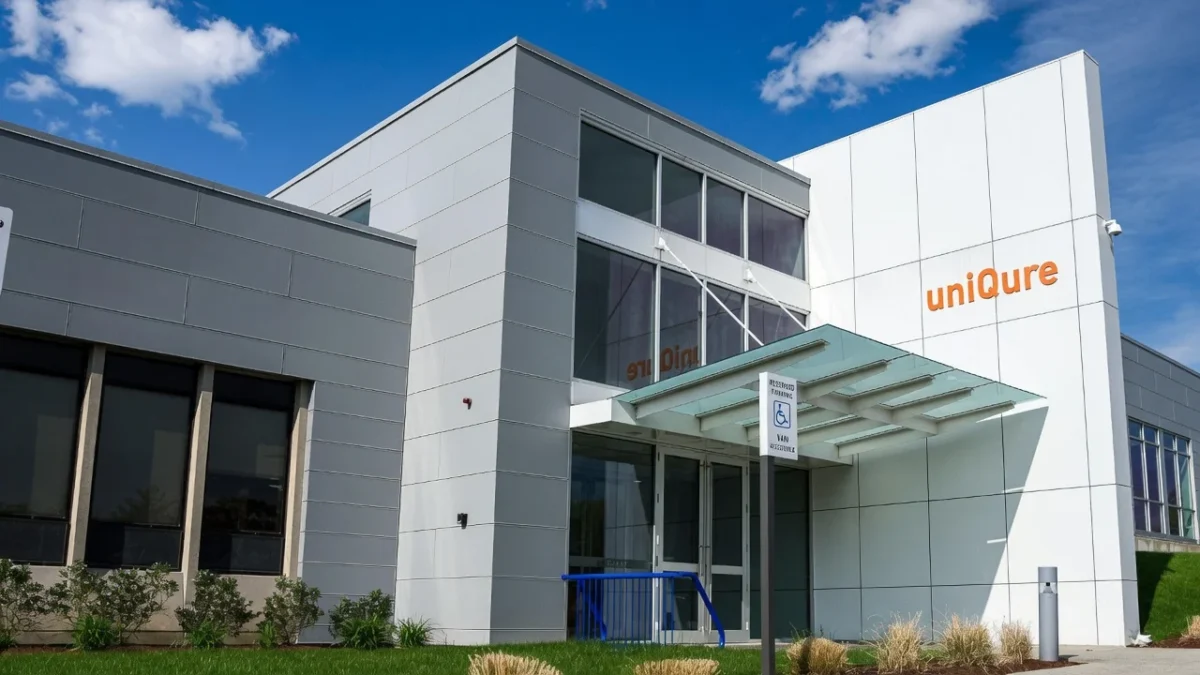
Shares of uniQure collapsed 48% to $20.50 in premarket trading Tuesday following the Netherlands-based biotech firm’s announcement of underwhelming new data from its experimental Huntington’s disease treatment.
The experimental gene therapy, designated AMT-130, aims to halt the advancement of this devastating neurological condition by reducing levels of a harmful protein in patients’ brains.
According to a 48-month evaluation involving 12 patients receiving the high dose, AMT-130 demonstrated a 44% reduction in disease advancement. However, this outcome failed to achieve the predetermined statistical significance threshold.
This represents a dramatic reversal from June, when the company announced plans to pursue regulatory clearance for the treatment, sending shares higher at that time.

Breaking Down the Latest Results
uniQure evaluated its trial participants against an external control cohort. As the study progressed, an increasing number of individuals withdrew from the control group.
This attrition resulted in a comparison population dominated by patients whose disease naturally progressed at a slower rate. The company believes this compositional shift may have distorted the 48-month findings.
The biotech highlighted an alternative 36-month evaluation as offering greater reliability. This assessment included all 15 patients who received the high dose and achieved statistical significance.
An additional 36-month analysis focusing exclusively on 12 high-dose recipients revealed an 80% reduction in disease progression. This calculation utilized data gathered through June 30, 2026.
According to uniQure, patients demonstrated good tolerance of the therapy at both dosage levels tested. Safety concerns were not identified as a contributing factor to Tuesday’s stock decline.
Regulatory Path Forward
The company submitted a Biologics License Application to the FDA earlier in the month. The application requests accelerated approval for AMT-130, which is also referred to by its scientific name, ifezuntirgene inilparvovec.
The regulatory filing relies on the 36-month dataset rather than the more recent 48-month analysis. uniQure indicated that FDA officials confirmed during a June consultation that 36-month outcomes from 12 high-dose patients would provide adequate support for the application.
The regulatory agency has previously expressed reservations about the therapy. In the previous year, the FDA determined that Phase I and II data were insufficient for a submission, and as recently as March recommended conducting an additional study.
Huntington’s disease is a hereditary condition with a universally fatal outcome. No treatments currently exist that alter the disease’s natural course—available therapies only address symptom management.
The development of AMT-130 has spanned nearly ten years for uniQure. It represents the flagship program within the company’s product pipeline.
Despite Tuesday’s setback, uniQure emphasized that the update holds significant importance for patients due to the absence of alternative disease-modifying therapies. Complete study results will be shared at an upcoming medical conference.
According to Dow Jones Market Data, Tuesday’s selloff was tracking to become uniQure’s steepest single-day percentage loss since November.
Get 3 Free Stock Ebooks
Discover top-performing stocks in AI, Crypto, and Technology with expert analysis.
- Top 10 AI Stocks - Leading AI companies
- Top 10 Crypto Stocks - Blockchain leaders
- Top 10 Tech Stocks - Tech giants


