



Key Highlights
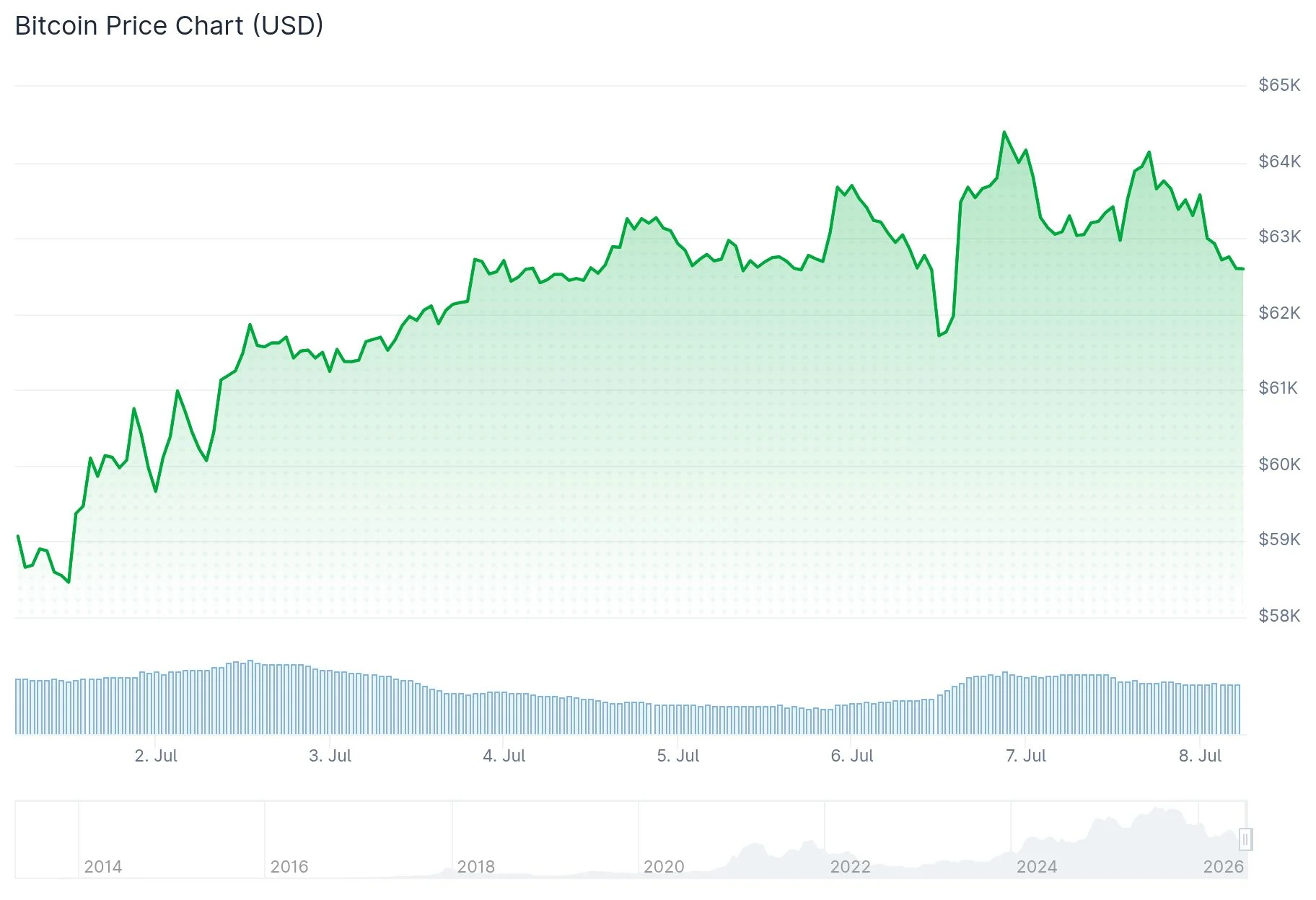
- BTC declined 1.4% to $63,305 following U.S. military action targeting Iranian interests
- Crude oil surged more than 5% amid escalating tensions in critical shipping lanes
- Semiconductor stocks tumbled, with Micron experiencing losses exceeding 9%
- Spot Bitcoin ETFs attracted $265.7 million in net inflows on Monday
- Technical analyst Ted Pillows cautions that breaking below $62,500 could trigger a move toward $60,000
Bitcoin retreated to approximately $63,000 on Tuesday following U.S. military operations against Iranian targets. The action was prompted by incidents involving three commercial oil tankers near the strategically vital Strait of Hormuz.
The U.S. Central Command characterized the military response as retaliation for Iranian hostilities directed at commercial maritime traffic. The attacks involved projectile strikes on two vessels and a drone assault on a third. Fortunately, no injuries were recorded.
The United Kingdom’s Maritime Trade Operations division elevated its regional threat assessment to “severe.” Petroleum markets reacted immediately, with crude prices jumping over 5%.
[[LINK_START_0]]https://twitter.com/HormuzLetter/status/2074676277441876130?s=20[[LINK_END_0]]Earlier during Tuesday’s trading session, Bitcoin had touched $64,660—representing its strongest level since June 22—before reversing course. The cryptocurrency’s decline mirrored broader weakness across American equity markets.
The S&P 500 shed 0.6% while the Nasdaq 100 plummeted 2.1%. Semiconductor manufacturers bore the brunt of the selling pressure, exemplified by Micron Technologies’ steep 9% decline.

Cryptocurrency market analyst Ted Pillows identified crucial support and resistance zones on X. According to his assessment, Bitcoin faced rejection at the $64,500–$65,000 resistance area and must now defend the $62,500–$62,800 support zone. Pillows warned that a daily candle close beneath this range could catalyze a descent toward $60,000.
https://twitter.com/TedPillows/status/2074406312864031206?s=20
Institutional Investment Remains Resilient
Notwithstanding the price volatility, institutional appetite demonstrated continued robustness. U.S.-based spot Bitcoin exchange-traded funds captured $265.7 million in net inflows on Monday, building on the $221.7 million recorded on July 2.
This represents a notable turnaround following a challenging period in late June, when approximately $2.4 billion exited spot Bitcoin investment products across multiple trading sessions.
Market participant Daan Crypto Trades highlighted on X that Bitcoin’s correlation coefficient with the Nasdaq underwent a dramatic transformation—shifting from -0.87 to +0.72 within mere days. This transition indicates Bitcoin is currently behaving more like a volatile technology equity rather than serving as a portfolio hedge.
[[LINK_START_3]]https://twitter.com/DaanCrypto/status/2074457917793734709[[LINK_END_3]]Federal Reserve Minutes in Focus
Market participants are now directing attention toward Wednesday’s release of Federal Reserve meeting minutes for guidance on monetary policy trajectory. The document could significantly influence both equity and cryptocurrency valuations.
John Bollinger, developer of the widely-used Bollinger Bands indicator, characterized [[LINK_START_4]]Bitcoin’s price[[LINK_END_4]] movement as reaching “a critical point.” He continues monitoring for indications of a potential long-term trend reversal in BTC valuation.
As part of its comprehensive response to the maritime attacks, the United States also terminated a general license that had permitted Iranian crude oil production and export activities.
Bitcoin was changing hands at $63,305 as of 6:04 PM Eastern Time on Tuesday.
Get 3 Free Stock Ebooks
Discover top-performing stocks in AI, Crypto, and Technology with expert analysis.
- Top 10 AI Stocks - Leading AI companies
- Top 10 Crypto Stocks - Blockchain leaders
- Top 10 Tech Stocks - Tech giants


