



Key Takeaways
- The Van Rossem hard fork went live on Saturday, bringing Cardano to Protocol Version 11
- This marks the first upgrade in Cardano’s history approved completely via onchain governance
- Plutus enhancements included in the update are designed to reduce smart contract costs
- ADA continues trading at $0.165, positioned beneath its 50, 100, and 200-day EMAs
- Trader positioning shows a long-to-short ratio of 0.90, reflecting bearish outlook
Cardano (ADA) is currently changing hands at $0.165 on Monday, maintaining stability following a modest uptick in the previous week. Despite a significant protocol enhancement going live over the weekend, the token’s price remains stagnant.
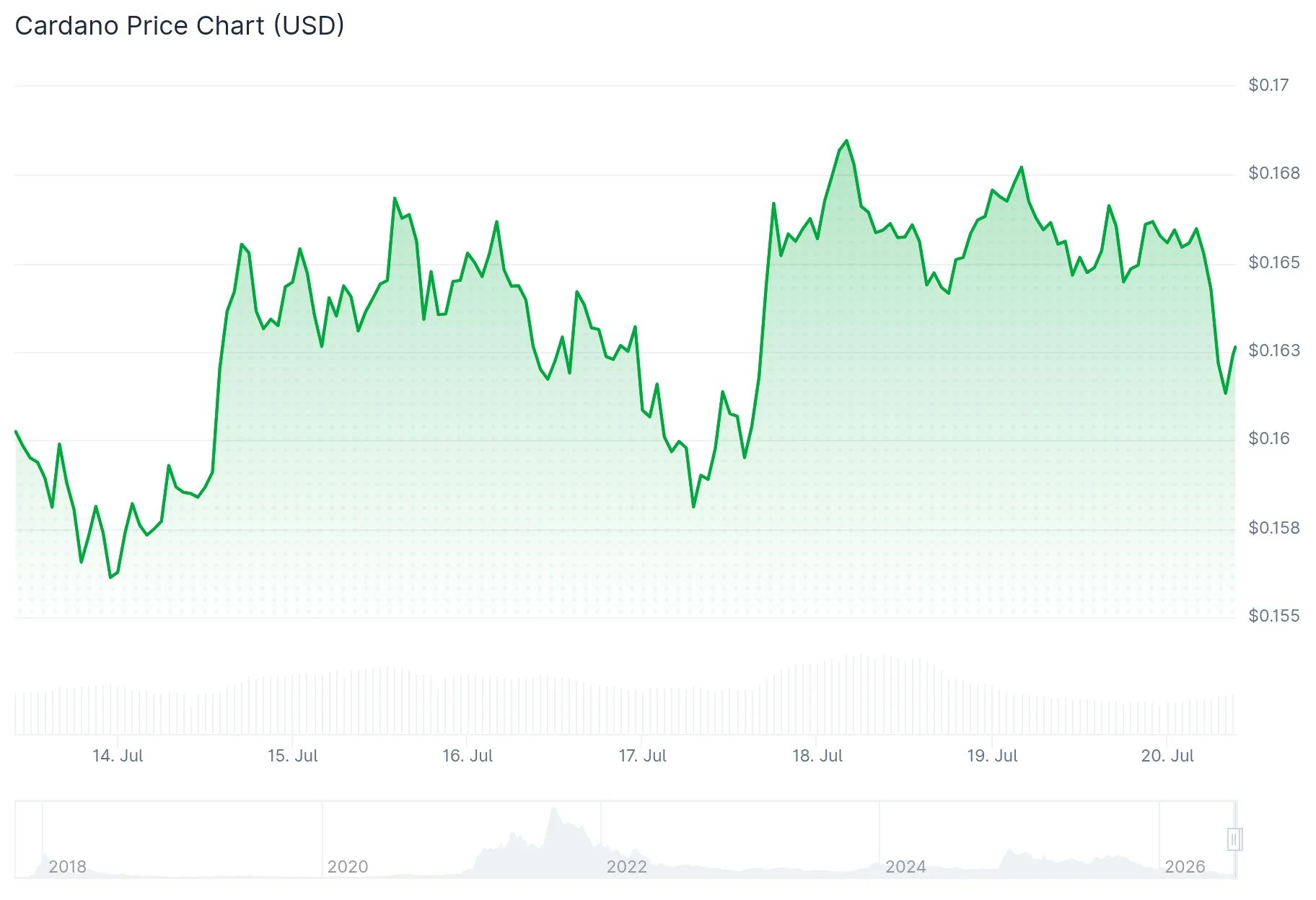
The Van Rossem hard fork became operational on Saturday, transitioning Cardano’s mainnet from Protocol Version 10 to Version 11. Blockchain data tracked by Cardanoscan shows the network progressed from epoch 643 into epoch 644 as part of this upgrade cycle.
This represents a milestone moment as the first hard fork in Cardano’s operational history to receive complete approval through onchain governance mechanisms. Prior network upgrades were managed and executed by Input Output, the development entity responsible for creating Cardano’s infrastructure.
The Van Rossem update brings enhanced Plutus functionality alongside refinements to the cost model. The central objective centers on decreasing the expenses associated with executing smart contracts across the blockchain.
In a development update released Friday, Input Output explained: “As well as Plutus improvements and Plutus Cost Model enhancements, this upgrade lays the foundation for the next upgrade, the Dijkstra era hard fork, which will introduce Ouroboros Leios to Cardano.”

Looking Forward: Preparing for Ouroboros Leios
Ouroboros Leios represents a scaling enhancement designed to operate atop Cardano’s current proof-of-stake consensus framework. The feature is scheduled for deployment in late 2026 and aims to significantly boost transaction throughput while maintaining the network’s existing security architecture.
Rather than functioning as an isolated enhancement, the Van Rossem upgrade serves as preparatory infrastructure for this future evolution.
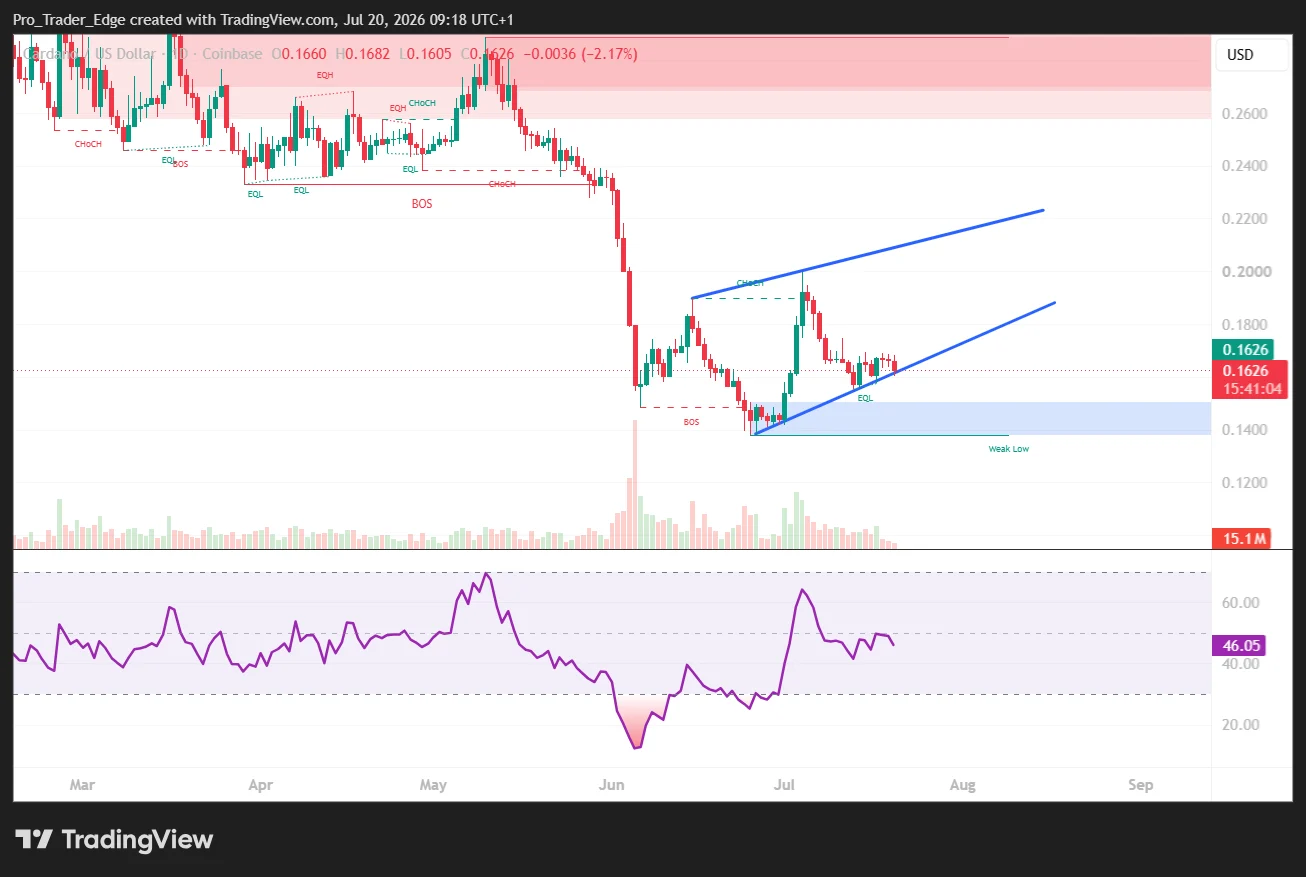
The protocol improvement has not triggered positive price movement for ADA. The cryptocurrency continues trading significantly below its 50-day, 100-day, and 200-day Exponential Moving Averages, which range from $0.180 to $0.270.
Futures Market Reveals Mixed Trader Sentiment
According to Coinglass data, the funding rate turned positive Friday and currently registers at 0.0061% on Monday. Positive funding rates signal that long position holders are compensating short traders, suggesting moderately improved market sentiment.
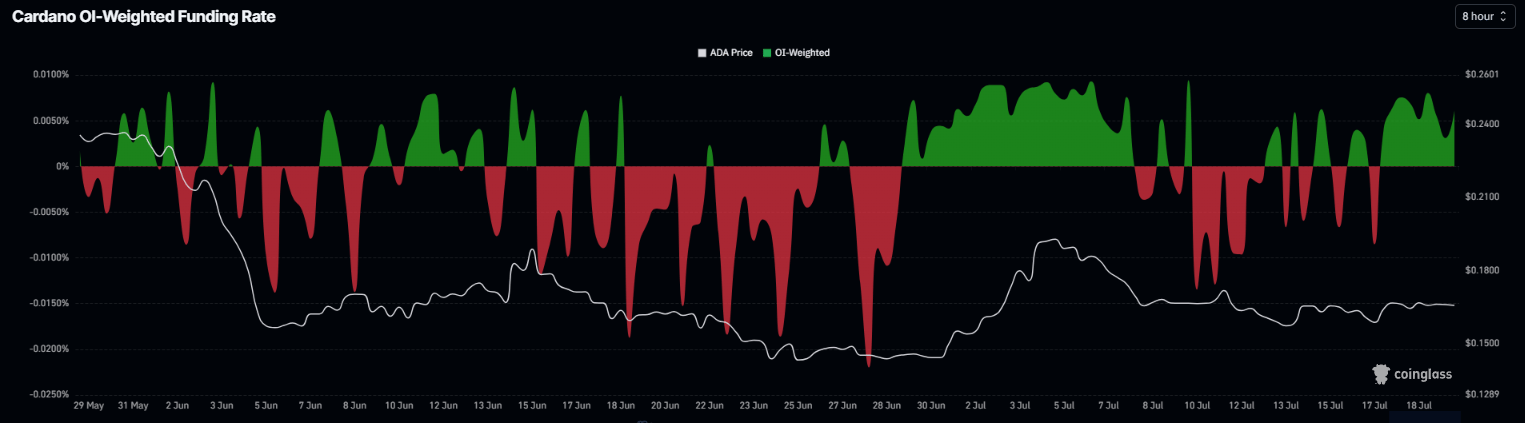
Despite this, ADA’s long-to-short ratio measures 0.90 as of Monday. Values under 1.0 reveal that more market participants are betting on downward price movement rather than gains.
The Relative Strength Index remains just beneath the 50 threshold, indicating neutral momentum without clear directional bias. The MACD indicator shows slight positive territory but lacks strong conviction.
Looking at technical levels, ADA encounters immediate resistance at $0.173, with the 50-day EMA creating another barrier at $0.177. Additional overhead resistance exists at $0.195 and $0.202. Downside support levels are positioned at $0.150 and $0.138.
Following the Van Rossem hard fork implementation, ADA maintains its position at $0.165 with a long-to-short ratio of 0.90 as of Monday’s trading session.
Get 3 Free Stock Ebooks
Discover top-performing stocks in AI, Crypto, and Technology with expert analysis.
- Top 10 AI Stocks - Leading AI companies
- Top 10 Crypto Stocks - Blockchain leaders
- Top 10 Tech Stocks - Tech giants


