


Key Highlights
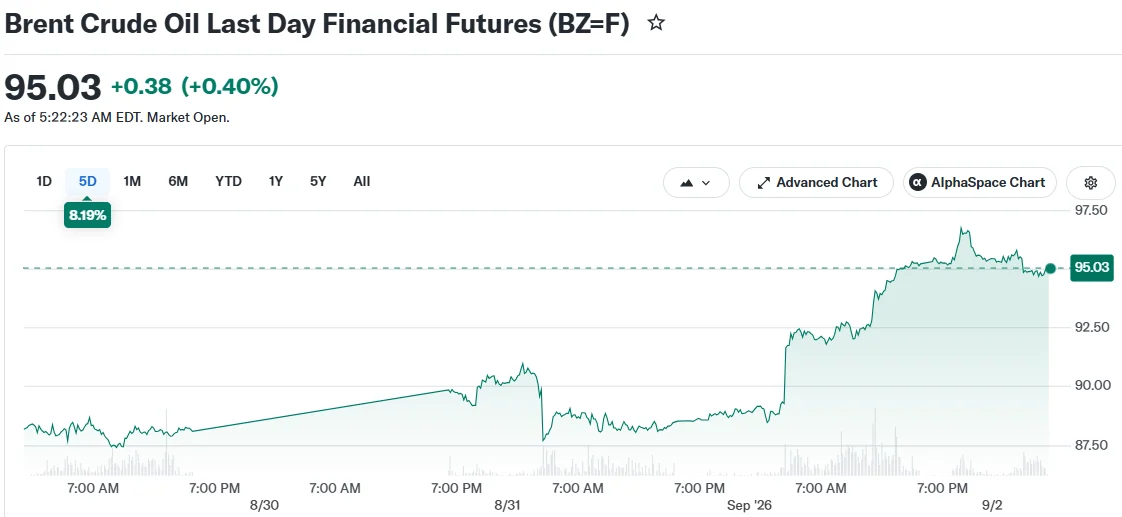
- Brent crude reached $95.55 while WTI climbed to $90.73 per barrel on Wednesday, marking three consecutive sessions of increases
- Fresh U.S. military operations targeted Iranian facilities; Tehran responded with drone and missile strikes against American bases in Jordan and Bahrain
- On Monday, two massive oil tankers sustained damage from unknown projectiles while transiting the Strait of Hormuz
- Iranian oil shipments have plummeted dramatically, declining from approximately 2 million barrels daily in March to just 220,000-255,000 barrels by August
- Treasury Secretary Scott Bessent projected the Strait of Hormuz may lose strategic significance within 24 months as regional pipeline infrastructure expands
Global energy markets extended their upward trajectory for a third consecutive trading session on Wednesday, driven by intensifying military exchanges between Washington and Tehran that threaten to disrupt critical Middle Eastern oil supplies.
Brent crude futures advanced 0.9% to reach $95.55 per barrel, after earlier climbing as high as $97.04 during intraday trading. West Texas Intermediate posted a 0.6% gain to settle at $90.73 per barrel. The previous session saw both benchmark contracts surge approximately 5%.
American forces executed another round of military operations on Tuesday, targeting facilities associated with Iran’s Revolutionary Guard Corps located near the coastal cities of Bandar Abbas and Chabahar. Tehran countered with coordinated missile and unmanned aerial vehicle strikes against American military installations positioned in Jordan and Bahrain.
President Trump characterized the operations as a direct response to Iranian mining activities in the Strait of Hormuz and previous assaults on U.S. positions in Jordan. He indicated that additional, more extensive military action would follow should Iran continue its counterattacks.
Iranian officials communicated through government-controlled media outlets their commitment to respond, identifying American military installations and economic assets throughout the region as possible targets.

Critical Chokepoint Faces Growing Threats
The escalating confrontations have intensified worries regarding petroleum transportation through the Strait of Hormuz, a waterway that previously facilitated approximately 20% of worldwide oil trade.
Earlier this week, a pair of supertankers transporting Saudi Arabian crude sustained hits from unidentified projectiles during their passage through the strategic waterway. Both vessels had taken on approximately 2 million barrels each at Saudi Arabia’s Juaymah loading facility.
“Despite the ongoing standoff between Washington and Tehran, we’ve witnessed continued oil movement through the Strait of Hormuz, though escalating hostilities unmistakably increase the hazards for vessels making crossings,” according to ING’s analyst team.
The U.S. energy secretary reported that 17 million barrels transited the strait on Monday. Nevertheless, market analysts suggested that vessel-tracking information indicated potentially lower actual volumes.
Tehran’s Oil Shipments Collapse
Iranian petroleum exports have experienced a dramatic contraction since hostilities commenced. Reuters data indicates that loadings plunged to between 220,000 and 255,000 barrels daily in August, compared with approximately 2 million barrels per day recorded in March.
Persian Gulf oil production has rebounded to roughly two-thirds of pre-conflict levels, based on Goldman Sachs analysis. A significant portion of this crude is currently being transported through pipeline networks to Red Sea and Gulf of Oman terminals.
Treasury Secretary Scott Bessent noted that Gulf states, including the United Arab Emirates, Saudi Arabia, and Iraq, are aggressively expanding pipeline infrastructure to bypass the strait entirely. He projected the waterway could become “worthless” as a transit route within the next two years.
American crude stockpiles decreased by 2.6 million barrels during the week concluded August 28, based on American Petroleum Institute data. This decline contrasted with the previous week’s 4.2 million barrel build.
ING’s analytical team cautioned that middle distillate crack spreads, an important profitability indicator for refiners, are expected to remain elevated and unpredictable, particularly as seasonal consumption patterns strengthen.
The escalating conflict is simultaneously influencing U.S. monetary policy expectations. Market probability for a Federal Reserve rate hike in September has climbed to approximately 70%, as rising energy costs threaten to fuel inflationary pressures. The Fed’s upcoming September policy meeting has become a focal point for market participants.
Get 3 Free Stock Ebooks
Discover top-performing stocks in AI, Crypto, and Technology with expert analysis.
- Top 10 AI Stocks - Leading AI companies
- Top 10 Crypto Stocks - Blockchain leaders
- Top 10 Tech Stocks - Tech giants


