



Key Highlights
- Crude markets declined more than 3% on Monday with losses extending into Tuesday following diplomatic progress between Washington and Tehran
- Washington approved a 60-day sanctions exemption permitting Iranian crude exports worldwide
- Shipping traffic through the Strait of Hormuz began resuming after extended closure
- America’s Strategic Petroleum Reserve reached its most depleted point since early summer 1983
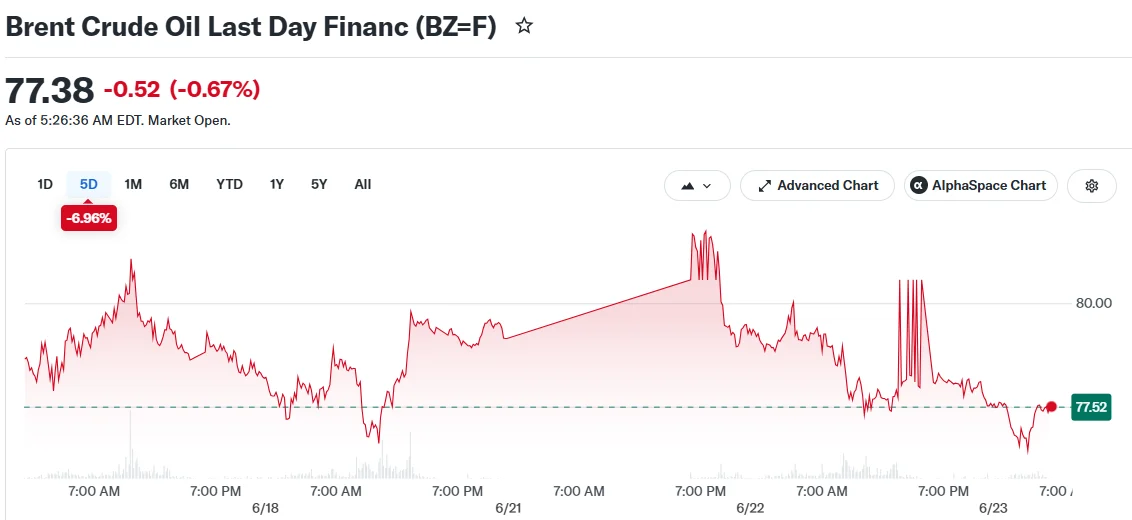
- Brent benchmark descended to approximately $76.76, a dramatic retreat from conflict-era peaks exceeding $120
Washington’s decision to provide Tehran with a temporary sanctions exemption amid diplomatic negotiations has alleviated market anxieties over crude availability, driving benchmark prices down for consecutive trading sessions.
Understanding the Crude Market Selloff
Oil prices experienced substantial declines Monday, with downward momentum carrying through Tuesday after Washington issued a 60-day general authorization enabling Tehran to market crude oil and refined products internationally.
The Brent benchmark retreated approximately 1.5% to reach $76.76 per barrel. The WTI benchmark declined 1.3% to settle at $72.88 per barrel.
The temporary authorization encompasses more than just crude transactions—it extends to associated financial services, insurance coverage, and maritime logistics. This development creates opportunities for Iranian petroleum to access additional markets, potentially including American refineries.
“Tehran had already begun increasing export volumes after Washington removed its blockade. This temporary exemption will enable Iran to access broader markets for its petroleum, potentially including American buyers,” analysts at ING noted.
Benchmark crude had skyrocketed beyond $120 per barrel during peak tensions when maritime passage through the Strait of Hormuz faced severe interruptions.

Strait of Hormuz Shipping Gradually Restarting
The Strait of Hormuz serves as a critical passage for approximately 20% of global petroleum and liquefied natural gas flows. The waterway had remained effectively closed for over three months throughout the conflict period.
Maritime traffic resumed Monday through the strategic waterway. Two medium-sized crude carriers transporting nearly 2 million barrels departed into the Gulf of Oman, based on MarineTraffic tracking information.
Nevertheless, market observers cautioned against expectations of immediate normalization. Vessel operators are demanding verification that underwater explosive devices have been completely removed. Infrastructure damage, maritime debris, and port bottlenecks continue presenting challenges.
“Vessel owners and maritime operators will need guarantees that hazards from underwater explosives have been comprehensively addressed,” explained Tamas Varga, an analyst with PVM Oil Associates.
U.S. Emergency Reserves Hit Four-Decade Minimum
American crude holdings in the Strategic Petroleum Reserve fell to 331.2 million barrels during the previous week. This represents the reserve’s lowest inventory since June 1983.
The depletion illustrates the severity of supply constraints experienced throughout the conflict period. Iranian representatives characterized recent diplomatic discussions as yielding “substantial advancement,” with expectations for a comprehensive agreement within the 60-day timeframe.
Ole Hansen, an analyst with Saxo Bank, observed that the sanctions exemption redirects market focus decisively toward supply fundamentals. Additional Iranian barrels flowing into global commerce now represents the primary factor influencing price movements.
Market analysts surveyed by Reuters anticipate American crude stockpiles also declined during the prior week, providing additional context to a marketplace rapidly adapting to evolving geopolitical circumstances.
Get 3 Free Stock Ebooks
Discover top-performing stocks in AI, Crypto, and Technology with expert analysis.
- Top 10 AI Stocks - Leading AI companies
- Top 10 Crypto Stocks - Blockchain leaders
- Top 10 Tech Stocks - Tech giants


