



TLDR
- Brent crude dropped 0.8% to $97.24 per barrel while WTI declined 1% to $89.50 on Thursday.
- Gulf region crude shipments reached 16.328 million barrels daily in September, marking the highest volume since February’s conflict outbreak.
- Saudi Arabia resumed operations at Yanbu terminal following East-West pipeline repairs.
- Major financial institutions like Goldman Sachs, J.P. Morgan, and Morgan Stanley revised their crude forecasts upward for the remainder of 2023.
- U.S. diesel costs surged to an unprecedented $6.53 per gallon amid discussions of potential export restrictions.
Oil prices retreated on Thursday following Wednesday’s gains, as market participants assessed emerging signals of supply restoration in Middle Eastern producing regions. However, uncertainty persists regarding the durability of this recovery.
December Brent crude futures declined 0.8% to settle at $97.24 per barrel as of 02:41 ET. Meanwhile, U.S. West Texas Intermediate crude slipped 1% to reach $89.50 per barrel.
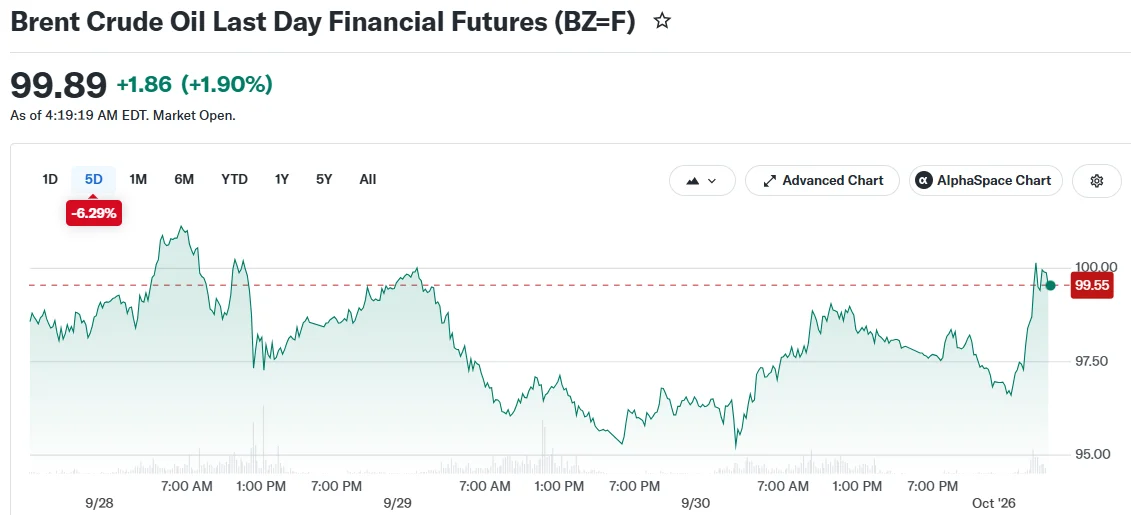
Wednesday marked the expiration of the front-month Brent contract, which closed at $103.50 in the previous trading session.
September proved strong for both benchmarks, with Brent climbing approximately 14%—its most robust monthly performance since July. WTI posted gains of roughly 5% during the same period.
Gulf Region Shipments Show Recovery
Fresh data indicates a rebound in regional petroleum shipments. September saw Middle Eastern crude exports hit 16.328 million barrels daily, representing the peak volume since hostilities commenced in February, based on figures from analytics provider Kpler.

The Kingdom of Saudi Arabia has restarted loading operations at Yanbu, its Red Sea export facility. This follows the successful repair and restart of the East-West pipeline system, which sustained earlier damage.
Despite these improvements, regional shipment volumes continue trailing pre-conflict benchmarks. Kpler’s analysis reveals September exports remained approximately 3.2 million barrels per day below February figures. This gap leaves markets vulnerable to additional supply interruptions.
Diplomatic developments continue influencing market sentiment. Iran announced Wednesday it had received Washington’s response to its most recent ceasefire proposal. This followed President Trump’s rejection of an earlier framework connected to Strait of Hormuz access.
Financial Institutions Increase Price Projections
According to a Wall Street Journal analysis, leading financial institutions have elevated their crude price outlooks. Goldman Sachs, J.P. Morgan, and Morgan Stanley collectively project Brent crude will average $90.22 per barrel during Q4. WTI is forecast to average $85.47 per barrel.
These projections significantly exceed previous estimates of $78.92 and $74.62 per barrel respectively. The upward revisions stem from persistent concerns about supply interruptions linked to the Iranian situation.
Looking at full-year 2023, the survey anticipates Brent averaging $88.13 per barrel, with WTI expected at $82.98 per barrel. Analysts forecast some price moderation in early 2024, projecting Brent at $83.44 and WTI at $79.88 during the first quarter.
Chinese petroleum consumption patterns remain difficult to forecast. Beijing has drawn upon strategic reserves accumulated prior to the conflict, reducing immediate purchase requirements. Goldman Sachs data shows Chinese crude imports climbed 6% in September versus August levels.
Concurrently, U.S. refined product markets face increasing constraints. Gasoline inventories declined by 1.7 million barrels in the previous week. Distillate reserves, encompassing diesel and heating oil, fell by 2.3 million barrels.
U.S. diesel costs reached an unprecedented $6.53 per gallon last week. Diesel stockpiles remain at exceptionally depressed levels. President Trump indicated Wednesday that deliberations continue regarding potential restrictions on U.S. diesel exports. The White House previously disputed media reports suggesting a 90-day comprehensive export prohibition.
Russia appears poised to prolong its diesel export limitations for an additional month. This development compounds pressure on already strained international fuel supplies as the year’s final quarter approaches.
Get 3 Free Stock Ebooks
Discover top-performing stocks in AI, Crypto, and Technology with expert analysis.
- Top 10 AI Stocks - Leading AI companies
- Top 10 Crypto Stocks - Blockchain leaders
- Top 10 Tech Stocks - Tech giants


