


Key Takeaways
- Banking giant Standard Chartered initiated coverage on Ethena with a $2 ENA price projection through year-end 2028.
- Analysts forecast USDe stablecoin supply expanding from current $4.9 billion to $40 billion during this timeframe.
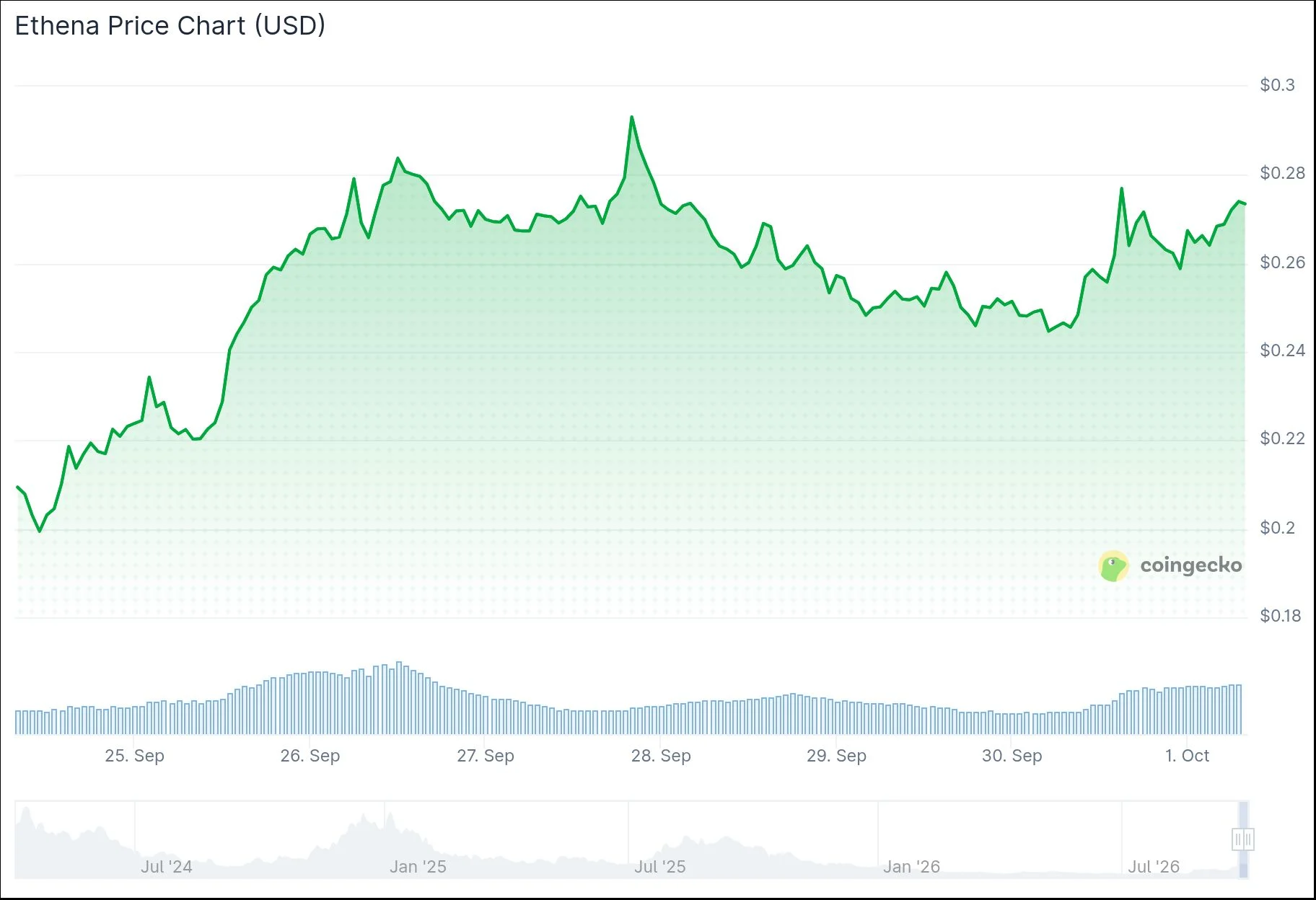
- With ENA trading near $0.26 on Wednesday, the projection represents approximately 669% potential upside.
- The protocol’s fee mechanism allocates 95% of net revenues toward ENA token repurchases.
- Following the announcement, ENA surged over 5%, extending monthly gains beyond 77%.
Banking institution Standard Chartered has launched research coverage on Ethena, establishing a $2 price objective for the ENA token through the conclusion of 2028. Analyst Geoff Kendrick anchored this projection on Ethena’s expanding presence across stablecoins, tokenization infrastructure, and perpetual futures markets.
With ENA changing hands at $0.26 on Wednesday, the financial institution’s projection represents roughly 669% appreciation from present levels.
The core of Standard Chartered’s analysis focuses on USDe, the stablecoin issued by Ethena. Analysts anticipate USDe circulation will multiply over eight times, expanding from today’s $4.9 billion to approximately $40 billion through 2028.
Ethena presently holds the position as the fourth-largest stablecoin provider globally, positioned behind Tether, Circle, and Sky. Within the yield-generating stablecoin category, it maintains second place after Sky.
Diversification of USDe Revenue Streams
According to the bank’s research, Ethena is actively diversifying USDe’s yield generation mechanisms. Profits derived from cryptocurrency basis trading, the protocol’s initial strategy, have recently declined.

Additional revenue sources now encompass real-world asset integration, decentralized finance lending protocols, institutional credit facilities, and basis trades linked to equities or commodities. Ethena has also entered tokenized stock markets via Binance’s bStocks platform.
Standard Chartered’s broader market analysis suggests tokenized assets collectively, encompassing stablecoins and additional real-world assets, will achieve $4 trillion by 2028. Current market capitalization stands near $350 billion.
Token Repurchase Framework
A substantial component of the ENA valuation model relies on Ethena’s fee switch mechanism, which secured unanimous approval through governance voting. This framework channels 95% of net revenues generated by Ethena-branded operations toward ENA token repurchases.
Standard Chartered’s calculations indicate that achieving $40 billion USDe supply while ENA maintains current pricing would generate annual buybacks equivalent to roughly 23% of circulating token supply. Analysts consider this repurchase rate unsustainable at constant prices, suggesting token appreciation becomes necessary for long-term economic viability.
The research draws parallels with Uniswap’s experience. UNI’s annualized repurchase rate stabilized within the 3% to 4% range following its fee switch activation in December 2025, with the token approximately tripling since Standard Chartered initiated coverage last June.
Market observers express varying perspectives. Analyst Altcoin Sherpa commented on X that ENA “probably goes back to $1 in crazy bullish conditions,” representing a more measured expectation than the bank’s $2 forecast while still indicating substantial appreciation potential from current trading levels.
Standard Chartered identified decelerating expansion within yield-bearing stablecoins as the primary downside risk to their thesis. Reduced momentum in real-world asset blockchain migration represents a secondary concern, given Ethena’s growing reliance on these instruments for revenue generation.
ENA advanced more than 5% immediately following the research publication, trading around $0.26 based on TradingView market data. The token has appreciated over 77% across the trailing thirty-day period.
This price movement coincided with Bitcoin surpassing $85,000, supported by softer-than-anticipated PCE inflation metrics that diminished market expectations for a Federal Reserve interest rate reduction in October.
Get 3 Free Stock Ebooks
Discover top-performing stocks in AI, Crypto, and Technology with expert analysis.
- Top 10 AI Stocks - Leading AI companies
- Top 10 Crypto Stocks - Blockchain leaders
- Top 10 Tech Stocks - Tech giants


