



TLDR
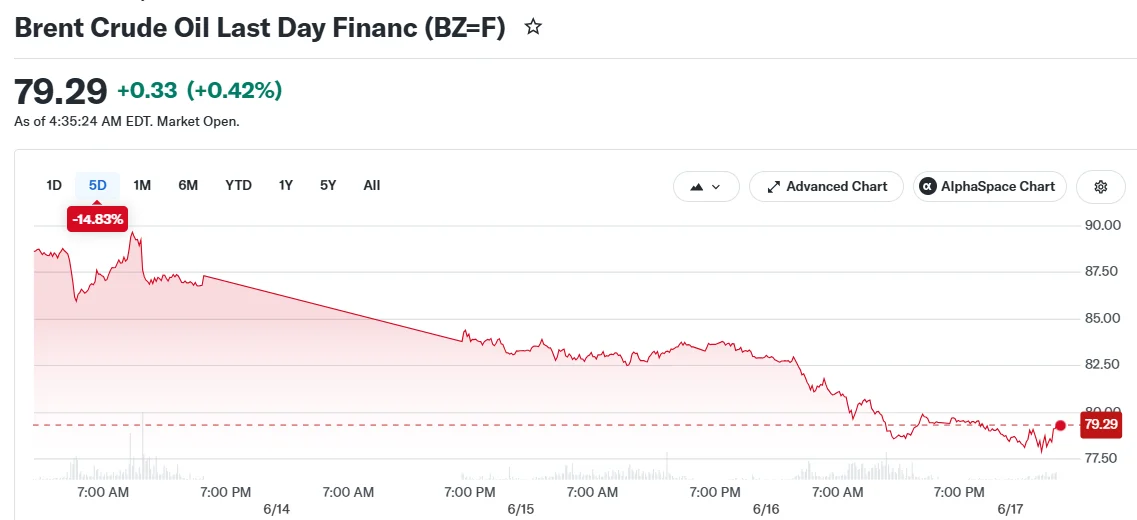
- Brent crude declined to approximately $78 per barrel, marking its weakest level since March
- Washington and Tehran reached an interim agreement set for Friday signing, reopening the Strait of Hormuz
- Iranian oil exports will resume immediately following the agreement’s execution
- American crude stockpiles decreased by 8.33 million barrels in the latest week, exceeding forecasts significantly
- US gasoline costs have retreated toward $4 per gallon after reaching May highs exceeding $4.56
Crude oil markets extended their downward trajectory for a fifth consecutive trading day on Wednesday, reaching their weakest valuations since the beginning of March, as market participants anticipated additional Iranian barrels entering the global marketplace following a diplomatic breakthrough between the United States and Iran.
Brent crude futures declined to approximately $78.23 per barrel, while the West Texas Intermediate benchmark slipped to $75.16. Both major oil indices have shed nearly 10% of their value across the previous two trading sessions.
Diplomatic Breakthrough Pressures Markets
Washington and Tehran have finalized a preliminary accord scheduled for official signing on Friday. According to the agreement’s terms, Iran will permit commercial shipping to resume passage through the Strait of Hormuz, while the United States will discontinue its naval blockade of Iranian maritime facilities.
The Islamic Republic will gain authorization to export petroleum products immediately upon the agreement’s execution. The framework includes American sanctions waivers encompassing Iranian crude oil, petrochemical products, and associated services including financial transactions and insurance coverage.
A comprehensive 14-point preliminary memorandum establishes the agreement’s framework. Additionally, it initiates a 60-day period of structured negotiations designed to conclude hostilities and impose restrictions on Iran’s nuclear enrichment activities.

The Strait of Hormuz represents a critical maritime chokepoint linking the Persian Gulf with the Indian Ocean. During peacetime conditions, approximately one-fifth of global oil supplies transit through this strategic waterway.
Logistical Challenges Remain for Supply Restoration
Market observers are closely monitoring the timeline for actual supply restoration. Maritime operators are awaiting definitive guidance on security protocols before dispatching vessels through the strait.
Dennis Kissler, senior vice president for trading operations at BOK Financial Securities, indicated that American naval assets would probably provide convoy protection during the initial weeks, while mine-clearing operations would additionally constrain traffic flow.
Parash Jain, global head of transport and logistics research at HSBC, emphasized that any restoration would occur incrementally. He noted that shipping companies invested considerable time reorganizing their routes and would exercise caution before reversing these adjustments until security conditions were definitively confirmed.
Vessel-tracking systems have already detected two oil tankers previously bound for African destinations executing course reversals in the Indian Ocean, now heading toward Middle Eastern ports.
Strong Inventory Decline Provides Market Support
Notwithstanding the pessimistic sentiment surrounding supply prospects, a substantial reduction in American crude stockpiles offered some stabilization to energy markets.
The American Petroleum Institute disclosed that domestic crude reserves contracted by 8.33 million barrels during the week concluded June 12. This withdrawal exceeded analyst projections of a 4.5 million barrel decline by more than double.
The inventory data suggested robust consumption patterns within the United States, the planet’s primary petroleum consumer. Official governmental inventory statistics were scheduled for release later Wednesday.
Fuel prices at American pumps have also moderated. The nationwide average has retreated toward $4 per gallon following May peaks above $4.56, according to American Automobile Association tracking data.
The Federal Reserve was simultaneously convening Wednesday to determine monetary policy direction. While no adjustment to interest rates was anticipated, declining energy expenses represented a consideration for policymaking officials.
Get 3 Free Stock Ebooks
Discover top-performing stocks in AI, Crypto, and Technology with expert analysis.
- Top 10 AI Stocks - Leading AI companies
- Top 10 Crypto Stocks - Blockchain leaders
- Top 10 Tech Stocks - Tech giants


