



Key Highlights
- Record-setting session saw the Dow Jones Industrial Average breach the 52,000 threshold for the first time, propelled by diplomatic progress between Washington and Tehran.
- Under terms of the emerging agreement, Tehran would gain immediate authorization to restart petroleum exports, triggering downward pressure on energy prices.
- No change in monetary policy is anticipated from the Federal Reserve, with newly appointed Chair Kevin Warsh preparing for his inaugural media briefing.
- Market participants are analyzing Warsh’s communication approach for signals regarding monetary policy direction, as persistent inflation and employment strength have eliminated near-term easing prospects.
- Cryptocurrency markets showed weakness, with Bitcoin declining 1.3% to $64,469 in the 24-hour period preceding the central bank announcement.
Equity markets displayed strength during Wednesday’s premarket session, extending gains from the previous day’s historic performance as speculation mounted regarding an imminent diplomatic resolution between the United States and Iran.
Tuesday marked a watershed moment when the Dow Jones Industrial Average shattered the 52,000-point barrier for the first time in history. Wednesday’s early trading showed continued momentum with Dow futures advancing approximately 50 points, representing a 0.1% increase. S&P 500 futures climbed 0.3%, while Nasdaq 100 futures demonstrated robust gains of 0.8%, primarily driven by technology sector enthusiasm.
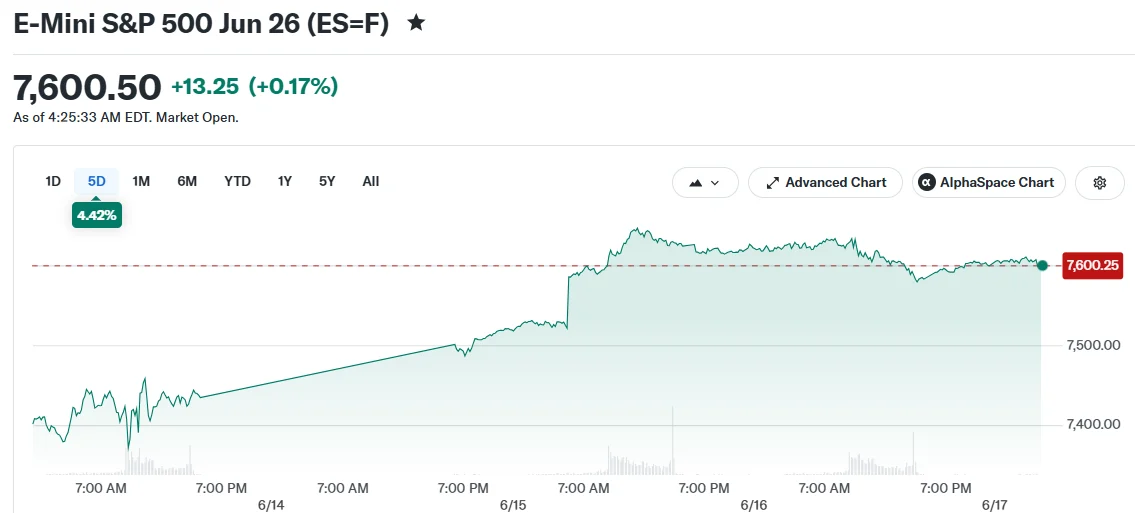
The broader market indices — specifically the S&P 500 and Nasdaq Composite — experienced modest declines during Tuesday’s session as capital flowed from technology holdings into previously underperforming sectors.
According to reporting from the Wall Street Journal, the diplomatic framework would grant Iran authorization to commence petroleum and refined product sales without delay. Both nations are targeting Friday for the official signing ceremony of the comprehensive agreement.
Energy commodity markets reacted negatively to the diplomatic developments. Brent crude futures declined 0.7% to settle at $78.43 per barrel, while West Texas Intermediate experienced a steeper 1.1% drop to $75.25 per barrel.

Central Bank Policy Announcement Under New Leadership
The Federal Reserve will unveil its latest monetary policy determination at 2 p.m. Eastern time. Market consensus overwhelmingly anticipates the central bank will maintain current interest rate levels.
However, significant attention is focused on Warsh’s debut press conference in his new capacity as Fed chair. Investors seek insight into his communication methodology and perspective on future monetary policy adjustments.
“Market participants must now adapt to the incoming Fed Chair’s messaging approach, representing a transition phase for financial markets,” noted James Demmert, chief investment officer at Main Street Research.
Warsh assumes leadership during a particularly challenging economic environment. Elevated inflation readings, partially attributed to geopolitical tensions with Iran, coupled with robust employment conditions, have effectively eliminated the possibility of near-term rate reductions. Questions persist about whether policy tightening could resume should inflationary pressures fail to subside.
Demmert emphasized that any market turbulence stemming from Warsh’s Wednesday remarks should be viewed as an attractive entry point, noting that “underlying market fundamentals remain intact.”
Digital Currency Weakness Precedes Monetary Policy Decision
Bitcoin experienced a 1.3% decline during the preceding 24-hour period, settling at $64,469, mirroring the defensive positioning in broader markets ahead of the Fed’s policy statement.
The benchmark 10-year U.S. Treasury yield edged lower by 1 basis point to 4.44%. The U.S. dollar index remained unchanged against its major currency counterparts.
Market observers continue monitoring conditions in the Strait of Hormuz, where petroleum transit has faced disruption due to ongoing tensions. The diplomatic accord raises expectations that maritime commerce could normalize, potentially alleviating constraints on international energy supply chains.
Washington and Tehran are working toward formalizing the 14-point memorandum of understanding on Friday, following Tuesday evening’s disclosure of the agreement’s provisions.
Get 3 Free Stock Ebooks
Discover top-performing stocks in AI, Crypto, and Technology with expert analysis.
- Top 10 AI Stocks - Leading AI companies
- Top 10 Crypto Stocks - Blockchain leaders
- Top 10 Tech Stocks - Tech giants


