



Key Takeaways
- Retail holders distributed a combined 307K ETH during the past week, significantly exceeding the 82K ETH accumulated by whales.
- US spot Ethereum ETF inflows collapsed to $218.4M from $824M week-over-week, representing a 74% decline.
- ETH continues to face rejection at the $2,544 resistance threshold across multiple attempts.
- More than 116,000 ETH exited centralized exchanges within a 48-hour window, tightening available selling inventory.
- Critical demand zone established at $2,475, representing a price level where approximately 2.86 million ETH previously transacted.
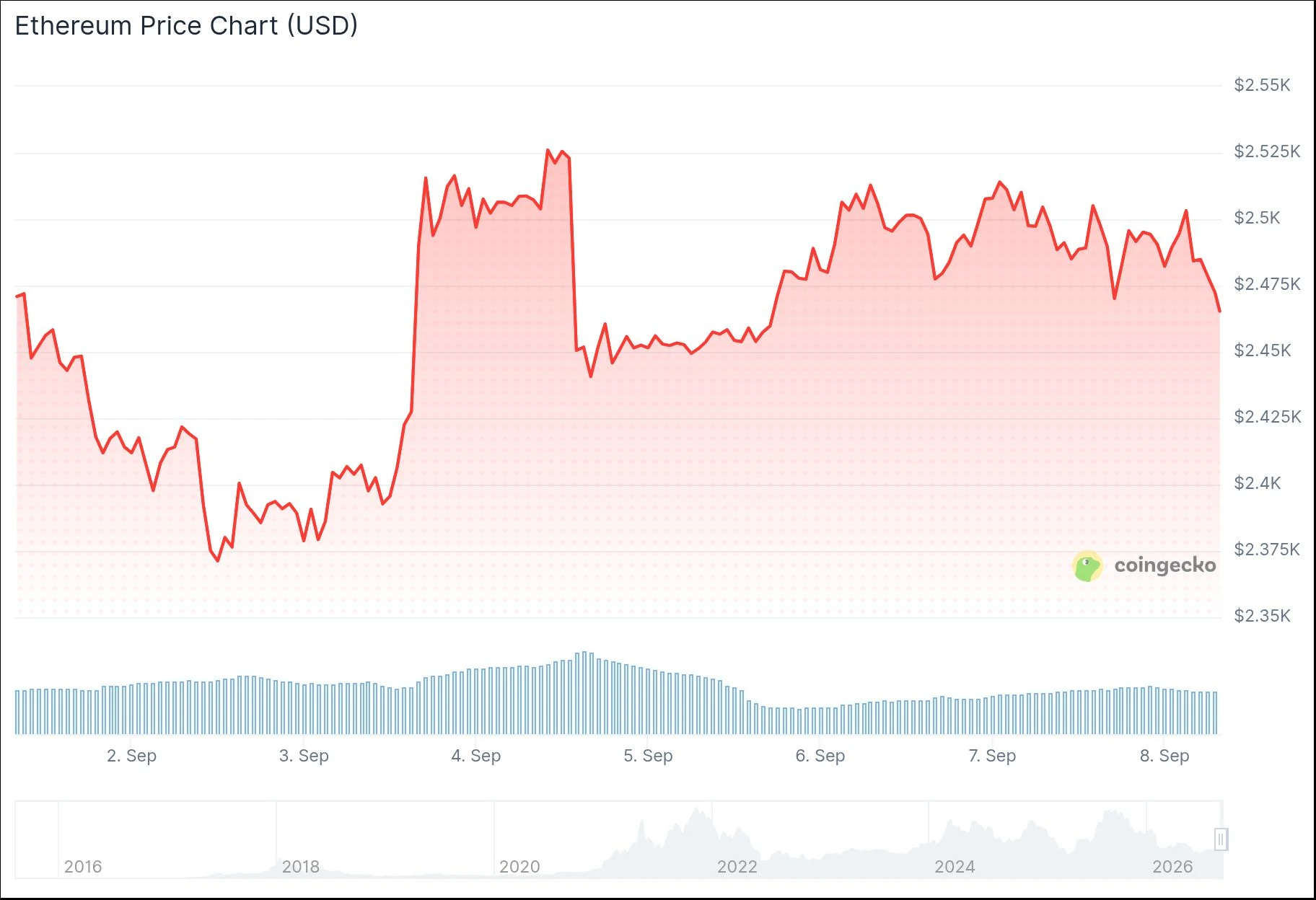
Ethereum currently hovers around the $2,495 mark and has encountered difficulty maintaining momentum above the $2,500 threshold. The primary obstacle preventing upward price action stems from persistent retail distribution.
Address clusters holding between 1,000 and 10,000 ETH offloaded 214K tokens during the previous seven-day period. Meanwhile, wallets containing 100–1,000 ETH distributed an additional 93K tokens. Combined, retail cohorts dumped 307K ETH in just one week.
Analysis suggests these holders are exiting positions near their entry points. On-chain data indicates their average acquisition price hovers around $2,265, positioned slightly beneath current trading levels.
Institutional Accumulation and ETF Interest Weakens
Large holders — addresses containing 10,000 to 100,000 ETH — did exhibit buying activity, accumulating 82K tokens throughout the week. However, this absorption proved insufficient to counterbalance the selling volume from smaller investors.
Investment vehicle demand also experienced a significant downturn. United States-based spot Ethereum exchange-traded funds recorded $218.4 million in net inflows last week, marking a roughly 74% decrease from the previous week’s $824 million. During the identical timeframe, Bitcoin ETFs attracted $986.9 million in capital.

Market commentator Ted Pillows observed that purchasing appetite has diminished throughout major digital assets, initially affecting Bitcoin before spreading to Ethereum. He indicated that another substantial upward movement remains feasible if buying interest resurfaces within the coming days, though a correction may materialize first should demand remain subdued.
Network activity on Ethereum has remained depressed, with daily active addresses consistently registering below 500,000 throughout September, reflecting a decline exceeding 5% compared to the equivalent timeframe last year.
Exchange Withdrawals Provide Modest Relief
Market observer Ali Martinez documented that over 116,000 ETH was withdrawn from cryptocurrency trading platforms during the preceding 48 hours, representing approximately $300 million in value. Total exchange reserves declined to roughly 11.92 million ETH, marking the lowest level since August 31.
Reduced token availability on centralized platforms diminishes the supply accessible for rapid liquidation.
Analyst Crypto Patel highlighted that ETH remains confined within a well-defined trading corridor, encountering resistance between $2,520–$2,530 and finding support within the $2,360–$2,370 range. According to his assessment, a confirmed two-hour candle closure above $2,530 would signal a bullish breakout trajectory targeting $3,000, whereas a breakdown beneath $2,370 would elevate downside exposure toward $2,000.
Ali Charts identified $2,475 as a critical demand zone, emphasizing that the pathway toward $2,722 remains viable provided this support floor maintains integrity. The more substantial challenge emerges between $2,723 and $2,822, representing a price range where in excess of 10 million ETH changed ownership historically.
Ethereum witnessed $39.5 million in forced liquidations throughout the past 24-hour cycle, with $22.4 million originating from bearish positions.
The Relative Strength Index currently registers near 64, and ETH maintains positioning above all primary moving averages when examined on the daily timeframe.
Get 3 Free Stock Ebooks
Discover top-performing stocks in AI, Crypto, and Technology with expert analysis.
- Top 10 AI Stocks - Leading AI companies
- Top 10 Crypto Stocks - Blockchain leaders
- Top 10 Tech Stocks - Tech giants


