



Key Highlights
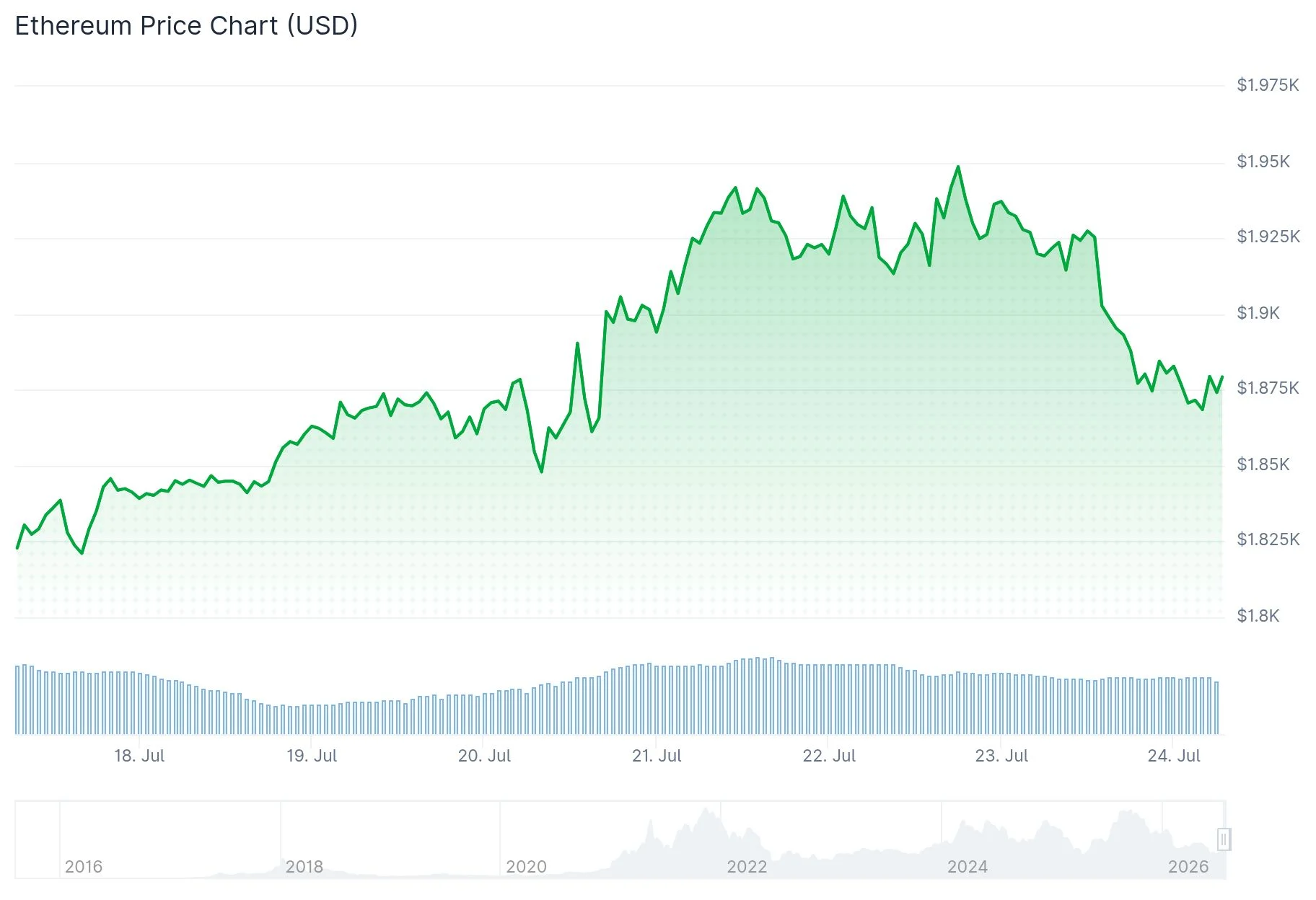
- Ethereum currently changes hands around $1,927, struggling to surpass the crucial $2,000 threshold despite gaining 27% from June lows
- Escalating crude oil costs are amplifying inflation concerns, with September Fed rate hike probability now reaching 79%
- U.S. spot Ethereum ETFs recorded $72.64 million in net inflows on July 22, with BlackRock contributing $53.47 million
- BitMEX’s upcoming September 23 shutdown introduces additional concerns regarding leverage dynamics and market liquidity
- According to CryptoQuant analysis, ETH currently trades 17% beneath its realized price of approximately $2,300, a level historically associated with market bottoms
Ethereum finds itself trapped in a challenging position — unable to reclaim the $2,000 threshold. The digital asset hovered around $1,927 on July 23, following an intraday peak of $1,941. While this represents a significant 27% bounce from its June bottom near $1,514, consistent rejections around $1,955 have prevented ETH from achieving a sustainable breakthrough above the psychological $2,000 mark.
The primary headwind currently facing the market stems from developments in energy commodities. Escalating geopolitical tensions across the Middle East have driven crude oil prices upward for five consecutive trading sessions. West Texas Intermediate surged past the $90 per barrel threshold following Houthi militant attacks targeting Saudi Arabian oil tankers, sparking fresh supply disruption fears. Elevated energy costs typically accelerate inflationary pressures and constrain the Federal Reserve’s flexibility to maintain accommodative monetary policy.
Interest rate expectations have experienced a notable shift in recent sessions. Market-implied probabilities for a September Federal Reserve rate increase have jumped from 68% to 79%, based on CME FedWatch Tool metrics. Such a restrictive monetary policy stance historically creates downward pressure on speculative assets including cryptocurrencies.
Institutional Capital Provides Cushion
Notwithstanding these macroeconomic challenges, institutional investment has continued flowing into Ethereum products. U.S. spot Ethereum ETFs attracted $72.64 million in net inflows on July 22, according to SoSoValue tracking data. BlackRock’s iShares Ethereum Trust dominated this activity, capturing $53.47 million of the aggregate total.
Market analyst Ted Pillows emphasized the persistence of spot buying pressure. He commented: “Spot demand is strong and the key support zone hasn’t been lost. IMO, Ethereum could begin its next move up in a few days.” Pillows highlighted $2,030 as the initial upside objective, while identifying more substantial resistance clustered around $2,400.

Cryptocurrency analyst Daan Crypto Trades additionally observed that ETH has been demonstrating relative strength versus Bitcoin. He mentioned that ETH/BTC dominance patterns could experience a rotation if Ethereum sustains its outperformance, although Bitcoin dominance has not yet exhibited reversal signals.
Blockchain Metrics and Market Uncertainties
The latest CryptoQuant research indicates ETH is trading approximately 17% under its realized price of roughly $2,300. This valuation level has historically marked significant long-term accumulation zones. Nevertheless, only two out of CryptoQuant’s five bottoming signals have triggered confirmation thus far.
Separately, BitMEX disclosed plans to cease operations on September 23. The platform has facilitated trading for more than 2 million users since its 2014 launch. Account holders have been instructed to liquidate positions and complete fund withdrawals ahead of the closure date.
A historic 34% of Ethereum’s circulating token supply is currently locked in staking contracts, per Staking Rewards statistics. Tom Lee’s Bitmine Immersion Technologies has accumulated 325,000 ETH throughout the past month and maintains an objective of controlling 5% of total ETH supply.
Ethereum requires a decisive 4-hour candle close above $1,955 to establish momentum toward the $2,000–$2,030 zone. A breakdown below $1,860 would compromise the current bullish recovery pattern.
Get 3 Free Stock Ebooks
Discover top-performing stocks in AI, Crypto, and Technology with expert analysis.
- Top 10 AI Stocks - Leading AI companies
- Top 10 Crypto Stocks - Blockchain leaders
- Top 10 Tech Stocks - Tech giants


