


Key Highlights
- Dutch TTF natural gas futures plummeted over 5% on Friday, reaching their lowest point in two weeks.
- The decline followed President Trump’s announcement that a U.S.-Iran peace agreement could be finalized this weekend.
- Trump canceled scheduled U.S. military operations against Iran, reducing conflict escalation concerns.
- Approximately 20% of worldwide LNG supply flows through the Strait of Hormuz, which had been a significant market concern.
- Despite the price decline, market uncertainty persists as Iran has yet to officially confirm the final agreement.
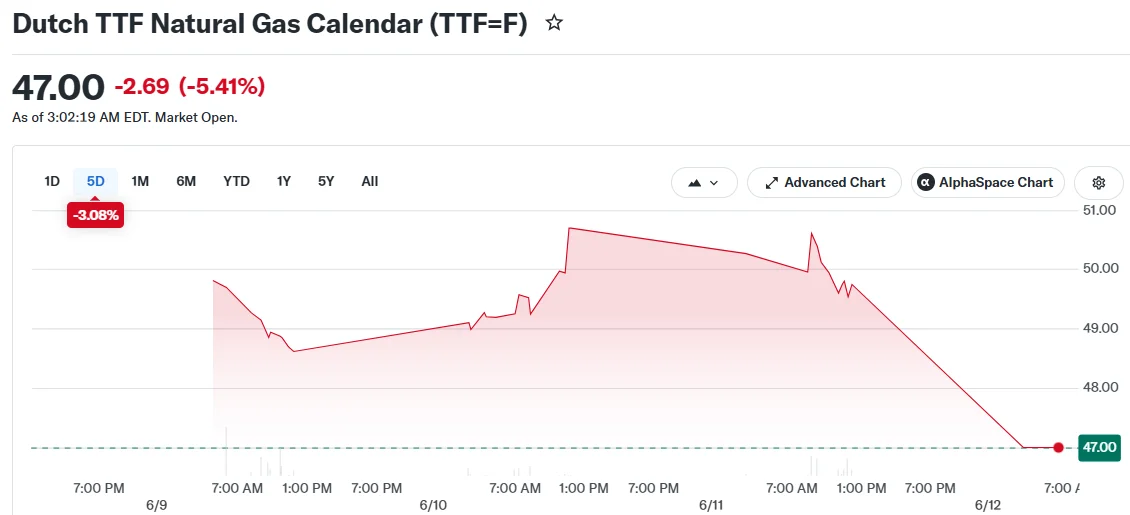
European natural gas futures experienced a significant downturn on Friday following statements from President Donald Trump suggesting progress in nuclear negotiations with Iran. The Dutch TTF natural gas benchmark contract plunged more than 5% to approximately €47 per megawatt-hour, marking its weakest performance in a fortnight.
According to Trump, a diplomatic agreement could potentially be executed in Europe within the coming weekend. Additionally, he revealed the cancellation of planned U.S. military operations targeting Iran. These developments triggered a selloff in energy markets as investors reduced their positions betting on imminent supply chain disruptions.
The Strategic Importance of the Strait of Hormuz
Recent weeks have seen the Strait of Hormuz emerge as a primary focal point for market anxiety. This critical maritime passage facilitates the transport of roughly one-fifth of the world’s liquefied natural gas volumes. Any potential blockade or military engagement in this region could severely constrain supply availability to European markets and international consumers.
Earlier in the week, Trump had issued threats regarding the seizure of Iran’s Kharg Island and potential control of its hydrocarbon resources. These statements drove natural gas valuations near multi-week peaks and maintained elevated trader anxiety approaching the summer months.
European markets face heightened vulnerability given that underground storage inventories currently sit below comparable levels from the previous year. Any constriction in global LNG availability could have driven prices substantially higher during the critical summer storage replenishment period.

Qatar represents a significant LNG exporting nation with shipments transiting through the Strait of Hormuz. Although Europe sources considerable natural gas through pipeline infrastructure and Atlantic basin suppliers, it remains in competition for spot cargoes in the international marketplace.
Trader Skepticism Persists Despite Price Correction
Notwithstanding the substantial price decline, market participants remain unconvinced that an agreement is finalized. Iranian authorities have not yet provided official confirmation of a completed framework accord, although officials have indicated that primary terms have been settled.
British natural gas futures also declined approximately 2% on Friday, briefly touching a one-month low at the session open before recovering slightly by settlement.
Crude oil similarly retreated to two-month lows following the same announcements. Market analysts characterized Trump’s statements regarding a peace agreement as the most substantive indication to date of a diplomatic resolution.
The ICE Dutch TTF contract, serving as Europe’s primary natural gas pricing benchmark, dropped below €47, briefly reaching €46.19 during the session. This represents a notable decline from levels exceeding €50 observed earlier in the week.
The geopolitical risk premium accumulated throughout weeks of escalating U.S.-Iran tensions dissipated rapidly across markets. However, until formal signatures appear on an official agreement, traders are anticipated to maintain vigilant monitoring.
Any resurgence of hostilities or breakdown in diplomatic discussions could swiftly reverse Friday’s price retreat and propel European natural gas back toward recent elevated levels.
Get 3 Free Stock Ebooks
Discover top-performing stocks in AI, Crypto, and Technology with expert analysis.
- Top 10 AI Stocks - Leading AI companies
- Top 10 Crypto Stocks - Blockchain leaders
- Top 10 Tech Stocks - Tech giants


