



Key Takeaways
- July U.S. inflation figures aligned with forecasts, diminishing expectations for a Fed rate increase in September
- Major European indices posted gains, with London’s FTSE 100 climbing 0.6%, while Frankfurt’s DAX and Paris’s CAC 40 advanced 0.3%
- British economic expansion reached 0.4% during the second quarter, in line with analyst predictions
- Crude prices retreated from recent peaks but maintained positions above the $80 threshold despite Middle East geopolitical concerns
- Danish jeweler Pandora saw shares surge almost 3% following stronger-than-anticipated quarterly results
Equity markets across Europe registered solid gains on Thursday following the release of U.S. inflation statistics that aligned with analyst forecasts, diminishing the likelihood that the Federal Reserve will implement a rate increase next month.
The benchmark Stoxx Europe 600 Index climbed 0.2%, extending its advance toward all-time highs. The rally was broad-based across European trading centers.
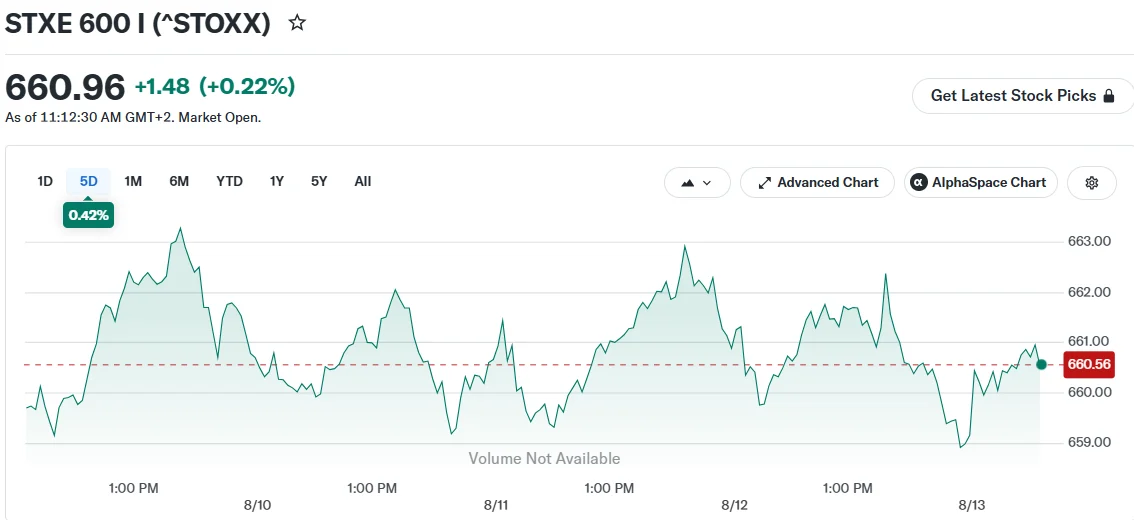
Frankfurt’s DAX index and the CAC 40 in Paris each posted 0.3% advances. The FTSE 100 in London led regional performance with a 0.6% climb, buoyed by encouraging domestic economic figures.
The positive momentum followed Wednesday’s release of the U.S. Consumer Price Index, which revealed headline inflation increased just 0.1% on a monthly basis during July. The core inflation measure remained stable at 2.5% compared to the previous year.
Investor sentiment had been fragile following the previous week’s disappointing U.S. employment figures. The measured inflation data helped restore confidence among market participants.

Interest rate futures adjusted swiftly following the release. The likelihood of a quarter-point Federal Reserve rate increase at the September 16 policy meeting fell to approximately 40%, declining from nearly 67% a week earlier.
“The US July CPI number offered up nothing in the way of a surprise,” said Sam Hill, head of market insights at Lloyd’s Bank. “It is hard to see a September hike on that basis.”
British Economic Expansion Reaches 0.4% in Second Quarter
The United Kingdom’s economy registered 0.4% growth during the April-June period, precisely matching economist expectations. The expansion was predominantly fueled by robust performance in consumer-oriented service industries.
While the figure represented a modest deceleration from the first quarter’s 0.5% expansion, it proved sufficient to bolster confidence in UK financial assets. The data provides the Bank of England with justification to maintain its cautious approach toward monetary easing without being forced to react to recessionary concerns.
The encouraging GDP release provided additional lift to the FTSE 100, with industrial companies and domestic banking institutions among the top performers.
Energy Markets Retreat, Corporate Results Take Center Stage
Crude oil quotations declined from multi-week peaks on Thursday but remained supported above the $80 per barrel level. Market participants continued monitoring escalating friction between Washington and Tehran regarding navigation through the Strait of Hormuz, which has maintained an elevated risk premium in petroleum markets.
On the corporate front, shares of Pandora climbed nearly 3% after the Danish jewelry retailer surpassed second-quarter profit projections and upgraded its annual guidance.
Thyssenkrupp declined 1.5% notwithstanding a tightened 2026 forecast range. Danish maritime giant Maersk elevated its full-year underlying EBITDA projection beyond consensus estimates.
Market attention also turned toward forthcoming Eurozone manufacturing output statistics for June and Spain’s finalized July consumer price readings, scheduled for release later in the trading day.
Additional corporate earnings announcements were anticipated from E.On, RWE, Antofagasta, Birkenstock, and Nomad Foods.
Get 3 Free Stock Ebooks
Discover top-performing stocks in AI, Crypto, and Technology with expert analysis.
- Top 10 AI Stocks - Leading AI companies
- Top 10 Crypto Stocks - Blockchain leaders
- Top 10 Tech Stocks - Tech giants


