


Key Takeaways
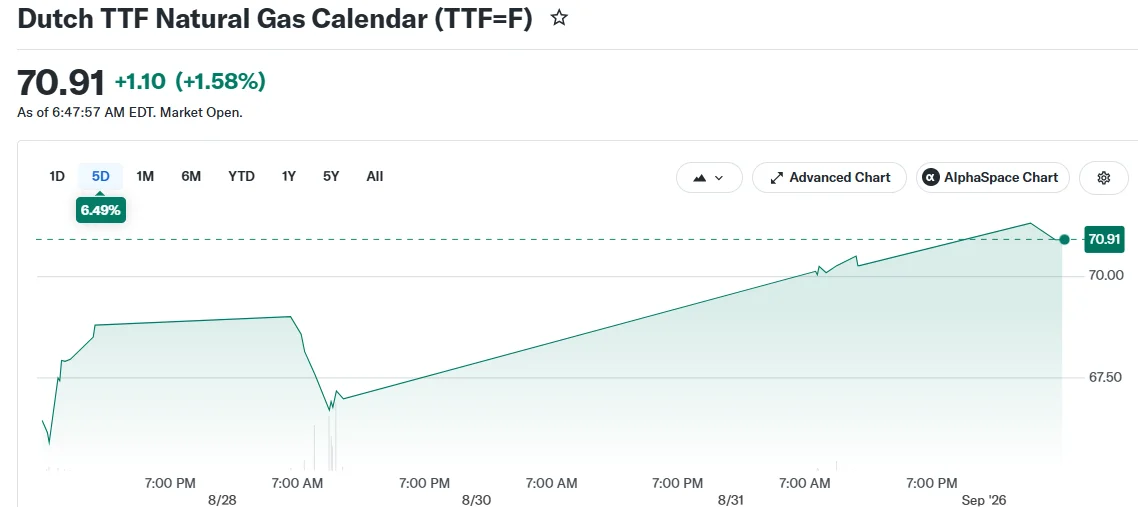
- The Dutch TTF natural gas benchmark climbed past €70/MWh, marking the highest level observed since March 2026
- Military action by US forces targeting Iranian positions near the Strait of Hormuz sparked Iranian counterattacks on American installations in Jordan
- Approximately 20% of worldwide LNG shipments transit through the Strait of Hormuz, which currently remains blocked to commercial traffic
- Gas inventories across Europe stand at only 62-64% of total capacity, significantly trailing the historical five-year average for this period
- Financial analysts at Goldman Sachs project potential price spikes to €100/MWh should regional supply disruptions continue through 2027
Natural gas markets across Europe experienced their sharpest rally in six months this week, driven by escalating military confrontations between Washington and Tehran that threaten critical liquefied natural gas transport routes in the Persian Gulf region.
The Dutch Title Transfer Facility (TTF) benchmark contract for the front month peaked at €70.85 per megawatt-hour during Monday trading sessions, followed by an additional 1.3% gain on Tuesday pushing values to €71.30. Across the Channel, Britain’s National Balancing Point (NBP) wholesale gas futures surged 6.4% to reach 175.40 pence per therm as market participants resumed activity following a bank holiday.
Market volatility intensified following weekend military operations in which American forces targeted Iranian rocket launch positions on Larak Island, situated in proximity to the strategically vital Strait of Hormuz. Tehran’s military responded with missile strikes directed at US installations across Jordan.
US President Donald Trump has publicly warned of additional strikes targeting Iranian critical infrastructure, while diplomatic initiatives aimed at reopening commercial shipping lanes through the contested waterway have made minimal progress.
Strategic Importance of the Hormuz Passage
The Strait of Hormuz represents a critical bottleneck for global energy transportation. Roughly 20% of international LNG shipments navigate through this narrow waterway, with substantial volumes originating from Qatar’s massive export facilities.

Commercial vessel traffic through the passage has been halted completely, eliminating a vital shipping corridor for LNG carriers bound for European and Asian markets. Qatar’s state energy company has formally notified Italian utility Edison that its force majeure declaration on LNG deliveries has been extended through early November due to ongoing hostilities.
The Qatar-Edison supply agreement typically accounts for approximately 10% of Italy’s yearly natural gas requirements. Edison has confirmed it is actively securing alternative supply sources to compensate for the shortfall.
Inventory Deficits Compound Supply Concerns
Europe was facing significant challenges even before the current geopolitical crisis intensified. Underground gas storage infrastructure throughout the region registered fill levels between 62-64%, based on figures from Gas Infrastructure Europe. This represents a shortfall of roughly 17 percentage points compared to the five-year seasonal norm for late summer.
Major economies including Germany and the Netherlands face difficulties meeting their mandated storage objectives of 70% and 80% capacity respectively ahead of the November 1 regulatory deadline. Elevated pricing has hindered injection activities because the price differential between summer acquisition costs and anticipated winter values has frequently been inadequate to justify storage economics.
Sebastian Heinermann, who serves as managing director for INES, Germany’s natural gas storage trade association, cautioned that inadequate inventory levels combined with severe winter weather could result in Germany’s inability to satisfy standard demand requirements.
European energy companies now find themselves in direct competition with Asian purchasers for available spot market LNG shipments, driving upward pressure on both shipping costs and cargo price premiums.
Investment analysts at Goldman Sachs issued a warning last week indicating that a protracted, gradual restoration of Middle Eastern energy shipments extending into 2027 would likely necessitate December 2026 TTF contract prices exceeding €100/MWh.
Escalating natural gas costs are contributing to wider inflationary pressures across the currency bloc. Eurozone consumer price inflation accelerated to 3.3% on an annual basis in August, with energy expenses representing the primary driver. The European Central Bank’s upcoming policy meeting scheduled for September 10 is widely anticipated to deliver another 25-basis-point interest rate hike.
Get 3 Free Stock Ebooks
Discover top-performing stocks in AI, Crypto, and Technology with expert analysis.
- Top 10 AI Stocks - Leading AI companies
- Top 10 Crypto Stocks - Blockchain leaders
- Top 10 Tech Stocks - Tech giants


