



TLDR
- Equity futures declined Tuesday morning, with Dow and S&P 500 contracts falling 0.5% while Nasdaq-100 futures slumped 1%
- Crude oil surged following military exchanges between the US and Iran in the Strait of Hormuz, driving Brent above $92 per barrel
- The benchmark 10-year Treasury yield climbed to 4.79%, intensifying concerns about additional Federal Reserve tightening
- Historical data shows September as the weakest month for equities, with the S&P 500 typically declining 1.1%
- Critical economic reports scheduled this week include JOLTS data, ISM manufacturing figures, and Friday’s employment report
Equity markets began September under pressure Tuesday as surging energy costs, advancing bond yields, and heightened Federal Reserve tightening concerns dragged futures lower throughout the morning session.
Futures tied to the Dow Jones Industrial Average declined approximately 255 points, representing a 0.5% drop. Contracts for the S&P 500 decreased 0.5%, while Nasdaq-100 futures tumbled 1%, wiping away portions of the gains accumulated during August’s robust performance.
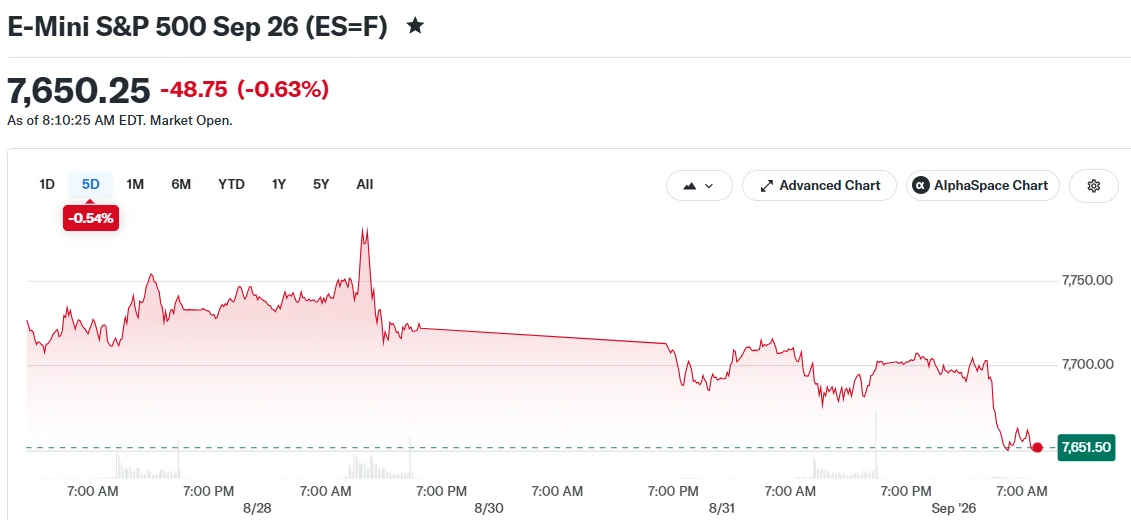
The three primary indexes concluded August with impressive returns. The S&P 500 delivered its strongest August showing in half a decade. However, historical patterns now pose challenges as September traditionally ranks as the calendar’s most challenging month for equity performance.
Data indicates the S&P 500 generally declines approximately 1.1% during September. Market strategists note that traders are fully cognizant of this recurring seasonal pattern.
Crude Prices Surge Following US-Iran Military Confrontation
Renewed military tensions between the United States and Iran propelled crude prices higher Tuesday. The nations engaged in military exchanges in the Strait of Hormuz during the weekend, creating turbulence across energy markets.

Brent crude contracts advanced 1.8% to reach $92.07 per barrel. West Texas Intermediate increased 1.8% to settle at $87.28 per barrel.
Elevated oil prices threaten to accelerate inflation pressures, potentially prompting the Federal Reserve to implement additional interest rate increases. This apprehension is already manifesting in fixed-income markets.
The benchmark 10-year Treasury note yield advanced 3 basis points to 4.79% during early Tuesday trading. Elevated yields increase borrowing costs and create headwinds for equity valuations.
Kathleen Brooks, research director at XTB, noted that market participants had become accustomed to the Iran situation remaining primarily an economic standoff. The resumption of genuine military engagement introduces fresh uncertainty that markets must now incorporate into pricing.
Employment Statistics and Corporate Earnings Headline Weekly Calendar
Market participants are monitoring a packed week of economic releases. The Job Openings and Labor Turnover Survey publishes Tuesday, providing initial insights into labor market conditions ahead of Friday’s comprehensive employment report.
Manufacturing indicators from S&P Global and the Institute for Supply Management will also be released during the week.
Regarding corporate results, Dell and Palo Alto Networks are scheduled to announce quarterly earnings. Their financial performance could reveal current corporate spending patterns on technology infrastructure and cloud computing services.
Equity futures entered September maintaining double-digit year-to-date gains. Yet escalating energy prices, climbing yields, and uncertain geopolitical conditions have traders exercising caution as the historically challenging month commences.
Get 3 Free Stock Ebooks
Discover top-performing stocks in AI, Crypto, and Technology with expert analysis.
- Top 10 AI Stocks - Leading AI companies
- Top 10 Crypto Stocks - Blockchain leaders
- Top 10 Tech Stocks - Tech giants


